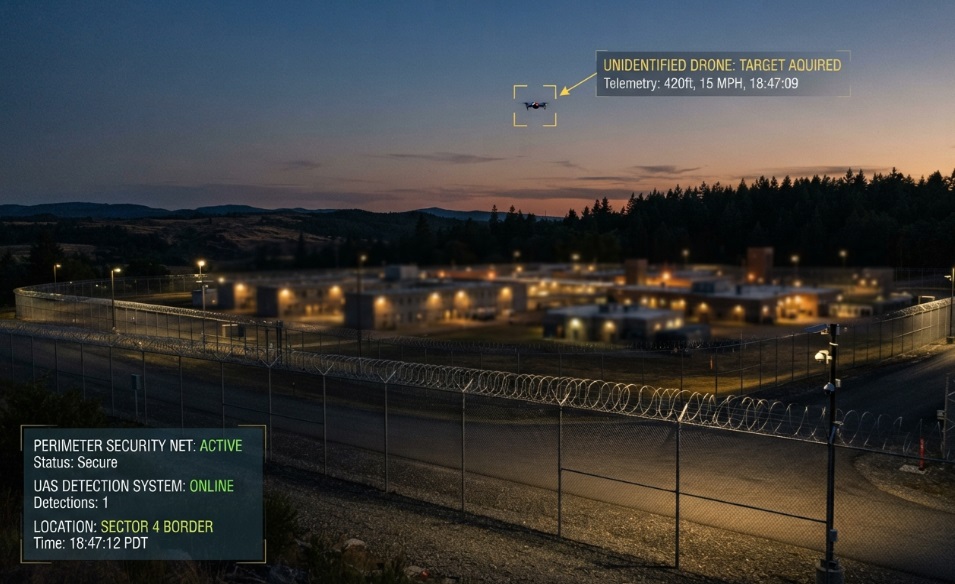
In September 2019, security guards at Arizona’s Palo Verde Nuclear Generating Station watched six unidentified drones cross the plant’s perimeter fence and hover near the reactor domes. Nothing was damaged. But for the hours it took to assess the threat, one of the country’s largest power plants had to divert security resources, track an aircraft nobody could identify, and coordinate with federal investigators over a drone it had no clear legal authority to bring down.
That incident is a useful illustration of why drone detection for power plants has become an operational issue, not just a security curiosity. A drone doesn’t need to carry a weapon or cause physical damage to be expensive. Uncertainty alone is often enough to trigger a precautionary shutdown, an emergency inspection, or a call to federal authorities that pulls staff away from running the plant.
This guide covers why power plants have become a more common drone target, what a facility can and cannot legally do about it, how detection technology actually works, and what a practical response looks like once a drone shows up on your radar literally.
Why Power Plants Have Become a Drone Target
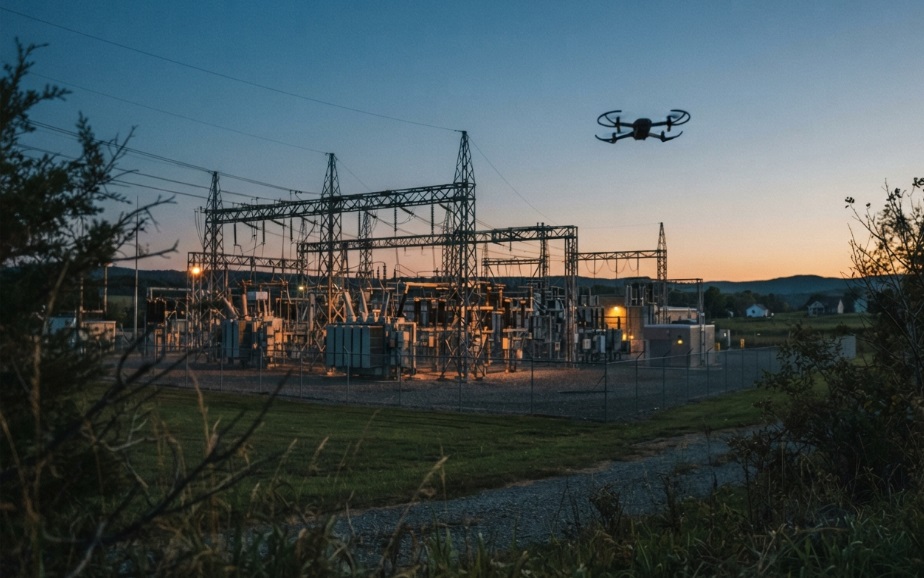
Commercial drones are inexpensive, quiet, and capable of carrying camera or sensor payloads that used to require a manned aircraft. That combination has made power generation facilities, along with substations and transmission corridors, an attractive target for everyone from curious hobbyists to organized reconnaissance operations.
The concern isn’t theoretical. Physical attacks on U.S. grid infrastructure, including the 2013 sniper attack on a PG&E substation in Metcalf, California, and the 2022 attack on substations in Moore County, North Carolina, that cut power to roughly 45,000 customers, have already shown that the bulk power system is a viable target for coordinated sabotage. A drone lowers the cost and risk of scouting a facility ahead of an attack: it can map camera coverage, fence lines, and access points from outside the property line, without anyone setting foot on site.
Federal agencies have taken notice. In early 2026, the Department of Homeland Security reportedly warned U.S. utilities about the possibility of drone-based retaliation tied to geopolitical tensions, adding urgency to a threat that grid operators say they still lack the tools and legal authority to fully address.
What Unauthorized Drone Activity Actually Costs a Power Plant
The financial risk of an unidentified drone isn’t limited to a worst-case sabotage scenario. In practice, the more common and more expensive outcome is operational disruption:
- Precautionary shutdowns or load reductions while security teams assess whether a drone is a genuine threat
- Diverted personnel, as operations and security staff stop routine work to track and report the activity
- Compliance and insurance exposure, since an undocumented drone incursion near a transmission or generation asset can raise questions during a NERC audit or a coverage review
- Reputational and community concern, particularly at nuclear and other high-visibility sites, where a drone sighting can quickly become a local news story
None of this requires the drone to be armed or to damage equipment. The cost comes from not knowing what it is which is exactly the gap drone detection is built to close: turning an unknown aerial object into a classified, trackable event a security team can act on with confidence instead of a full precautionary shutdown.
Can Power Plants Legally Detect and Respond to Drones?
This is the question most drone-detection content skips, and it matters more than the technology itself.
Detection vs. Mitigation: Know the Difference
Drone detection means identifying that a UAS is present, and often its location, altitude, flight path, and if it’s broadcasting Remote ID its registration data. Drone mitigation means taking action to disable, disrupt, or bring the drone down, through RF jamming, GPS spoofing, netting, or interception. Under U.S. federal law, these are two very different legal categories.
Who Has Authority to Disable a Drone
Mitigation authority is narrowly restricted. Under 6 U.S.C. § 124n, part of the Preventing Emerging Threats Act, only a short list of federal agencies, including the Department of Homeland Security, the Department of Justice, and, for certain covered facilities, the Department of Energy and Department of Defense, are authorized to counter a drone using jamming, signal interference, or physical interception. Because jamming a drone’s control or GPS signal can also interfere with FAA-regulated spectrum and other lawful communications, unauthorized mitigation by a private operator can itself violate federal law.
In practice, this means most investor-owned and privately operated power plants cannot legally jam, hack, or shoot down a drone themselves, regardless of how the drone is behaving.
What a Power Plant Can Legally Do Today
What every power plant operator can do and should is detect, classify, document, and report. That includes:
- Deploying detection sensors (RF, radar, camera, or Remote ID receivers) to identify drone activity over or near the facility
- Logging flight paths, timestamps, and Remote ID data to build an evidentiary record
- Notifying local law enforcement, the FBI, and/or the FAA when activity appears unauthorized
- Coordinating with DOE or DHS in the rare cases where federal mitigation support is warranted
This is the layer where a commercial drone detection system earns its value. It doesn’t require special federal authorization to operate, and it gives a plant’s security team the situational awareness and documentation needed to escalate appropriately.
How Drone Detection Systems Work at Power Plants
No single sensor type covers every scenario. Most credible systems combine two or more of the following.
Radio Frequency (RF) Detection
RF sensors passively listen for the radio signals exchanged between a drone and its controller, as well as Remote ID broadcasts. RF detection is relatively low-cost and works well against drones that are actively transmitting, but it can miss fully autonomous or pre-programmed drones that fly without a live RF link.
Radar Detection
Radar actively scans for moving objects rather than listening for signals, so it can detect “silent” drones that RF sensors miss. It works day or night and in poor weather, and typically offers longer range than RF alone, though radar hardware costs more and needs careful tuning to avoid false alarms from birds or other clutter.
Remote ID Detection
Since September 2023, the FAA has required most drones operating in U.S. airspace to broadcast Remote ID, essentially a digital license plate containing the drone’s identifier, location, altitude, and control-station location. A system that reads Remote ID can automatically recognize known or authorized flights, such as a contracted inspection drone, and flag anything that isn’t broadcasting as an anomaly worth a closer look. This cuts down significantly on false alarms from routine, legitimate drone use.
Electro-Optical / Infrared (EO/IR) Cameras
Cameras provide visual confirmation, help classify what type of drone is present, and capture evidence for law enforcement. On their own, cameras have a narrow field of view and need to be cued by another sensor to point in the right direction at the right time, which is why they’re rarely deployed as a standalone solution.
Layered Detection: Why One Sensor Isn’t Enough
RF detection misses silent or autonomous drones. Radar can struggle to distinguish very small drones from birds. Cameras need cueing. Layering sensor types compensates for each technology’s blind spots, which is why most serious counter-UAS deployments at critical infrastructure sites combine at least two detection methods rather than relying on one.
NERC CIP-014 and the Regulatory Case for Drone Detection
No NERC Critical Infrastructure Protection (CIP) standard specifically mandates drone detection today. But CIP-014 requires transmission owners and operators to conduct a physical security risk assessment for their most critical transmission stations and substations, identifying threats that could cause instability or cascading outages if a facility were damaged.
Regional auditors have started asking how utilities account for drone-based surveillance and reconnaissance within that CIP-014 risk assessment, even though the standard doesn’t reference drones by name. Utilities that can already document their aerial threat exposure, including how they’d detect a drone conducting reconnaissance before an attack, are in a stronger position during an audit than those with no visibility into their airspace at all. Drone detection doesn’t replace CIP-014 compliance work, but it directly supports it.
Choosing a Drone Detection System: What Power Plant Operators Should Evaluate
Not every facility needs the same setup. A small hydro station and a multi-unit nuclear plant have very different footprints, staffing, and risk profiles. Before evaluating vendors, it helps to be clear on what actually matters for your site.
| Evaluation Factor |
Why It Matters |
| Site footprint and terrain |
Determines how many sensors you need and whether hills, buildings, or cooling towers create detection blind spots. |
| Detection range required |
A perimeter-only system differs greatly from one that needs to detect a drone approaching from miles out. |
| Coverage of non-cooperative drones |
RF-only systems miss drones that aren’t broadcasting Remote ID; radar or other active sensing may be needed for full coverage. |
| Integration with existing security operations |
A system that feeds alerts into your existing security workflow gets used; one that requires a separate screen often doesn’t. |
| Monitoring model |
24/7 continuous monitoring suits high-risk sites; on-demand or mobile detection may suit smaller facilities or temporary needs. |
| Deployment type |
Fixed hardware suits a permanent perimeter; mobile or app-based detection suits temporary coverage or budget-constrained sites. |
| Total cost of ownership |
Per-user or per-seat licensing can get expensive as a security team grows; understand the full pricing model up front. |
| Ease of use for non-specialist staff |
Most plant security teams aren’t RF or radar specialists; the system should be usable without dedicated technical training. |
What to Do When a Drone Is Detected: A Practical Response Workflow
Detection is only useful if it plugs into a clear response process. A workable version looks like this:
- Verify and classify. Confirm the detection is a real drone (not a false positive from a bird or vehicle) and identify its type, altitude, and flight path.
- Cross-reference against known activity. Check whether the flight matches an approved inspection, survey, or third-party contractor operation already on file.
- Assess proximity and behavior. Determine how close the drone is to critical assets transformers, cooling systems, control buildings and whether its behavior looks like transit, loitering, or a deliberate approach.
- Escalate by pre-set threshold. Notify security leadership, and law enforcement or the FBI if the activity appears unauthorized or targeted, using thresholds agreed on in advance rather than improvised in the moment.
- Document everything. Preserve flight path data, timestamps, Remote ID information, and any video for an evidentiary record that supports both law enforcement follow-up and compliance documentation.
- Debrief and update watchlists. After the event, update geofences, watchlists, or authorized-operator lists so recurring legitimate flights are recognized automatically next time.
How AirSentinel Supports Drone Detection for Power Plants
AirSentinel builds drone detection for critical infrastructure operators, including power generation and transmission sites, around the same principle covered above: give security teams real airspace visibility without requiring specialized RF or radar expertise on staff.
The AMS Sensor line covers both cooperative and non-cooperative drones detecting Remote ID broadcasts as well as identifying custom or non-compliant UAVs that don’t transmit standard signals in fixed or mobile hardware configurations suited to a plant perimeter.
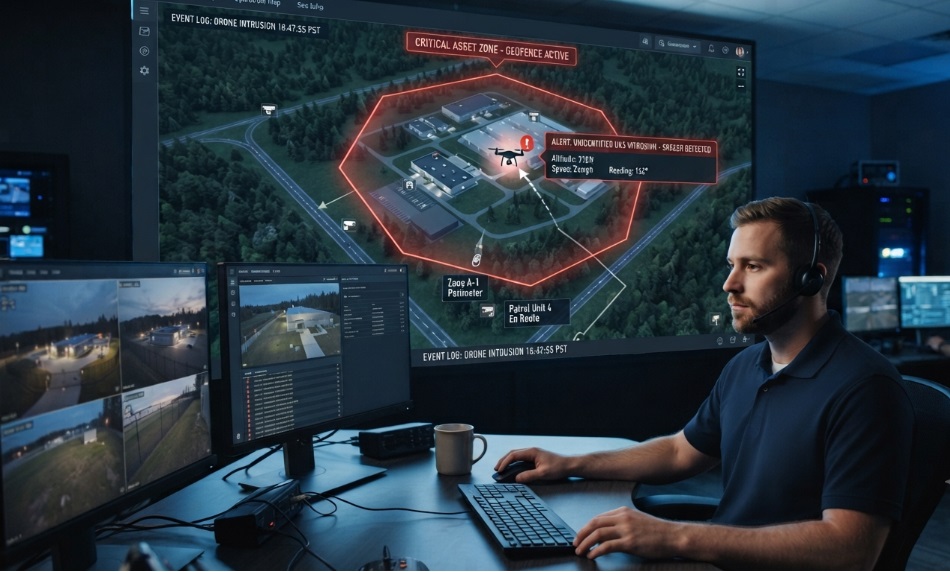
The Cloud Platform turns sensor data into live and historical airspace intelligence, with custom watchlists and geofences so a security team can quickly tell a routine, authorized flight from one that warrants escalation without paying per-user fees as the team grows.
For smaller sites or as a lower-cost starting point, the free AirSentinel mobile app gives any Android device real-time Remote ID drone detection within roughly 1,000 to 5,000 feet, useful for facilities evaluating whether they need a permanent fixed installation.
FAQs
1) Is it legal for a power plant to detect drones over its property?
Yes. Detecting, tracking, and documenting drone activity is legal for private operators in the U.S. It’s disabling or bringing down a drone mitigation that’s federally restricted, not detection.
2) Can a power plant jam or shoot down a drone?
Generally, no. Under 6 U.S.C. § 124n, counter-drone mitigation authority is limited to specific federal agencies such as DHS, DOJ, and, for certain covered facilities, DOE and DOD. Most private power plant operators do not have this authority and should instead detect, document, and report to the appropriate federal agency or law enforcement.
3) Does NERC require drone detection at power plants?
No NERC CIP standard currently names drone detection as a requirement. However, CIP-014 requires a physical security risk assessment for critical transmission stations, and auditors have started asking how utilities account for drone-based reconnaissance within that assessment.
4) What’s the difference between RF and radar drone detection?
RF detection passively listens for the radio signals between a drone and its controller, including Remote ID broadcasts. Radar actively scans for moving objects and can detect drones that aren’t emitting any RF signal at all. Most effective systems use both.
5) Can drone detection systems tell the difference between an inspection drone and a hostile one?
A system that reads Remote ID can automatically recognize a drone’s registration data and cross-reference it against a list of approved or expected operators, such as a contracted inspection crew. Anything that doesn’t match, or isn’t broadcasting Remote ID at all, can be flagged for closer review.
6) How much does a drone detection system cost for a power plant?
Cost depends heavily on site size, sensor type (RF, radar, or both), and whether monitoring is continuous or on-demand. Pricing models also vary: some vendors charge per user or per seat, which adds up as a security team grows, while others offer flat or unlimited-user pricing.
7) Do small or mid-size power plants need drone detection, or is this only for nuclear facilities?
Nuclear plants tend to get the most attention because of their visibility, but reconnaissance and sabotage risk apply across generation types. Any transmission or generation asset covered by a NERC CIP-014 risk assessment is a reasonable candidate for some level of drone detection, scaled to its footprint and risk profile.

 BLOG · SEP 22, 2026