2.4 + 5.8 GHz
Add supported Remote ID reception to any AMS sensor. Bring broadcast aircraft identity, position and available control-station or takeoff location into your operational picture.
Explore Remote ID
Three sensor configurations. Open interfaces. Scalable coverage. Build the RF foundation for your security, UTM or counter-UAS architecture.
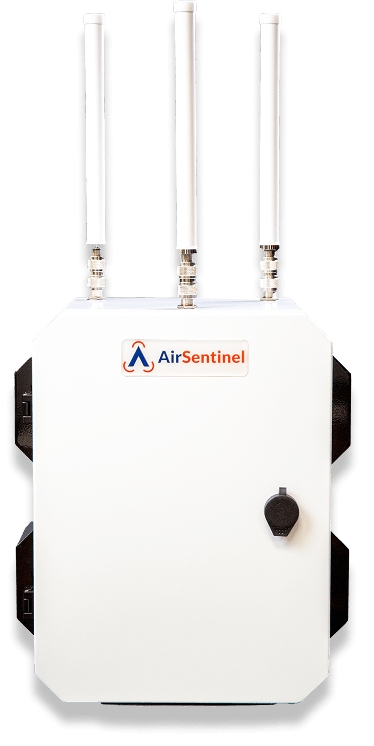 Enclosure reference · V10: 4 antennas · Pro / Pro Max: 5
High-density Remote ID sensing for security, UTM and persistent airspace awareness.
| Capability | AMS V10 | AMS Pro | AMS Pro Max |
|---|---|---|---|
| Primary RF capability | Remote ID | Supported DJI signal intelligence | Advanced supported signal decryption |
| Remote ID receiver · 2.4 / 5.8 GHz | Available | Available upgrade | Available upgrade |
| Hundreds of simultaneous Remote ID targets¹ | Supported | Supported | Supported |
| DJI O1–O4 signal intelligence | — | Supported aircraft | Supported aircraft |
| DJI O1–O4 advanced decryption | — | — | Supported aircraft |
| Selected Autel decryption | — | — | Supported aircraft |
| Cloud + local APIs | Included | Included | Included |
| Platform access | Included | Included | Included |
| Dual-band ADS-B input | Optional upgrade | Optional upgrade | Optional upgrade |
| NDAA-compliant configuration | Available | On request | On request |
| Standard antenna count | 4 | 5 | 5 |
| PoE power requirement | 30 W | 90 W | 90 W |
| Antenna count with ADS-B | 6 | 7 | 7 |
| Enclosure protection | IP65 | IP65 | IP65 |
¹ With the Remote ID receiver configured. DJI and Autel data fields depend on aircraft, protocol and firmware. Confirm the supported-aircraft matrix for your deployment.
Start with the installation fundamentals, then specify the configuration for your site.
Antenna totals include the standard configuration; the ADS-B option adds two. Confirm the supplied PoE equipment, installed weight, antenna clearances and site-specific operating-temperature requirement with AirSentinel. Coverage and available data vary by aircraft, protocol, firmware and installation.
AMS sensors deliver 1–12 miles of reception range with standard antennas, depending on the environment, aircraft and installation. Dense city environments require placement around structures, interference and the paths aircraft are likely to take.
Range depends on terrain, obstructions, antenna placement, the transmitting aircraft and local RF conditions. Validate persistent coverage at the site.
Plan your coverageAdd supported Remote ID reception to any AMS sensor. Bring broadcast aircraft identity, position and available control-station or takeoff location into your operational picture.
Explore Remote IDBring equipped crewed aircraft into the same airspace picture. Dual-band reception adds useful context for security, coordination and deconfliction planning.
Explore dual-band ADS-BUsed today by Fortune 100 companies and U.S. Department of War organizations.
AirSentinel is deployed across demanding climates and operating environments—from cold-weather installations to heat and humidity, industrial facilities and dense urban sites. We bring that field experience to the coverage, connectivity and installation plan for your operation.
Explore your operating environmentHigh-density Remote ID sensing
Beyond cooperative broadcasts
Advanced supported signal intelligence
Let’s build the right airspace picture for your mission.