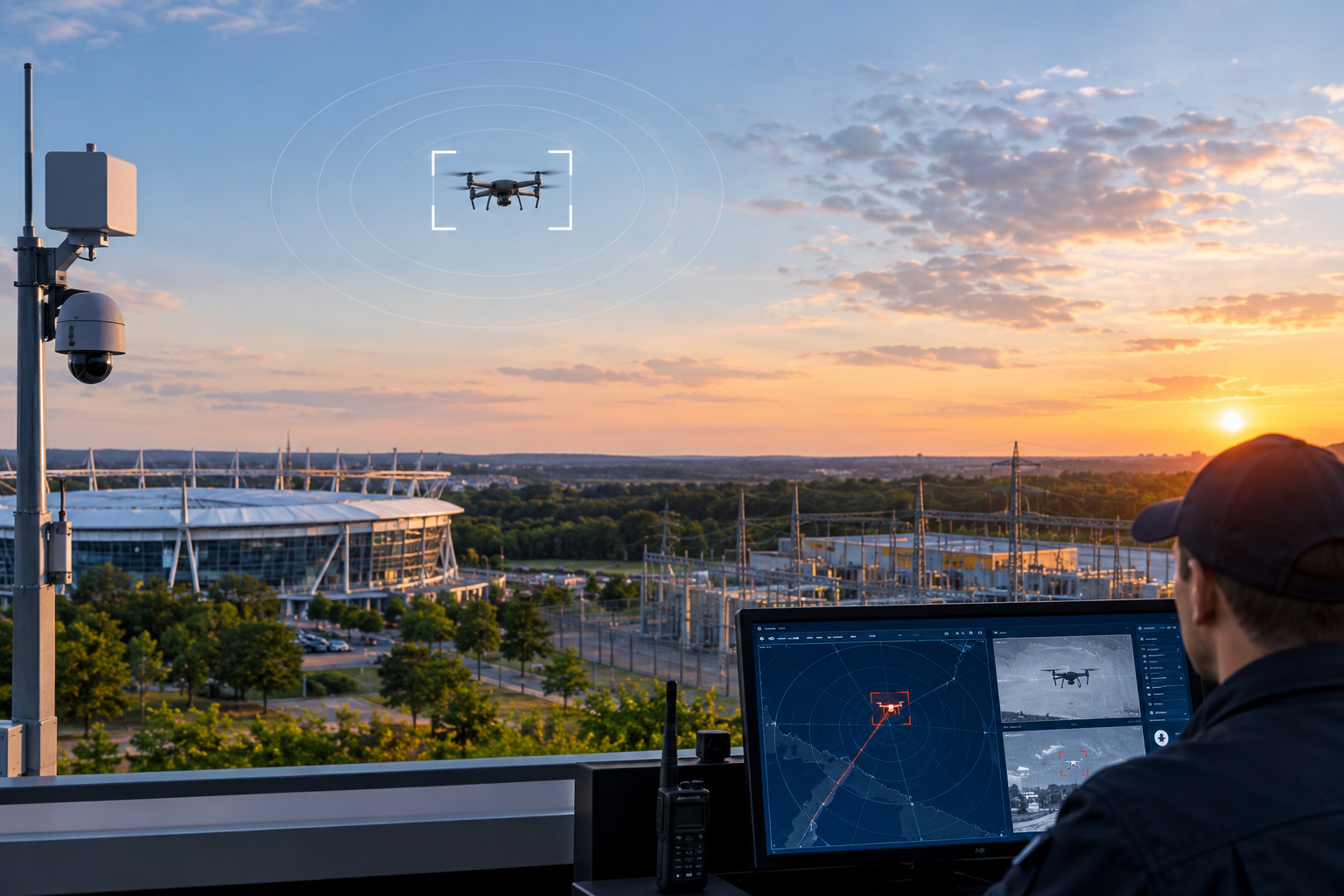
A stadium on game day and an unstaffed substation in a rural county face the same aircraft: a sub 250 gram quadcopter bought online for a few hundred dollars. What each site needs to see, and how fast, is completely different.
That is why the best airspace security systems in 2026 are judged less on range charts and more on fit. This guide covers airspace security by site type, what each sensing layer actually adds, and the questions that separate a working deployment from an expensive alarm panel.
The Short Answer
An airspace security system is a set of sensors and software that detects, tracks and identifies drones near a protected site, then sends that information to the people who respond. The right setup depends on where you operate:
Airports: radar plus RF and Remote ID, tied into the operations center.
Stadiums and campuses: closely spaced RF and Remote ID sensors with camera integration.
Power plants and substations: unattended, persistent coverage with remote alerting.
Correctional facilities: RF sensing that locates the pilot outside the fence.
Military and government sites: layered RF, radar and optical sensing with open interfaces.
Why Site Type Should Drive Your Airspace Security System Choice
The FAA receives more than 100 drone sighting reports near airports every month. In December 2018, sightings at London Gatwick disrupted roughly 1,000 flights and about 140,000 passengers across 33 hours. In October 2025, reported drones over Munich Airport halted flights and stranded thousands.
Speed matters as much as detection. A drone moving at 40 mph covers 1,173 feet in 20 seconds. If your track data arrives 20 seconds late, your team is working from a position more than 1,000 feet behind the aircraft. On a compact urban campus, that gap can put the drone over a different building entirely.
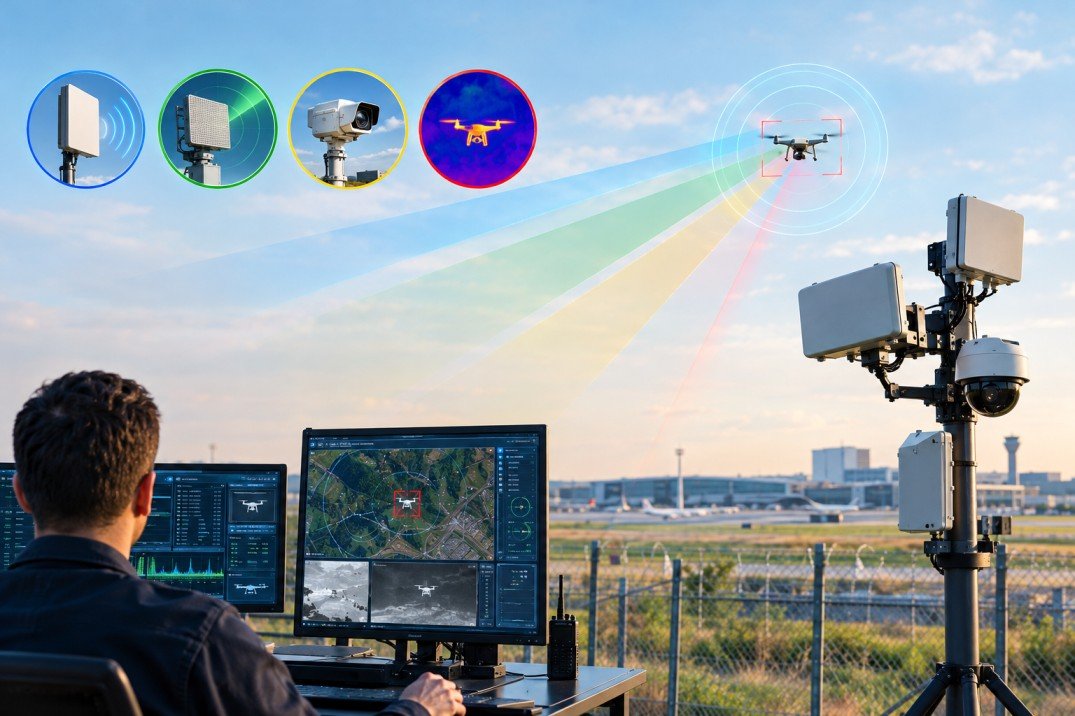
The Four Sensing Layers Inside an Airspace Security System
No single sensor sees everything. Most sites combine two or three of these layers.
RF and Remote ID Detection
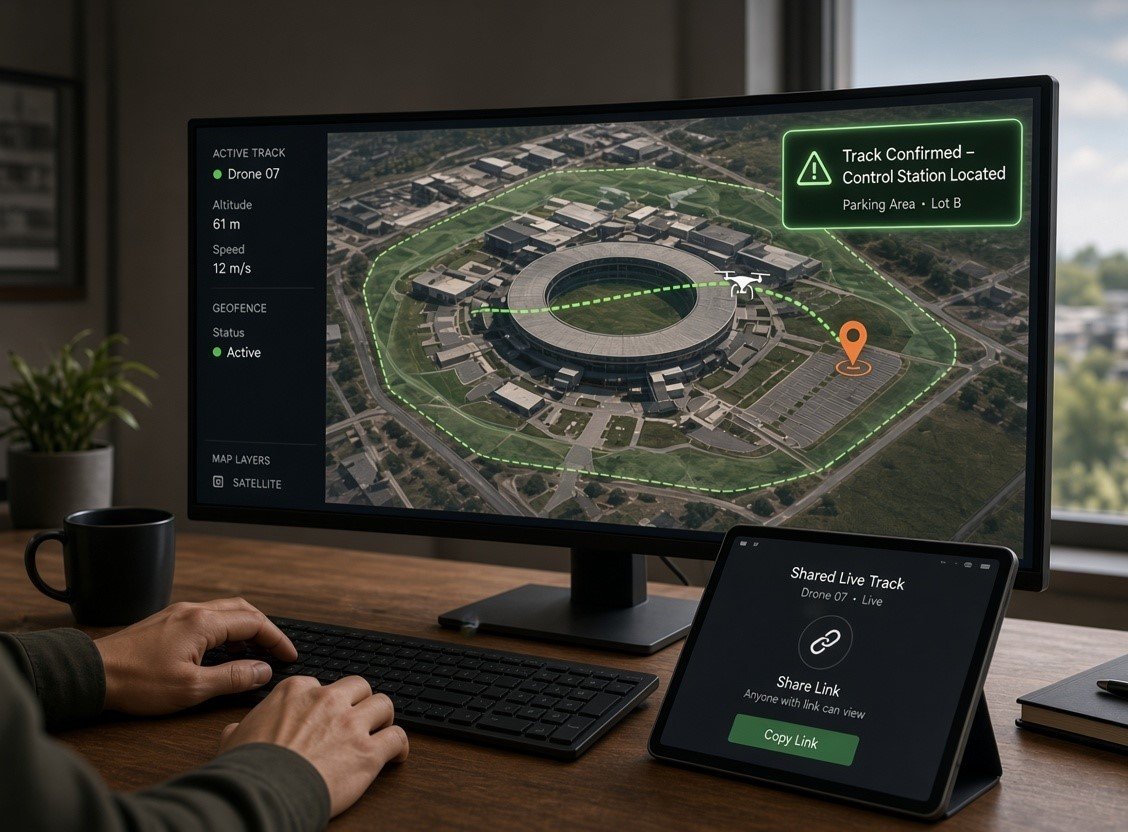
RF sensors pick up the control and video links most commercial drones use, typically in the 2.4 GHz and 5.8 GHz bands. Since March 2024, FAA rules require most drones flying in US airspace to broadcast Remote ID, which includes an identifier, position, altitude and the location of the control station. An airspace security system that reads Remote ID gives you something radar cannot: where the pilot is standing.
Radar
Radar tracks physical objects, so it catches drones that fly silent, including preprogrammed GPS waypoint flights. The tradeoff is clutter: birds, rooftop HVAC units and moving trees all need filtering.
Optical and Thermal Cameras
Cameras confirm what other sensors report. A PTZ or thermal camera cued by a radar or RF track shows the operator the aircraft and any payload. They rarely work as the first detector, because no camera watches the whole sky.
Command Software
The software merges tracks, stores history and pushes alerts. A drone that circles your substation every Tuesday at dusk is a different problem from one stray flight. A layered airspace security system running on a shared airspace security system platform makes that pattern visible.
Best Airspace Security Systems by Site Type
Airports and Heliports
Airports need wide area radar for drones that do not transmit, plus RF and Remote ID to identify operators fast. Integration with the operations center matters as much as detection, because one confirmed sighting can pause departures. Coordinate sensor placement with your aviation authority.
Stadiums and University Campuses
Venues see heavy traffic in short windows. Closely spaced RF and Remote ID sensors work well among tall structures, and an open API lets existing CCTV swing onto a live track. One pro sports venue pairs its airspace security system with authorized shared city observations, so security sees activity beyond the perimeter before kickoff.
Power Plants and Critical Infrastructure
Substations, water plants and data centers are often unstaffed. The priority is persistent coverage with alerts sent to a remote control room or a supervisor’s phone. An airspace security system built on PoE powered sensors with LTE backhaul cuts installation cost at sites with no spare network capacity.
Correctional Facilities
Most prison drone incidents are contraband drops, and the pilot is usually close by, often in a parked car. Detection that locates the control station gives officers a place to go, not just a direction to look.
Military and Government Installations
Defense sites face the widest target set, including custom builds. Layered RF, radar and EO/IR sensing with open links to command systems is standard. One military air installation tested an airspace security system from AirSentinel against its previous one, on its own ground.
How to Evaluate an Airspace Security System Before You Buy
Test in Your Own Environment
Published range figures assume clear line of sight. Ask for a pilot deployment with test flights along your likely approach paths.
Check Simultaneous Target Capacity
Near cities and delivery corridors, dozens of legitimate drones fly at once. Confirm how many tracks the system holds without dropping any.
Measure Track Latency
Ask for the time from drone broadcast to operator alert, in writing, then test it. AirSentinel typically delivers live tracks in under one second over cellular.
Confirm Open Integration
Your airspace security system should feed the VMS, PSIM or command platform you already run. A closed system becomes a second screen nobody watches.
Choosing Your Airspace Security System
The drone airspace security solutions 2026 buyers can choose from are more capable than ever, but the right one starts with your ground: what you protect, which aircraft you expect and the tools your team already uses. Match the layers to your site type, test on location and insist on fast, open data.
Ready to plan coverage for your site? Talk to the AirSentinel team about a deployment built around your mission.
FAQs
1. What is an airspace security system?
It combines sensors such as RF receivers, radar and cameras with software that detects, tracks and identifies drones near a protected area, then alerts the responsible team.
2. How does an airspace security system detect drones?
It listens for drone radio links and Remote ID broadcasts, tracks movement with radar and confirms targets with optical or thermal cameras.
3. Can drones be detected without Remote ID?
Yes. RF sensors can identify many drones from their control signals, and radar can track drones that emit nothing at all. That is why high risk sites pair RF with radar.
4. What range does drone detection cover?
It depends on sensor type, antenna, terrain and the drone itself. AirSentinel AMS sensors with standard antennas typically cover 1 to 12 miles, depending on the environment.
5. Is drone detection legal for private businesses?
In the United States, passive detection is generally lawful for private operators. Interfering with a drone in flight is limited to authorized government agencies, so private sites plan around alerting and police coordination.

 BLOG · OCT 24, 2026