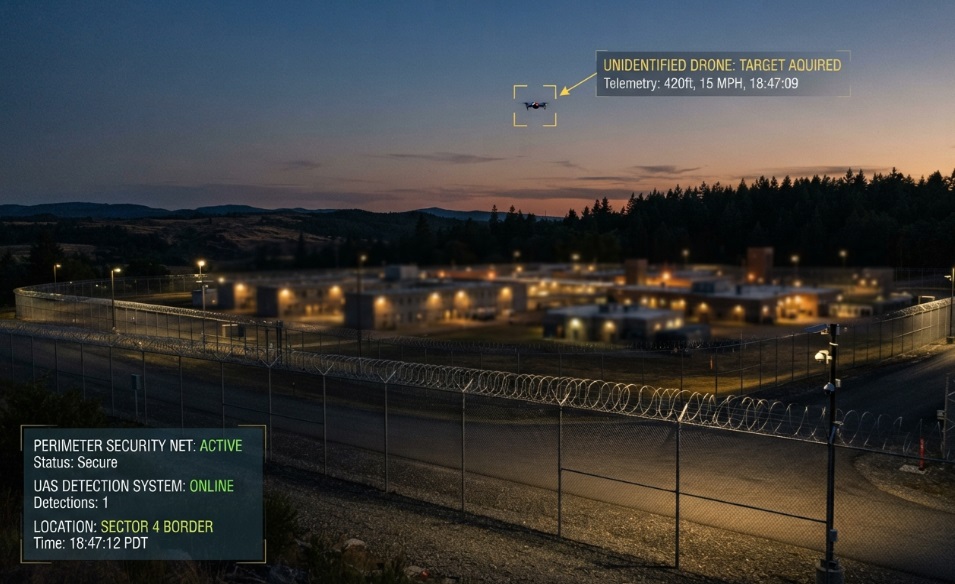
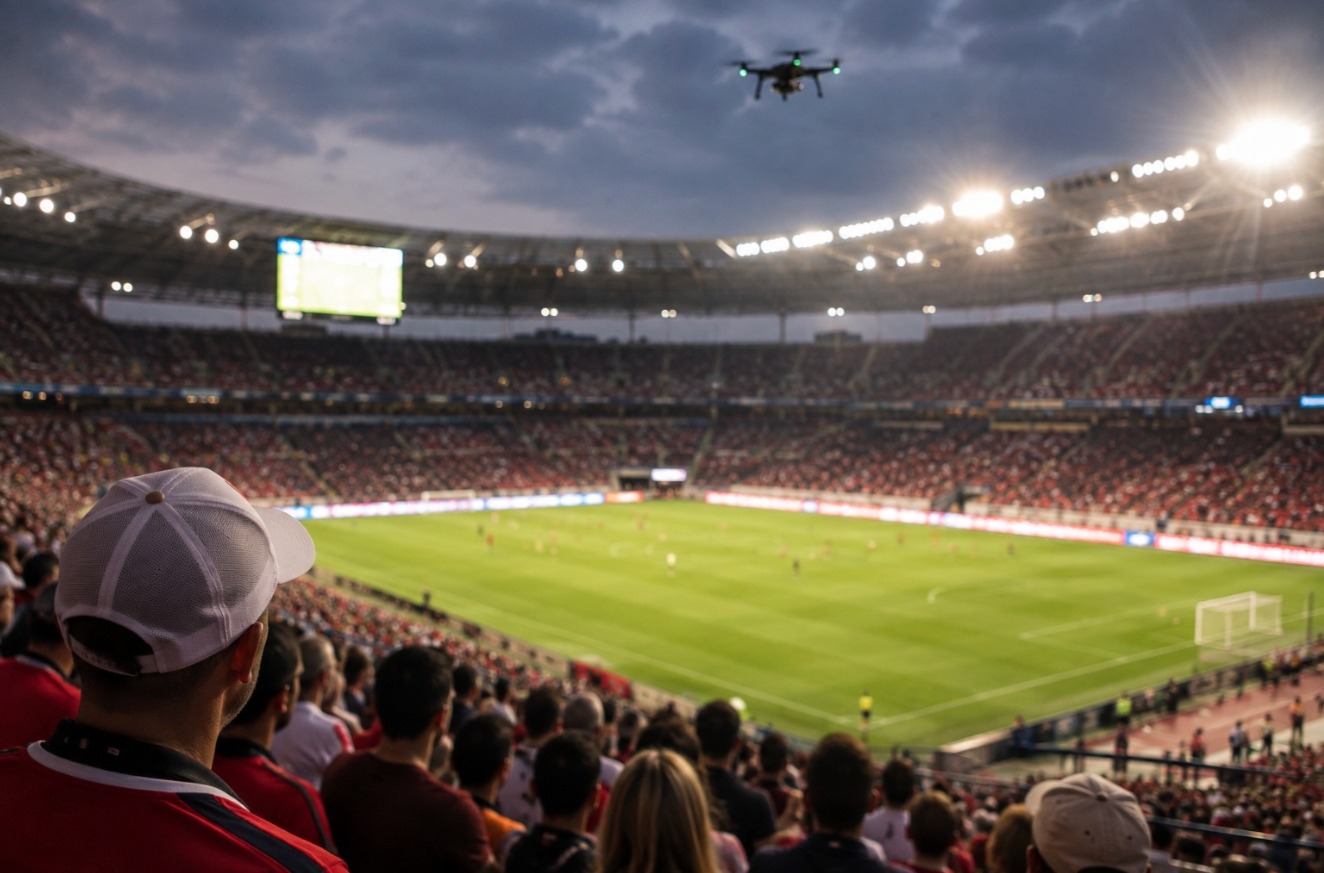
A packed stadium is one of the hardest places to secure from the sky. Fifty thousand people sit under open air, cameras track every angle at field level, yet the space directly above the bowl often goes unwatched until a drone is already circling the lights. That gap is exactly why drone detection for stadiums has moved from a nice-to-have into a standing line item on the game-day security checklist. Venue operators aren’t only asking whether a drone showed up on a Sunday afternoon anymore they’re asking how fast their team found out, and what they were actually able to do about it. This piece walks through why stadiums are exposed, how drone detection for stadiums works on the ground, and what AirSentinel offers venues that want real-time visibility over their airspace instead of an after-the-fact incident report.
Why Stadiums Are Exposed to Unauthorized Drones
Stadiums make an unusual security problem. There’s no roofline to block a flight path, no perimeter fence tall enough to matter, and the crowd itself is the asset being protected. A rogue drone doesn’t need to breach a gate or slip past a checkpoint; it only needs to fly into open airspace that nobody is watching, which is precisely why drone detection for stadiums has become its own category of security planning rather than an add-on to an existing camera network.
Three risks show up again and again at university and professional venues alike. Event disruption comes first a drone hovering over the field during a game or a halftime show pulls attention away from the event and forces a response mid-broadcast. Privacy comes second: unauthorized footage of a locker room tunnel, a VIP suite, or a student section can turn into a legal and reputational problem long after the drone has left the property. Safety is the third and most serious risk: a drone losing power or drifting into a crowded section isn’t a hypothetical; it’s a physical hazard to the people sitting in the stands. These line up with the exact categories AirSentinel’s own stadium and university page calls out: event security, campus privacy, and student and staff safety. Drone detection for stadiums exists specifically to close the gap between takeoff and the first sign of trouble on the field.
How Drone Detection for Stadiums Actually Works
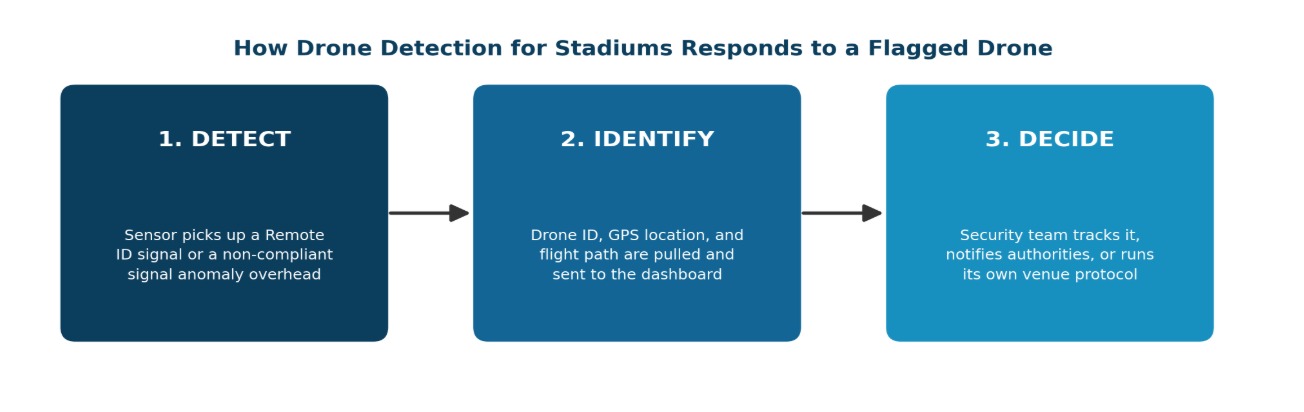
Most people picture drone detection for stadiums as a single radar dish scanning the sky. In practice, it’s closer to a layered listening system built around identification rather than interception.
AirSentinel’s AMS Sensor is the hardware layer. The standard AMS V8 reads Remote ID broadcasts, the identification signal most drones are now required to transmit, and gives security teams 360-degree, real-time coverage from a fixed or mobile unit. That covers compliant traffic. The AMS V8 Pro goes a step further with multi-band SDR detection, built to catch custom-built or legacy drones that don’t broadcast Remote ID at all, by picking up on signal anomalies and device fingerprints instead. For a stadium, that combination matters because not every drone showing up over the parking lot on game day is going to announce who it is.
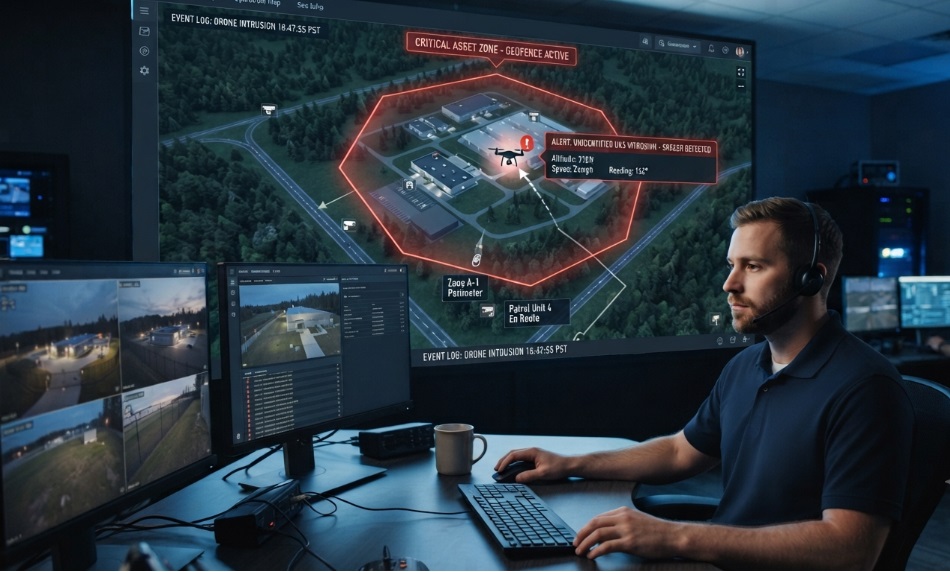
Every detection, Remote ID or not, routes into the Cloud Platform, where security staff see drone ID, GPS location, and flight path on one dashboard. That’s also where geofencing lives a stadium can draw a boundary around the bowl, the loading docks, or a VIP entrance and get flagged the moment a drone crosses it, instead of relying on a guard happening to look up.
One thing worth being direct about: drone detection for stadiums, as AirSentinel builds it, stops at detection and alerting. The system doesn’t jam a signal or take control of a drone in flight that authority sits with federal agencies in most jurisdictions, not private venues. What a stadium security team gets instead is information fast enough to make its own call: track it, radio the field, or bring in law enforcement.
What to Look For in a Stadium Detection Setup
Not every venue needs the same setup, but a few capabilities separate a system built for stadium use from one built for a warehouse roof.
Custom geofencing matters more at a stadium than almost anywhere else, because the areas that actually need protecting the field, the tunnel, a press box sit inside a much larger space that doesn’t need the same level of alerting. Custom geofencing is what turns a generic sensor network into drone detection for stadiums tuned to one venue’s actual risk points instead of its entire footprint.
Portable deployment matters for venues that host more than their own home team. A college stadium doubling as a concert venue for one weekend needs a setup that goes up and comes down without a construction crew that’s the kind of practical detail that separates a genuine drone detection for stadiums deployment from a generic security add-on. Continuous, 24/7 monitoring earns its keep at venues running events most of the year rather than eight Saturdays a season. And scalability without a per-seat licensing fee means a security office can add sensors or add dashboard users as the venue grows, without renegotiating a contract every time attendance jumps.
There’s also a mobile piece worth calling out on its own. The AirSentinel Mobile App turns an Android phone into a Remote ID detector with a working range of roughly 1,000 to 5,000 feet, which is genuinely useful for staff walking the concourse or patrolling the parking structure rather than watching a fixed dashboard. Paired with the AMS Sensor covering the fixed perimeter, that gives a stadium two different vantage points on the same airspace.
What Happens When a Drone Is Flagged
The sequence itself is simple, even if the technology behind it isn’t. A sensor picks up a drone signal, Remote ID, or an anomaly consistent with a non-compliant device, and the system pulls its ID, GPS position, and flight path. That alert lands on the Cloud Platform dashboard and, for staff in the field, on a phone through the Mobile App.
From there, it’s a human decision, not an automated one. Security staff can watch the drone’s path in real time, notify law enforcement if the flight looks deliberate, or simply confirm it’s a hobbyist who wandered outside a marked boundary before quietly leaving the area. That’s the entire point of drone detection for stadiums done this way it buys the seconds a security officer needs to make an informed call instead of reacting to a drone someone in the upper deck already spotted and started filming.
Why Stadiums Choose AirSentinel
A few things come up repeatedly when stadium and university security teams look at AirSentinel specifically. There’s no requirement for a dedicated IT department to run it; the sensors are built to deploy without specialized training, and the mobile app walks a first-time user through setup. Because the platform is cloud-native, updates and alerts happen in real time without anyone maintaining a server on-site. Pricing doesn’t scale by user count, which matters for a security office that might have a dozen people monitoring one game and three times that on a concert night. And first responders get access at no cost, a detail that matters when a stadium’s own security office is coordinating with a local police department during a high-attendance event.
That combination is what makes drone detection for stadiums practical for a security office running lean on both budget and staff. None of it replaces judgment on the ground; it just means the person making the call has better information than a radio report from a fan in section 214.
Closing Thought
Stadiums were never designed with airspace security in mind they were designed to get sound and sightlines right for people in seats. Retrofitting that same space for drone detection for stadiums doesn’t require rebuilding the venue, just adding a layer of visibility that wasn’t there before: sensors that read what’s overhead, a dashboard that shows exactly where it is, and a mobile option for staff already walking the property. For a closer look at what fits a specific venue, visit AirSentinel’s Universities and Stadiums page, or request a demo directly.
Frequently Asked Questions
Can stadiums legally use drone detection systems?
Yes. Detecting a drone and reading its identification signal is legal for a private venue in most jurisdictions. What’s restricted is mitigation jamming a drone’s signal or taking control of it which stays with federal agencies. AirSentinel’s systems are built around detection and alerting for exactly this reason.
Do drone detection systems stop drones, or just detect them?
They detect and alert. AirSentinel does not jam a drone’s signal or take control of it mid-flight. When a drone is flagged, the security team gets its ID, location, and flight path, and decides the next step themselves track it, call it in, or run their own protocol.
What is Remote ID and why does it matter for drone detection?
Remote ID is the identification signal most drones are now required to broadcast, similar in spirit to a license plate. A stadium’s sensors read that signal to identify a drone’s location and flight path in real time. Drones that don’t broadcast Remote ID can still sometimes be flagged through signal anomalies, which is what AirSentinel’s AMS V8 Pro is built to catch.
Can a stadium detect drones that don’t have Remote ID?
To an extent, yes. Standard sensors are optimized for Remote ID signals, but AMS V8 Pro adds multi-band detection that can pick up custom-built or non-compliant drones by identifying signal anomalies and device fingerprints, rather than relying on a broadcast ID alone.
How much staff or technical setup does a stadium need to run a drone detection system?
Less than most security teams expect. AirSentinel’s sensors are designed to deploy without a dedicated IT team, and the mobile app walks a first-time user through setup. Once running, the system operates continuously in the background and reports through the Cloud Platform dashboard.

 BLOG · SEP 22, 2026