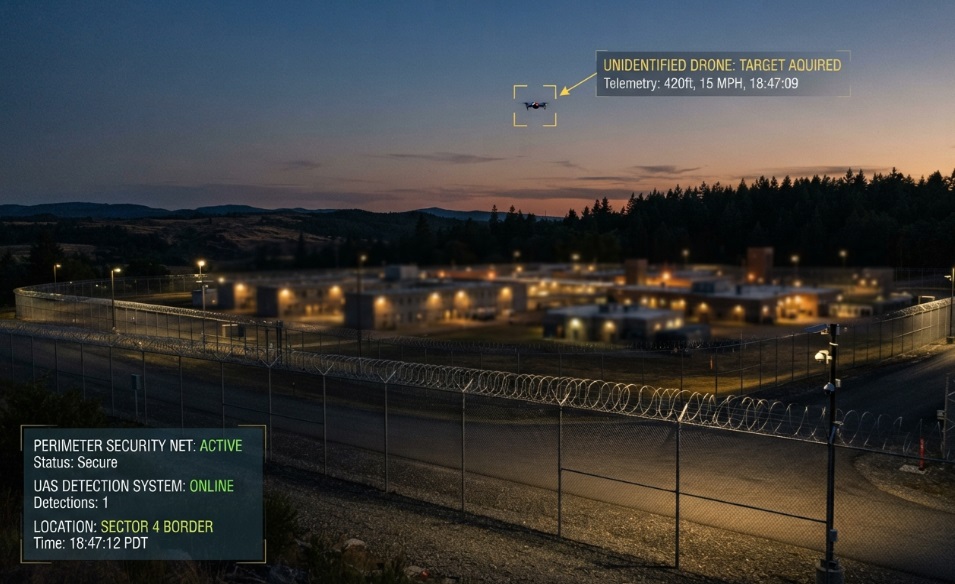
Every open-air venue eventually has to ask the same question: what happens if a drone shows up uninvited?
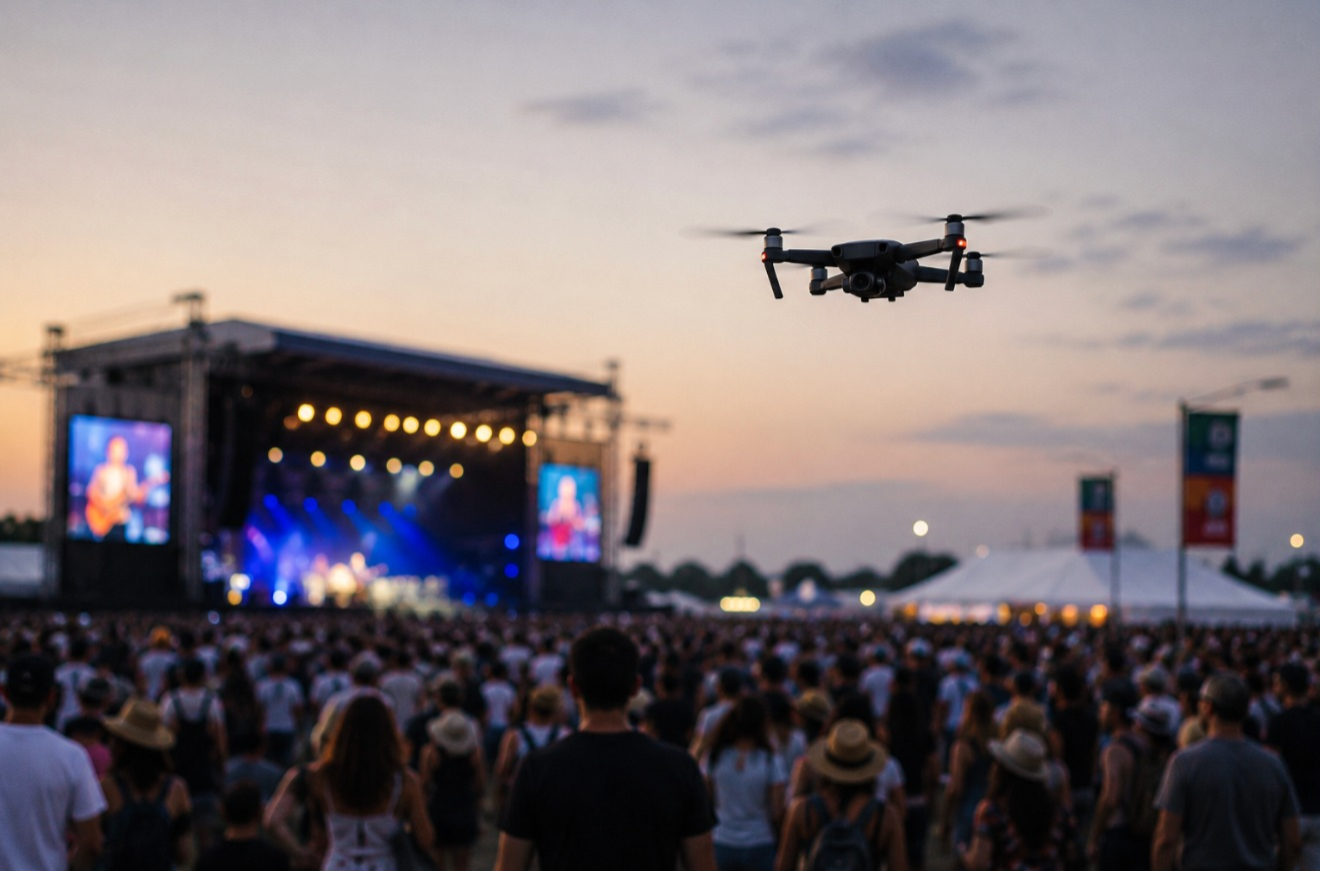
A festival with thousands of people on a field, a stadium hosting a night game, or a marathon finish line packed with spectators has one security gap that traditional ground-based measures cannot completely address: the airspace above the venue.
This is where drone detection for events becomes an important part of modern event security. Unlike a surveillance drone, which is operated by the venue to observe an area, a drone detection system is designed to identify unauthorized aircraft entering protected airspace. It can detect, classify, track, and, depending on the technology used, help locate the drone and its operator.
For event organizers, the goal is not simply to spot a drone. It is to give security teams enough information and time to determine whether the aircraft is harmless, unauthorized, or potentially dangerous and then follow the appropriate response procedure.
Why Public Events Need Drone Detection
Ground security at a major event can be extensive. Staff manage entrances, access credentials, barriers, cameras, and crowd movement. But none of these measures automatically protect the airspace above the venue.
An unauthorized drone can potentially enter from outside the event perimeter and reach a stage, field, or spectator area within minutes.
Common concerns include:
- A drone flying over a stage during a concert or live broadcast
- Unauthorized photography or recording of performers, athletes, VIPs, or attendees
- A drone losing its connection or battery and falling into a crowd
- A drone carrying an unauthorized payload
- Multiple drones entering the area at the same time
- An airspace violation causing security teams to pause an event or activate an emergency protocol
Not every unauthorized drone represents an immediate threat. However, security teams need to know what is happening before they can determine the level of risk.
That is the real value of drone detection technology for events: turning an unknown object in the sky into actionable information.
How a Drone Detection System Works
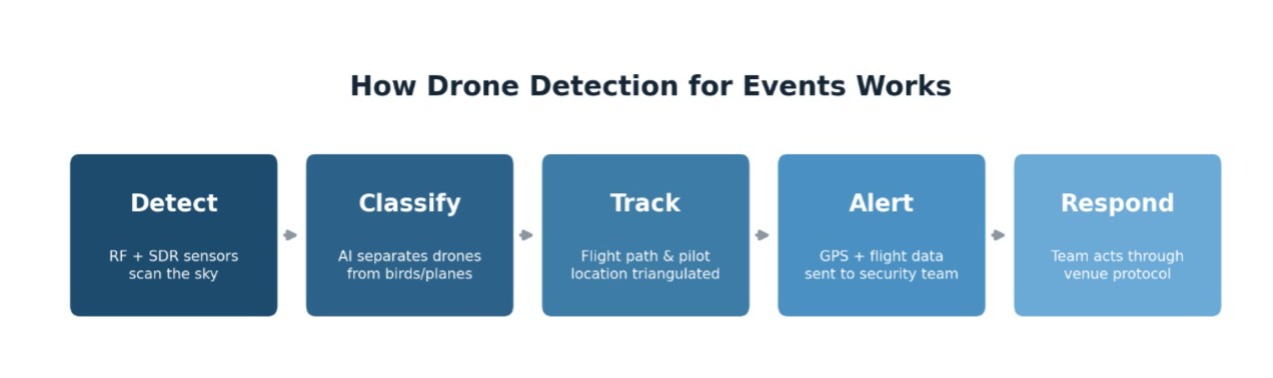
A modern drone detection system can use several technologies to identify aircraft. The main approaches include radio frequency (RF) detection, radar, acoustic sensors, and optical or AI-based cameras.
1. RF Detection
RF detection monitors radio signals associated with drones and their controllers. It can provide early warning and, depending on the system, help identify the drone and locate the operator.
However, RF detection has limitations. Autonomous or radio-silent drones may not provide the signals an RF-only system needs to detect them.
2. Radar
Radar detects physical objects by analyzing reflected radio waves. It can provide useful information about the position and movement of an aircraft and can continue operating at night.
The challenge is that small consumer drones can have a relatively small radar signature and may be difficult to distinguish from birds or other objects.
3. Acoustic Detection
Acoustic sensors listen for the characteristic sound produced by drone motors and propellers.
This can be useful at shorter distances, but large events create challenging acoustic environments. Music, crowds, traffic, and announcements can make it difficult to isolate a drone’s sound.
4. Optical and AI Detection
Optical systems use cameras and computer vision to identify aircraft visually. They can help confirm whether an object detected by another sensor is actually a drone.
Their effectiveness depends heavily on visibility, line of sight, lighting, weather, and the physical layout of the venue.
Why Sensor Fusion Matters
No single detection technology works perfectly in every event environment.
That is why effective drone detection for events often involves combining multiple sensor types into a unified monitoring system.
RF detection may provide early warning, while radar or optical sensors can help confirm the track. Other sensors can provide additional information depending on the venue and deployment.
This layered approach is particularly important at stadiums and festival grounds. Large structures, stage equipment, roofs, lighting rigs, and crowded RF environments can create blind spots or interfere with individual detection methods.
AirSentinel’s approach combines airspace monitoring with detection, classification, tracking, alerting, and response workflows. Its Airspace Monitoring System is designed to provide 360-degree monitoring and identify relevant drone activity, while its mobile solution provides a portable option for security personnel.
What Happens When an Unauthorized Drone Is Detected?
Detection is only the first part of the process.
Once a system identifies a potential drone, event security needs to verify the alert, determine the aircraft’s location and direction, assess the potential threat, and follow the venue’s response procedure.
Possible response actions can include:
- Tracking the aircraft’s flight path
- Identifying or locating the operator where the technology allows
- Contacting law enforcement or the appropriate aviation authority
- Moving security personnel to relevant areas
- Temporarily restricting activity in a particular part of the venue
- Activating an established emergency response procedure
An important point is that detection does not automatically mean private security can disable or bring down the drone.
In many jurisdictions, signal jamming, GPS interference, physical interception, or other counter-drone measures may be restricted to authorized government or law enforcement agencies. Event operators therefore need to understand the local legal framework before planning any response beyond detection and tracking.
For most private event operators, the practical role of a drone detection system is to detect, locate, assess, and quickly hand off information to the authority responsible for responding.
Planning Airspace Security Before the Event
Drone detection should not be something an organizer thinks about a few days before an event.
Airspace planning should be incorporated into the wider security strategy months in advance, particularly for large concerts, sports events, festivals, and public gatherings.
Event teams should consider:
- Whether a temporary flight restriction or local equivalent applies
- Which drones are authorized to operate at the event
- How media, production, or security drones will be identified
- Whether helicopters or medical aircraft will operate nearby
- Which aviation or law enforcement authorities need to be contacted
- What the escalation process will be when an unauthorized aircraft is detected
Clearly defining authorized aircraft is particularly important. An event may have its own drones for filming, production, security, or broadcasting. Those aircraft should be accounted for so that legitimate operations are not mistaken for unauthorized activity.
Integrating Drone Detection With Event Security
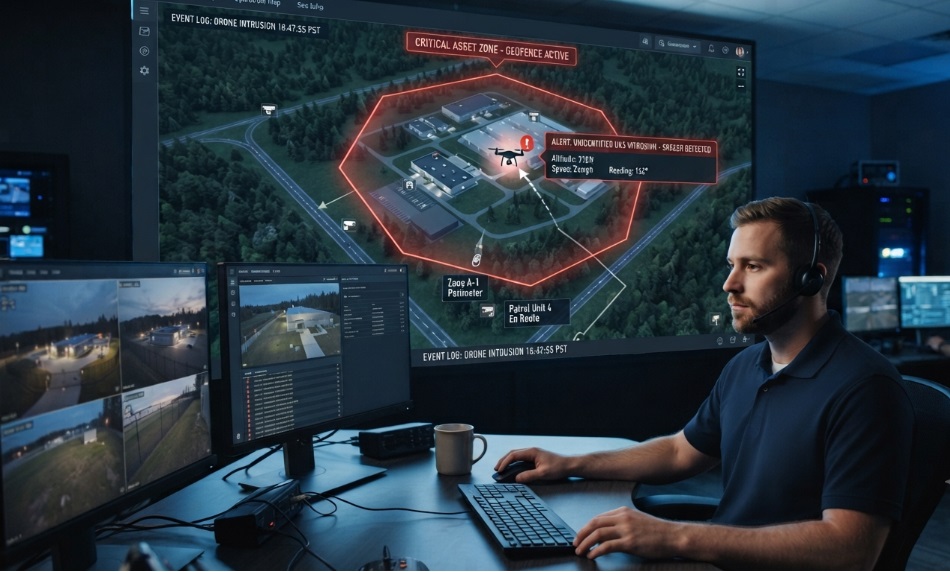
A drone alert is only useful if the right people see it and know what to do.
One common operational mistake is treating drone detection as a completely separate technology. Instead, alerts should become part of the venue’s overall security picture wherever possible.
An effective setup can connect drone detection information with:
- CCTV and video feeds
- Security operations center dashboards
- Access-control information
- Incident management procedures
- Radio communications
- Law enforcement coordination
Security teams should also conduct pre-event exercises. A technology demonstration shows that the system can generate an alert. A tabletop exercise tests what happens after the alert appears.
The team should know who verifies the incident, who contacts the authorities, who coordinates the ground response, and who makes decisions about event operations.
Fixed Sensors or Mobile Detection?
Different event environments require different deployment models.
For a permanent venue such as a stadium, university, or recurring event location, fixed sensors can provide continuous monitoring from strategic positions.
For temporary festivals, outdoor concerts, or events that move between locations, portable systems can be more practical.
AirSentinel’s AMS provides fixed airspace monitoring, while its Mobile App is designed for a more portable approach that can support personnel moving around a venue or perimeter.
The best solution depends on the venue size, event duration, expected drone activity, physical layout, and required coverage.
Privacy and Data Considerations
Drone detection can involve more than identifying an aircraft. Systems using optical sensors or cameras may also capture surrounding areas and members of the public.
Before deployment, event organizers should establish clear policies covering:
- How long footage and detection data are stored
- Who can access incident records
- Whether identifiable individuals may be captured
- How information is shared with law enforcement
- What attendees are told about monitoring technology
Privacy requirements vary by jurisdiction, so event organizers should review the applicable laws and policies before deploying systems that capture visual information.
What Does Drone Detection for Events Cost?
The cost of an event drone detection system depends on the size and complexity of the deployment.
Common models include:
Managed event deployment: A provider supplies equipment, monitoring personnel, and reporting for a specific event.
Permanent installation: A venue purchases and installs its own system for continuous or recurring use.
Hybrid deployment: A venue maintains a permanent base system and adds temporary sensors when larger events require additional coverage.
For a single event, the total cost can depend on the number of sensors, coverage requirements, event duration, monitoring requirements, and integration needs. Venues hosting events throughout the year may find permanent infrastructure more practical, while occasional organizers may prefer a managed deployment.
Where Drone Detection Systems Can Still Fail
Drone detection is an important security layer, but it is not a complete solution by itself.
Potential limitations include:
- Heavy rain, fog, and poor visibility affecting optical sensors
- Birds and other objects creating false positives
- Radio-silent or autonomous drones challenging RF-only systems
- Buildings, roofs, and stage structures creating sensor blind spots
- High RF congestion affecting signal detection
- Delays when the response chain has not been planned in advance
These limitations make proper system design and testing essential. The objective is not to find a technology with zero limitations, but to build a layered detection and response strategy that accounts for the environment.
What to Check Before Choosing a System
Before investing in drone detection for an event, security teams should ask:
- Which detection technologies are included?
- Are multiple sensor feeds combined into one alert system?
- What is the documented false-positive rate?
- What happens when a drone is detected?
- Can the system help locate the operator?
- How quickly can the equipment be deployed?
- How does it integrate with existing security systems?
- What privacy and data-retention policies apply?
- What is included in the total cost?
- What support is available during the event?
A provider should be able to explain not only detection range and hardware specifications, but also how the technology fits into the venue’s complete security workflow.
The Bottom Line
Public events create a unique security challenge because large crowds can gather in spaces where traditional perimeter controls cannot protect the airspace above them.
A well-designed drone detection system for events gives security teams visibility into unauthorized UAV activity and can help them detect, track, assess, and escalate incidents before they become larger disruptions.
The most effective approach combines the right detection technologies with proper airspace coordination, clear legal procedures, integration with existing security operations, and trained personnel.
For stadiums, festivals, concerts, universities, and other public gatherings, drone detection is not about eliminating every possible risk. It is about giving security teams the information they need to make faster and better decisions when something enters the airspace that does not belong there.
Frequently Asked Questions
How does drone detection work at large public events?
Drone detection systems can use RF, radar, acoustic, and optical technologies to identify aircraft entering protected airspace. Multiple technologies can be combined to improve detection and tracking.
Can event security legally disable or jam a drone?
Not necessarily. In many jurisdictions, jamming, GPS interference, and physical interception are restricted to authorized government or law enforcement agencies. Event organizers should confirm local requirements before planning counter-drone actions.
What is the difference between a drone detection system and a surveillance drone?
A surveillance drone is an aircraft operated by the event for monitoring or filming. A drone detection system is ground-based technology designed to identify unauthorized aircraft entering the monitored airspace.
Can drone detection systems identify drones that do not use Remote ID?
Detection capabilities depend on the technology used. RF-based systems may have limitations with autonomous or radio-silent drones, which is why a multi-layered approach can provide broader coverage.
Are drone detection systems useful at night?
Some detection technologies, including RF and radar, can continue operating after dark. Optical systems may depend more heavily on lighting and visibility conditions.
Is drone detection suitable for temporary events?
Yes. Temporary or managed deployments can be used for festivals, concerts, sporting events, and other short-duration gatherings where permanent infrastructure may not be practical.

 BLOG · SEP 22, 2026