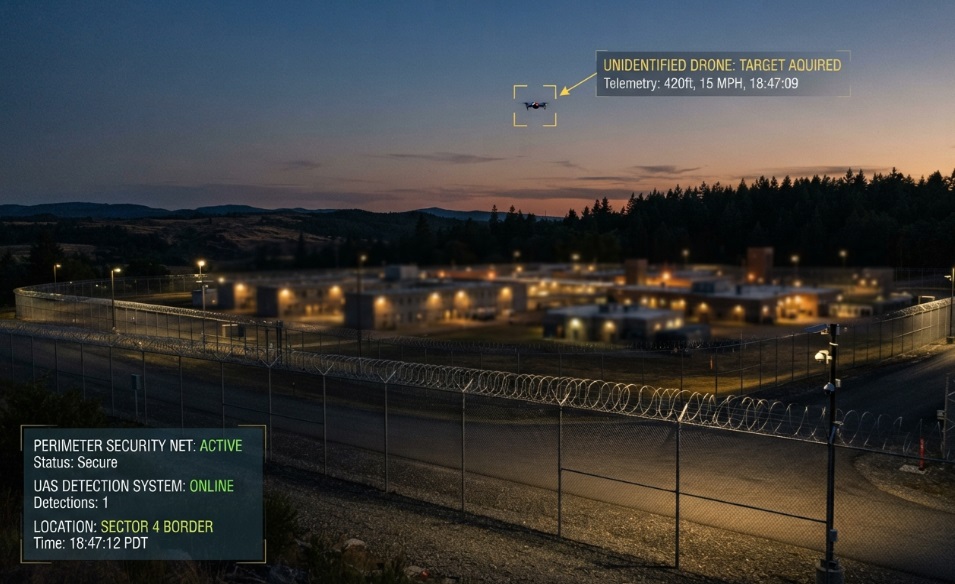
For years, prison security ran almost entirely on what happened at ground level: sally ports, pat-downs, mail screening, visitor logs. None of that stops a threat that comes in over the fence line at two hundred feet. Drone detection for correctional facilities exists because contraband smuggling stopped being a ground-level problem the moment consumer drones became cheap enough, and capable enough, to carry a phone, a package of narcotics, or a weapon across a perimeter in under a minute.
Facility staff who have lived through a drone incident usually describe the same sequence: a drop happens in a blind spot, someone finds the package later, and there is no record of who flew it in. Drone detection for correctional facilities changes that sequence by giving security teams visibility into the airspace itself, not only the ground it surrounds.
The Contraband Problem Behind Every Prison Fence
Cell phones remain the most commonly recovered item from drone drops, followed by drugs and, less often, weapons or tools meant to aid an escape. What separates these deliveries from contraband smuggled through visitation or the mail is timing and volume. A single flight can carry several items at once, released precisely into a yard or exercise area where staff supervision is already stretched across a large space.
The economics explain why operators keep coming back to the same institutions. A phone or a small quantity of narcotics is worth far more once it is inside a facility than it costs on the outside, which makes the risk worthwhile for the people flying these drones. Without drone detection for correctional facilities, there is rarely any record of these flights at all. The first sign of a problem is usually the contraband itself, already inside the wire.
Why Fences and Cameras Can’t Stop a Drone
Perimeter fencing, motion sensors, and fixed cameras were built to stop someone walking, climbing, or driving in. A drone does none of those things. It can approach from beyond the property line, hover above camera range, release its payload, and be gone before a patrol officer reaches the area.
Fixed cameras also have a limited field of view. An operator who studies a facility’s patrol schedule and camera placement, which is exactly the kind of reconnaissance drones are also used for, can time a drop for the one window when no camera happens to be pointed at the drop zone. That is the core reason drone detection for correctional facilities has become its own security layer rather than an add-on to existing camera systems. It has to cover the sky, not only the ground.
How Drone Detection for Correctional Facilities Actually Works
AirSentinel’s correctional facility solution follows a five-step process that mirrors how a real incident unfolds, from first appearance in the sky to a documented response on the ground.
Detect. Smart RF sensors and radar identify drone activity from miles away, well before an aircraft reaches the fence line. This step turns a surprise drop into a warning.
Classify. Not everything in the sky is a threat. AI-driven algorithms separate drones from birds and other airborne objects, so staff aren’t chasing false alarms every time something flies past.
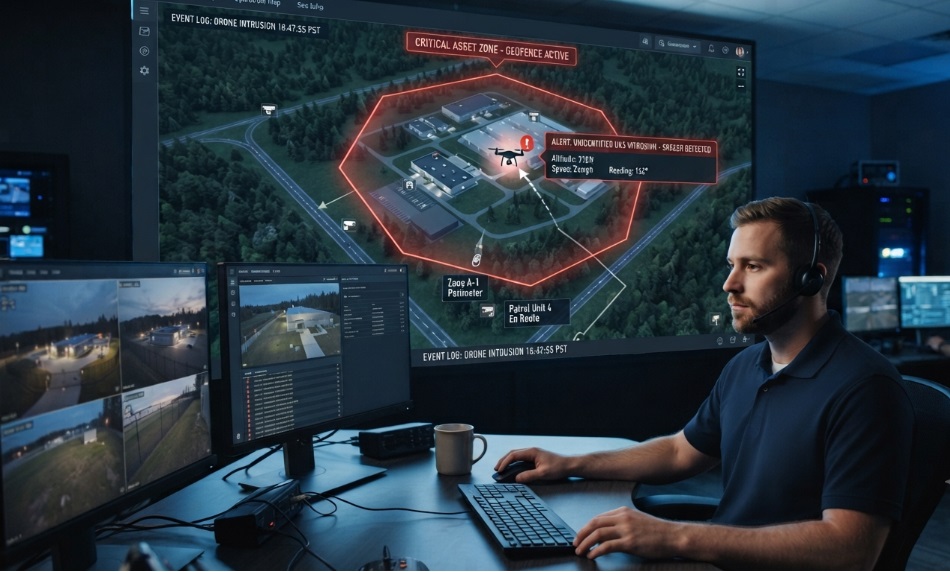
Track. Once a drone is confirmed, real-time triangulation maps its flight path and, just as important, the location of the signal controlling it, giving staff a starting point for locating the person on the ground.
Alert. Correctional officers and security commanders are notified immediately, while there is still time to intercept a drop or reposition staff before contraband reaches the ground.
Respond. Detection data feeds directly into existing security workflows, whether that means an internal response team or coordination with outside law enforcement.
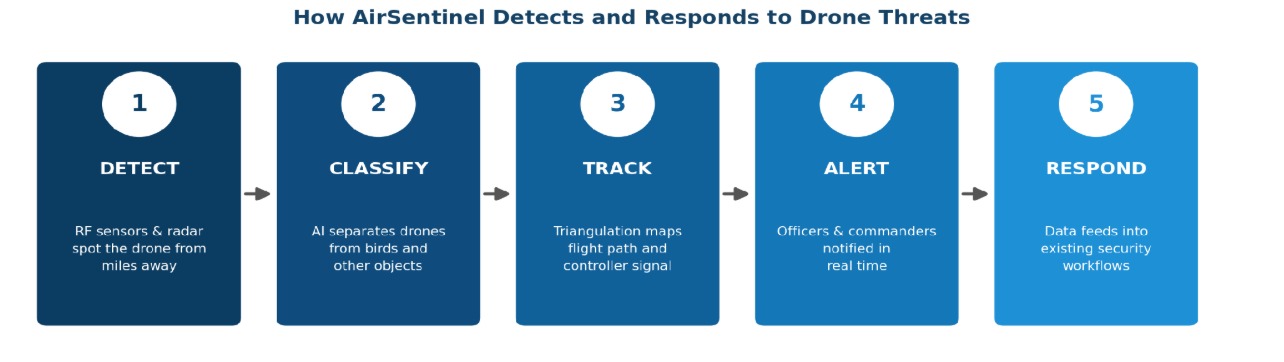 Figure 1: The five-step process behind drone detection for correctional facilities.
Every one of those five steps runs through a single dashboard, viewable from a command center or a staff member’s phone, so a facility doesn’t need a dedicated control room to run drone detection for correctional facilities day to day.
The Technology Layer: RF, Radar, and AI Working Together
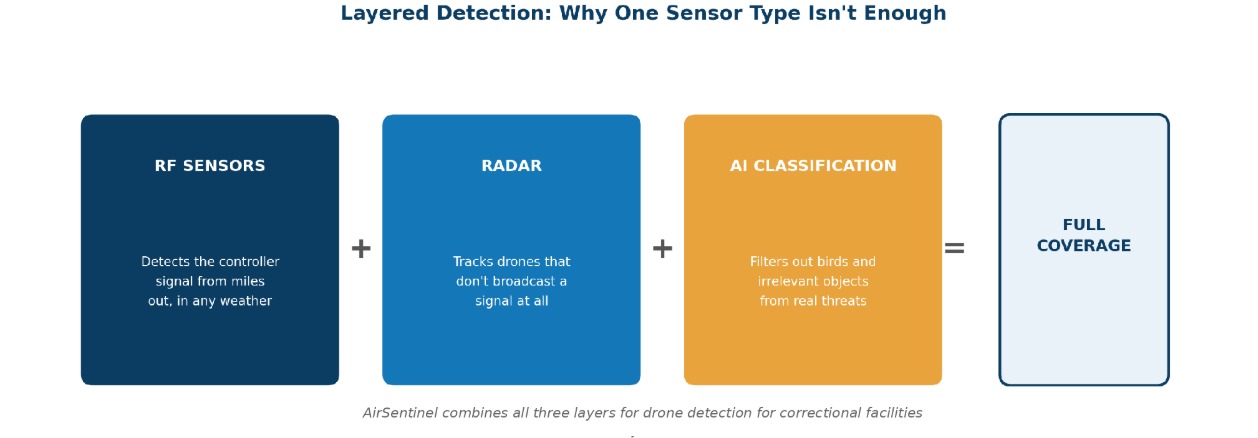
A detection system that relies on a single method of sensing is easy to get past. A drone flown without a broadcast signal, or one that looks like a bird on radar alone, can slip through. AirSentinel’s system layers RF analysis, radar tracking, and AI classification together, which is what allows drone detection for correctional facilities to hold up against drones of different makes, models, and configurations, rather than only the ones that happen to broadcast a signal.
Figure 2: How RF sensors, radar, and AI classification combine for correctional facility drone detection.
This layered approach is also why RF-based detection performs more consistently than camera-only systems in poor weather, low light, or reduced visibility. A camera struggles at night or in fog. An RF sensor doesn’t.
 What Makes a Correctional Deployment Different
Every facility that adopts drone detection for correctional facilities has its own layout and risk factors, but a handful of requirements set corrections apart from other industries:
Custom geofencing. Security teams can draw detection and alert zones around specific yards, towers, rooflines, and intake areas, then adjust those zones at any time through the dashboard if the facility’s layout or priorities change.
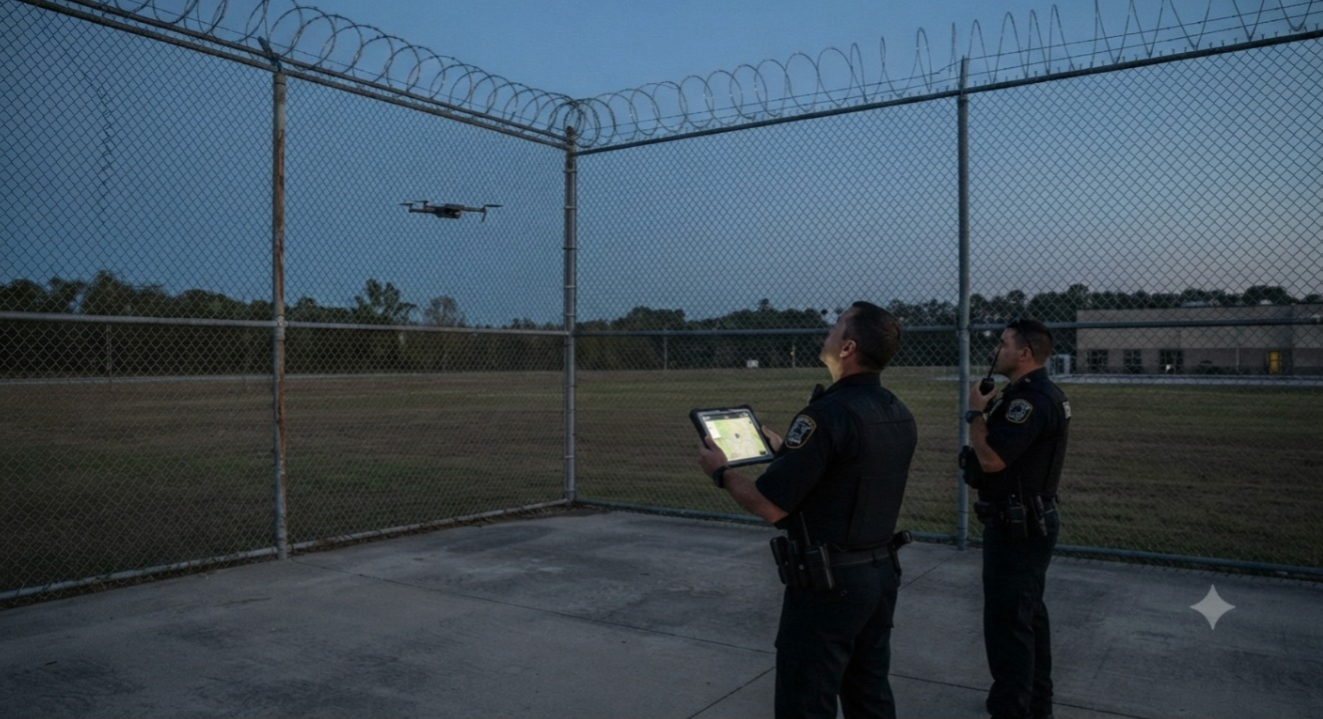
Pilot location, not just drone location. Knowing a drone is overhead is only half the picture. The tracking function locates the signal source controlling the aircraft, which is the piece of information that can help identify the operator.
Round-the-clock coverage. Drops don’t happen on a schedule. Drone detection for correctional facilities runs continuously, so a three a.m. flight gets the same alert response as one at three p.m.
Integration with what’s already in place. The system is built to plug into a facility’s existing security infrastructure rather than asking staff to learn and monitor a completely separate system.
Getting Started
Facilities usually begin by mapping their highest-risk zones, yards, perimeter fences, and rooflines, and work from there to configure sensor placement and geofencing around those specific areas. AirSentinel’s correctional facilities page walks through how drone detection for correctional facilities is deployed on-site, and the team can be reached directly to request a demo or get in touch about a specific facility layout.
For a closer look at the hardware and software behind the platform, the AMS sensor, Cloud Platform, and Mobile App pages on AirSentinel.ai cover each piece individually.
Frequently Asked Questions
How do prisons detect drones?
Correctional facilities use dedicated systems that combine RF sensors, radar, and AI classification to spot unauthorized aircraft as they approach. AirSentinel’s system detects and classifies drones in real time using this layered sensor fusion, then tracks the flight path and alerts security staff before a drop reaches the ground.
Can a drone be tracked back to its pilot?
Yes. Real-time triangulation can reveal both the drone’s flight path and the location of the signal controlling it, giving facility staff and law enforcement a starting point for locating the person flying it, not just the aircraft itself.
What is the best way to stop drones from dropping contraband in prisons?
The most effective approach pairs early detection with defined alert zones around high-risk areas like yards, perimeter fences, and rooflines. Drone detection for correctional facilities that includes custom geofencing lets staff know the moment a drone enters one of those zones, giving them time to respond before a drop is completed.
Does drone detection still work at night or in bad weather?
Systems built on RF signal detection, rather than cameras alone, are far less affected by darkness, fog, or low visibility, since they identify aircraft by their radio signal instead of a visual image.
How much does drone detection for correctional facilities cost?
AirSentinel’s AMS hardware starts at $2,949 annually for the RID model and $4,749 for the AMS Pro configuration, with discounts available for first responders and enterprise pricing for larger deployments. Each subscription includes access to the Cloud Platform and Mobile App at no additional cost.

 BLOG · SEP 22, 2026