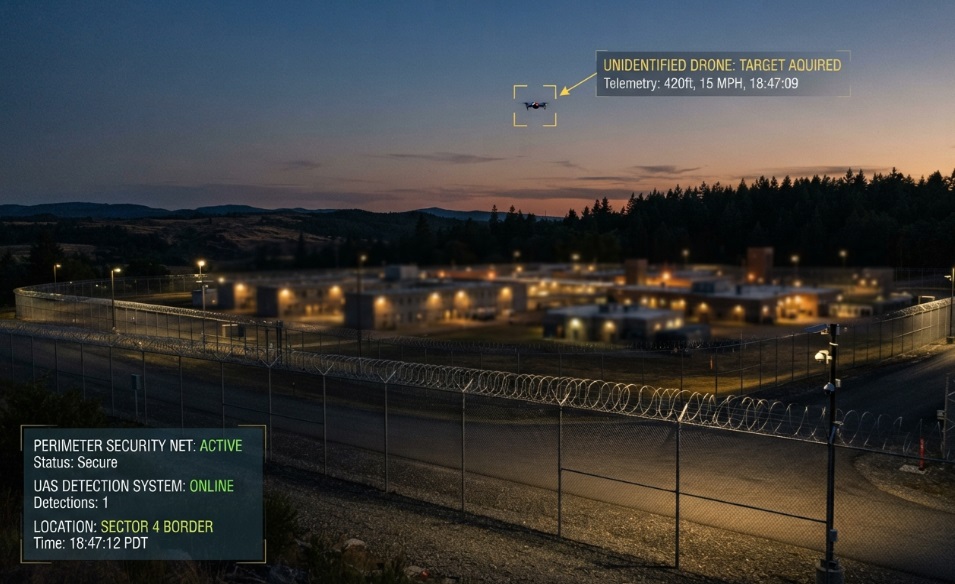
A prison fence, patrol road, tower, and camera network can be well designed and still leave one route open: the airspace above the property. Small unmanned aircraft can move quickly, operate from outside the perimeter, and release a package into a yard, roofline, recreation area, or other difficult-to-control location. Drone detection for correctional facilities gives security teams the time and location intelligence needed to respond before a suspected drop becomes an internal contraband incident.
The strongest programs do not treat this as a stand-alone gadget purchase. They extend established perimeter-security practices into the airspace: detect, verify, notify, respond, document, and improve.
Drones Have Changed the Correctional Perimeter
Aerial delivery attempts can involve mobile phones and accessories, narcotics, tobacco, tools, weapons, or other prohibited items. The exact payload changes by facility, but the operational problem is consistent: a drone may bypass vehicle screening, mail screening, visitor controls, and the physical fence in a matter of minutes.
What an aerial contraband attempt looks like
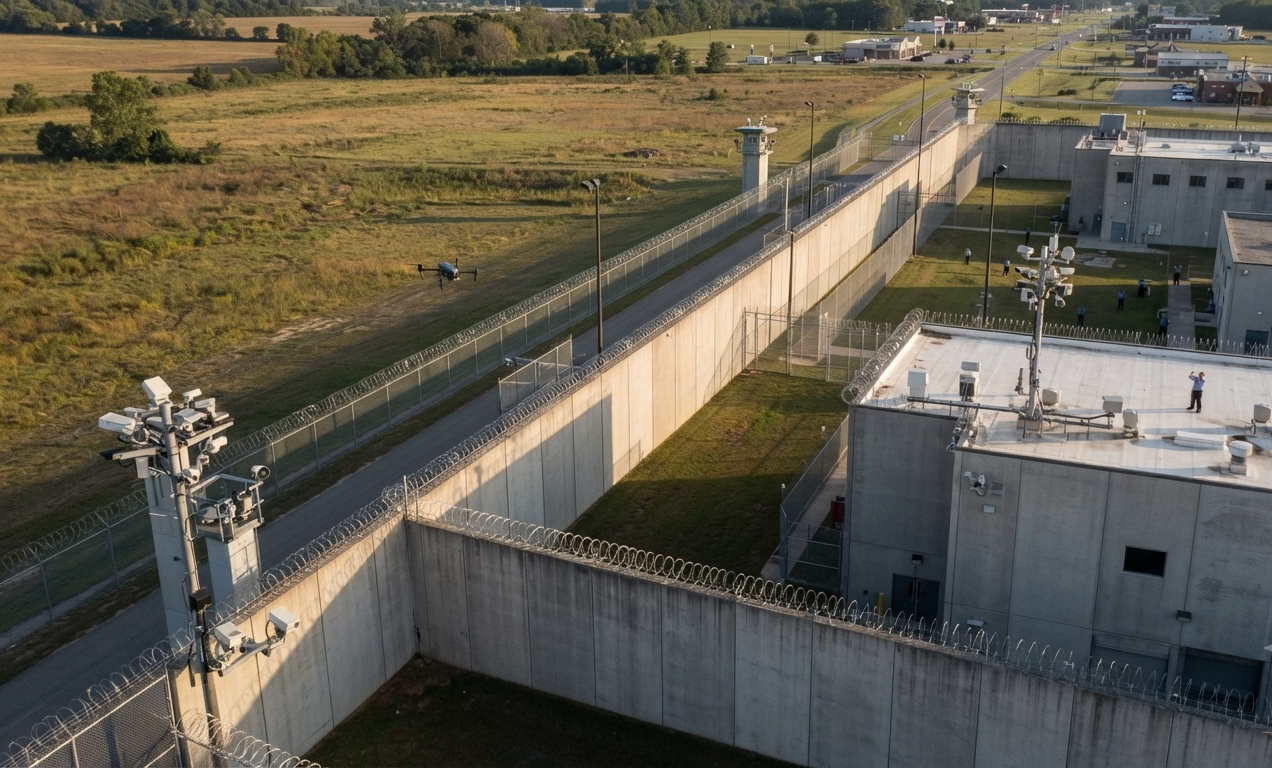
A typical incident may begin with a short flight from public or private property outside the boundary. The aircraft approaches at low altitude, crosses a vulnerable section of the perimeter, releases or lowers a package, and departs. By the time an officer sees it from a post or receives a report from staff, the flight may be over and the package may already be moving through the facility.
That is why drone detection for correctional facilities should be designed around early warning. The goal is not merely to know that a drone was present later; it is to provide actionable information while a response can still affect the outcome.
Why traditional controls have blind spots
Guards, towers, patrols, lighting, and cameras remain essential. Yet they were primarily built to observe activity on the ground and at known entry points. Drones can exploit darkness, noise, weather, obstructed sightlines, and the short duration of a flight. Continuous sensor coverage helps close that gap and gives personnel a cue to look in the right place at the right time.
What Drone Detection Should Deliver
The value of drone detection for correctional facilities is operational awareness. A usable system should help the command post understand whether an aircraft is present, where it is moving, whether the event merits verification, and which teams need to act.
Detection, tracking, verification, and evidence
Detection identifies potential drone activity. Tracking helps establish the aircraft’s direction, route, altitude or position information where available, and relationship to the facility boundary. Verification may use a camera cue, trained observation, or a second sensing modality to reduce uncertainty. Evidence retention preserves alert history, relevant video, and event notes for investigation and prosecution support.
No single sensor is ideal for every site. The facility’s layout, RF environment, terrain, nearby roads, weather patterns, structures, and operating procedures determine the right architecture.
Detection is not the same as mitigation
Detection is generally about awareness and reporting. Mitigation includes actions intended to disrupt, take control of, disable, or physically stop an aircraft. In the United States, correctional leaders should obtain qualified legal and policy guidance before assuming their agency can use any active counter-UAS capability. A sound program can still create meaningful risk reduction through lawful detection, rapid response, coordination with authorized partners, and evidence preservation.
Choosing the Right Detection Approach
RF sensing
Radio-frequency sensing looks for communications associated with drone activity. It can be useful for detecting many commercially available aircraft and may support pilot or controller-location intelligence when the signal environment permits. Its performance can be affected by radio congestion, changing protocols, autonomous flights, and aircraft that do not emit the signals a sensor expects.
Radar, acoustic, and optical layers
Radar can help identify and track objects in airspace, while acoustic sensors listen for characteristic sound signatures and optical or thermal cameras can help an operator verify a target. Each modality has strengths and constraints: radar may face clutter, acoustics can be affected by ambient noise and wind, and cameras depend on visibility and line of sight.
Why multi-sensor coverage matters
For high-consequence facilities, layered sensing can improve confidence by correlating events across more than one data source. Rather than forcing staff to react to every isolated alert, the system and SOP should prioritize events that enter protected zones, display a suspicious trajectory, persist near a sensitive area, or are confirmed by another source.
Building an Effective Response Program
Map the airspace to operational zones
Start with a site assessment. Map the outer detection area, the facility boundary, exclusion zones over housing or yards, likely approach corridors, rooftop areas, and probable drop zones. Review camera coverage, tower sightlines, high-value locations, outside staging areas, and locations where vehicles or people may conceal a controller.
This work turns drone detection for correctional facilities into a response tool. An alert near an administrative parking lot does not necessarily deserve the same urgency as one entering a recreation yard or moving toward a housing-unit roof.
Write a practical alert-to-response SOP
The response procedure should be short enough to use under pressure and specific enough to avoid confusion. Define the thresholds for dispatch, the person who owns verification, the radio channel or notification path, and the evidence to preserve.
- Receive and acknowledge the alert at the command post.
- Confirm the location, direction of travel, and affected operational zone.
- Cue available cameras and notify fixed posts or mobile units.
- Protect the likely drop area without creating unsafe staff or inmate movement.
- Look for associated activity outside the perimeter when lawful and appropriate.
- Preserve alert data, video, radio logs, officer observations, and recovered-property chain of custody.
- Conduct an after-action review and adjust zones, procedures, or training as needed.
Integrate with cameras and command operations
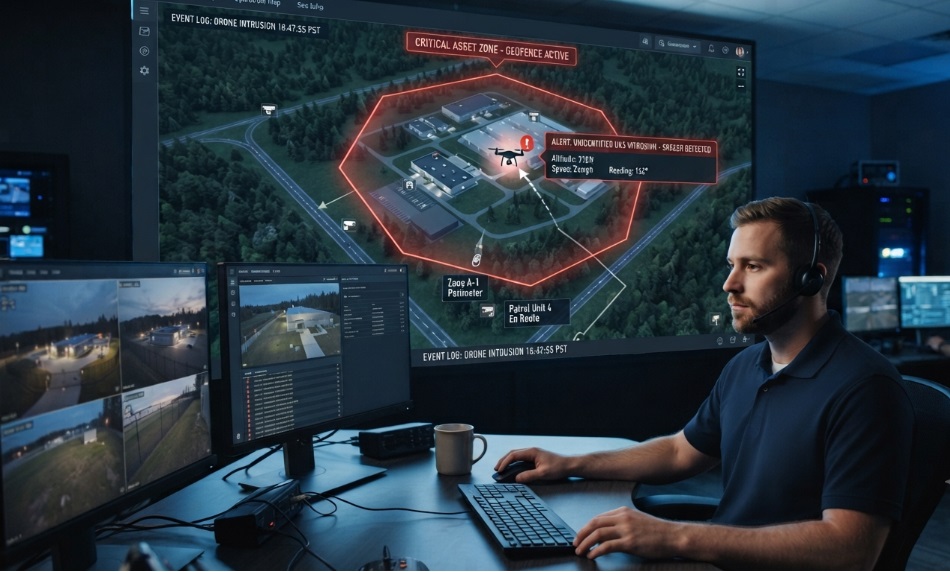
An alert becomes more useful when it can be correlated with the tools staff already use. Consider how the platform will relate to the video-management system, security operations center, dispatch workflow, incident-reporting process, and mobile response teams. The objective is to reduce swivel-chair work: operators should not have to search multiple unrelated screens during a short-duration event.
Evaluating a System for a Correctional Facility
Procurement teams should evaluate operational fit before comparing feature lists. Ask vendors to explain what their system detects, what it cannot detect, how it handles clutter or false positives, what data it retains, what training it requires, and how it integrates with existing systems. A credible deployment plan also defines maintenance, software updates, support responsibilities, cybersecurity expectations, and acceptance testing.
For drone detection for correctional facilities, insist on a demonstration that reflects the actual site environment. Test coverage near walls, buildings, towers, tree lines, parking areas, and likely approach routes. Confirm that alerts can be understood by the people staffing the command post, not only by a technical specialist.
What Success Looks Like
Success is not measured only by the number of alerts. Better indicators include faster verification, clearer dispatch decisions, improved recovery of suspected contraband, fewer unobserved perimeter incursions, usable incident records, and lessons that refine the next response. A mature program also tracks nuisance alerts and uses that information to improve sensor configuration and operator confidence.
AirSentinel’s correctional-facility solution page can serve as a relevant commercial next step for teams evaluating real-time airspace monitoring and actionable threat intelligence. Its AMS solution and law-enforcement drone-detection resources are also useful contextual paths for readers assessing monitoring capabilities and operational deployment.
FAQs
1) What is drone detection for correctional facilities?
It is the use of sensors and monitoring software to identify and assess unauthorized drones near a prison or jail. The system gives security personnel situational awareness so they can verify the event, protect likely drop zones, and preserve evidence.
2) Can a drone detection system stop a contraband drop by itself?
No. Detection creates early warning and location intelligence; staff procedures and authorized response partners determine what happens next. A system should be paired with clear incident-response procedures, camera verification, and coordinated security operations.
3) Which drone-detection technologies are best for prisons?
The best fit depends on the site. RF sensing, radar, acoustic sensing, and optical or thermal cameras each have strengths and limitations. High-consequence facilities often benefit from a layered approach that improves confidence before teams respond.
4) Can correctional facilities legally jam or disable drones?
Active mitigation may be restricted under U.S. law and policy. Facility leaders should seek legal advice and coordinate with authorized federal, state, and local partners before using jamming, takeover, or other disruptive counter-UAS measures.
5) How should a facility respond to a drone alert?
A practical response is to acknowledge the alert, verify the location and trajectory, cue cameras and officers, secure likely drop zones, observe related activity outside the perimeter where lawful, and preserve all relevant evidence.

 BLOG · SEP 22, 2026