


Stadiums pack tens of thousands of people into a fixed, open-air footprint with almost no natural barrier above it. A metal detector at the gate does nothing for a threat that arrives from three hundred meters up and outside the perimeter fence.
That gap is exactly why a growing number of venues now treat a drone radar system as a core part of the security stack rather than an optional extra.
This guide moves past the usual overview of what drones are and goes into the operational detail that actually matters to a security director: what the technology can and cannot see, what a realistic deployment costs, who is legally allowed to respond once a drone is confirmed, and how a team runs the program on a live game day.
1. The Threat Landscape: What Stadiums Are Actually Dealing With
Why Stadium Airspace Is Exposed
A modern stadium drone detection system designed is designed to stay open above the seating bowl for airflow, lighting rigs, and broadcast angles. That same openness removes any physical obstacle to a small aircraft entering from outside the venue.
Airport-style perimeter screening was never built with this problem in mind. Bag checks, metal detectors, and access control all assume a threat walks through a gate. A drone does not.
Categories of Drone Incidents at Venues
Not every drone over a stadium is a genuine attack. Security teams generally see six recurring categories:
- Reconnaissance or surveillance—filming the crowd, venue layout, or VIP movement ahead of an event
- Smuggling—dropping contraband, phones, or other prohibited items into restricted areas such as locker rooms or press boxes
- Broadcast piracy—unauthorized aerial filming of a ticketed or broadcast-rights-controlled event
- Protest or stunt flights banners, message drops, or attention-seeking flyovers timed to a broadcast window
- Payload or weaponized incidents are rare, but the highest-consequence category, involving a drone modified to carry or drop a harmful payload
- Near-misses with aircraft a drone straying into the approach or departure path of helicopters supporting event security or medical evacuation
Who Is Actually Flying These Drones
The operator profile changes what response is appropriate, and most published overviews of this topic never separate it out. A useful working framework:
- Careless or reckless hobbyists who simply do not know local airspace rules
- Content creators chasing footage for social media or unauthorized broadcast
- Activists or protesters using a flyover as a visibility tactic
- Criminal actors using a drone as a low-risk smuggling tool
- Coordinated or malicious actors conducting surveillance ahead of a planned act
A security team that treats every contact the same way either overreacts to hobbyists constantly or underreacts to the rare coordinated flight. A well-tuned detection platform that classifies flight behavior — hovering over a specific section versus a straight transit path, for example — helps a team triage which category it is dealing with before committing resources.
The Swarm Problem Nobody Is Planning For
Almost every published overview of this topic treats a drone as a single object. In practice, consumer drone swarms of five to twenty units, flown from one controller or pre-programmed flight software, are now commercially available for light-show and marketing use.
The same hardware repurposed with hostile intent creates a very different detection problem. A single-sensor system built to flag one track at a time can be overwhelmed by simultaneous detections, and a security team trained to respond to one alert has no playbook for ten.
Any venue evaluating a drone detection system in 2026 should specifically ask how the platform performs against multiple simultaneous tracks, not just a single test drone.
2. How a Drone Detection System Actually Works
The Four Core Sensor Types
A drone detection system is built from some combination of four sensor technologies, each with a different blind spot.
Radio Frequency (RF) Sensors
RF sensors listen for the communication link between a drone and its remote control, typically on the 2.4 GHz or 5.8 GHz bands. They are relatively inexpensive and can often identify the operator’s approximate location along with the drone itself. The limitation: they only detect drones that are actively transmitting. A pre-programmed, autonomous flight with no live radio link can pass through an RF-only system undetected.
Radar
Radar sends out a signal and reads the return bounced off a physical object, so it can pick up a drone regardless of whether it is transmitting RF.
This makes radar the only sensor type effective against RF-silent, autonomous drones. The tradeoff is cost, a higher rate of false alerts from birds and debris, and the number of radar units needed to cover a stadium’s full airspace without gaps.
Electro-Optical / Infrared (EO/IR) Cameras
EO/IR cameras provide the visual confirmation a security team needs before committing a response. High-zoom optics combined with thermal imaging let an operator identify a drone’s size, configuration, and any visible payload, including at night. Cameras alone struggle in crowded visual environments and cannot reliably detect an object before it is already close.
Acoustic Sensors
Acoustic sensors listen for the distinctive sound signature of rotor blades.
They are the shortest-range sensor of the four but can be useful in an urban stadium environment where RF noise floors and radar clutter from surrounding buildings degrade the other technologies.
Performance Tradeoffs You Won’t Find on a Spec Sheet
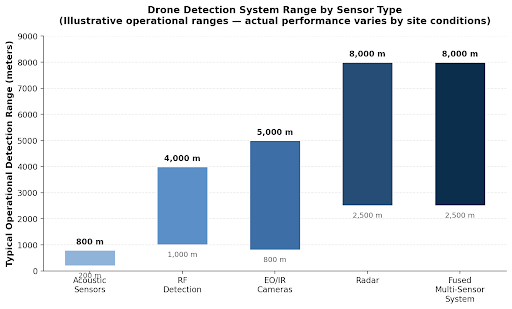
Vendor marketing tends to quote a single maximum detection range figure. In practice, a system’s real-world range depends heavily on the specific drone’s size, its RF power output, the surrounding RF noise floor, and line-of-sight obstructions from stadium structure, lighting rigs, and scoreboards.
A commercial quadcopter with a small RF footprint may be detected reliably by radar at several kilometers, while the same drone could sit inside an RF sensor’s effective range for only a fraction of that distance if it uses frequency-hopping or low-power transmission. False-positive rates are the other number vendors rarely lead with, radar in particular can generate frequent false alerts from birds, especially near open water or during migration season, which is why almost every credible deployment pairs radar with a secondary confirmation sensor before an alert reaches a human operator.
How Operators Evade Detection
A prepared adversary does not fly a stock consumer drone with its radio and telemetry switched on. Three evasion methods security teams should plan around:
- Autonomous, pre-programmed flights that never transmit a live RF control signal, defeating RF-only sensors entirely
- Remote ID spoofing or physical removal of the Remote ID broadcast module, undermining systems that rely on cooperative identification signals
- Low-RF-power or frequency-hopping transmitters designed specifically to sit below the detection threshold of consumer-grade RF sensors
This is the single strongest argument against relying on any one sensor type. A platform built entirely around RF detection will miss exactly the flights a security team most needs to catch.
Why Sensor Fusion Is the Real Differentiator
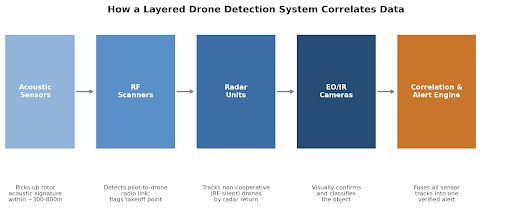
The technical answer to single-sensor blind spots is fusion: correlating tracks from radar, RF, cameras, and acoustic sensors into one verified alert rather than treating each sensor’s output separately.
A fused drone detection system reduces two problems at once. It cuts the false-alarm rate, because an object has to be corroborated across more than one sensor type before it reaches an operator’s screen, and it closes the coverage gap that any single sensor leaves open. Radar can catch what RF misses; RF can identify the pilot’s location that radar cannot; the camera confirms what both sensors flagged.
3. From Detection to Response
Detection Is Not the Same as Mitigation
This distinction gets a one-line mention in most vendor content and deserves far more. Detection identifies and tracks a drone , it does not do anything to stop it. Once a drone detection system confirms a threat, a completely separate decision-making and, where legally authorized, response process has to take over.
Confusing the two leads venues to assume that buying detection hardware alone solves the problem. It solves the “we didn’t know” problem. It does not solve the “now what” problem.
Response Options and Their Real Risk Profile
Any physical response to a confirmed drone carries its own safety tradeoffs inside a venue packed with people tradeoffs that are almost never discussed candidly in vendor material:
| Response Option | How It Works | Real-World Risk |
| Radio frequency link disruption | Serves the pilot’s control link to the drone | Drone can fall in an unpredictable location rather than a safe one |
| GPS signal override | Redirects the drone’s navigation input | Can interfere with legitimate GPS-dependent systems and nearby aircraft |
| Net-capture or interceptor drones | Physically brings down the target drone | Requires a clear flight path and trained operators to avoid secondary collisions |
| Directed energy / kinetic options | Disables or destroys the drone directly | Restricted almost exclusively to specific federal agencies |
None of these response options are appropriate to attempt without explicit legal authorization, and none should be treated as a default reaction to every alert the platform generates.
Who Is Legally Allowed to Act
In the United States, the FAA classifies any unmanned aircraft system as an aircraft under federal law. That classification means interfering with a drone in flight, through jamming, physical capture, or any other method is treated the same as interfering with a manned aircraft, and it is restricted to a short list of specifically authorized federal entities under 49 U.S.C. §44810.
A stadium’s own security staff, even with the best drone detection system on the market, cannot legally jam or bring down a drone on their own authority. For a mega-event such as a Super Bowl or a World Cup match, host cities work with DHS, the FBI, and other designated agencies to secure temporary response authorization for the event window. For a routine regular-season game, no such authorization typically exists, which means detection, verification, and coordinated notification to law enforcement is the entire scope of what venue security can legally do.
How Other Countries Handle It
Regulatory frameworks vary enough that a venue operating internationally cannot assume US rules apply elsewhere. The UK’s Air Navigation Order and the Civil Aviation Authority set separate rules for drone interference, and the EU’s EASA framework governs member states hosting major tournaments. Host nations for large international events, including 2026 World Cup venues outside the US, each apply their own aviation authority’s rules for who may respond to a drone incursion, and those rules can differ meaningfully from the American framework described above.
4. Building the Program: People and Process
Alert Thresholds and Escalation
Hardware alone does not run a security program. Every deployment needs a written standard operating procedure defining what happens at each stage of an alert:
- What confidence level or sensor-corroboration threshold triggers a notification to the security operations center
- Who has the authority to classify an alert as low, medium, or high priority
- What the escalation chain looks like from operator to shift supervisor to law enforcement liaison
- What the default action is for each priority level, including situations where no physical response is legally available
Integrating With the Security Operations Center
A detection platform that reports into its own standalone dashboard, disconnected from the rest of the venue’s security operations, is only doing half its job. Alerts need to route into the same SOC that manages CCTV, access control, and crowd monitoring so a single incident commander has the full picture.
That integration also matters for downstream decisions, a confirmed drone threat over one section of seating may trigger a localized evacuation plan, a public address announcement, or a temporary hold on gate operations, none of which a detection system can decide on its own.
Training and Tabletop Drills
Staff who have never seen a real alert will hesitate at the moment it matters. A realistic training cadence includes scheduled tabletop exercises that walk a security team through a simulated drone incursion end to end, from first detection through law enforcement notification, at least quarterly and ahead of any major event.
Coordinating With the FAA and Air Traffic Control Mid-Incident
For major events with temporary flight restrictions in place, the security operations center needs a direct communication line to the FAA and any air traffic control authority managing the restricted airspace. A confirmed drone incursion inside a TFR is a federal aviation event as much as it is a venue security event, and the notification protocol needs to be rehearsed, not improvised.
5. Planning a Deployment
The Core Evaluation Checklist
Before selecting a drone detection system, a security team should have clear answers to:
- What is the venue’s total airspace footprint, including parking, transport hubs, and approach corridors, not just the seating bowl?
- What detection range is actually achievable given the venue’s specific RF noise floor and physical obstructions?
- What is the vendor’s documented false-positive rate, tested against local bird activity and RF interference, not just a lab environment?
- Does the platform support sensor fusion across radar, RF, camera, and acoustic inputs, or is it single-sensor?
- Does it integrate through an open API with the existing SOC, CCTV, and access control systems?
- What is the total cost of ownership, including monitoring staff, not just hardware?
What It Actually Costs
Published pricing is rare in this space, but based on typical deployment tiers, venues should expect the following rough ranges when budgeting for airspace monitoring technology:
| Deployment Tier | Coverage | Approximate Annual Range |
| Single-layer, RF-only | Limited perimeter around gates and bowl | Lower five figures to low six figures |
| Layered RF + radar | Full stadium footprint | Mid six figures, plus monitoring and maintenance |
| Fully fused (RF + radar + EO/IR + acoustic) | Full footprint including approach corridors | High six figures to seven figures for large-capacity venues |
These figures vary significantly by venue size, existing infrastructure, and regional labor costs for monitoring staff. Any vendor quote should be benchmarked against more than one of these tiers before a final decision.
Venue-Specific Complications
Every stadium’s physical environment creates its own detection challenges that a generic deployment plan will not account for:
- Urban stadiums often sit inside a high RF noise floor from surrounding cellular and Wi-Fi infrastructure, which can raise the false-positive rate of RF sensors
- Stadium structure, roof trusses, and lighting rigs create radar clutter and line-of-sight obstructions that reduce effective radar coverage in specific zones
- Temporary events; concerts, festivals, and one-off tournaments often need a mobile or rapidly deployable version of the platform rather than the fixed installation used for a home stadium
6. Case Study: Astroworld, November 2021
The clearest publicly documented example of real-world drone activity data at a major public event comes from the Astroworld festival in Houston. Academic researchers who later analyzed detection data from that event found substantial drone traffic over the crowd throughout the evening , none of it used maliciously, but all of it illustrating exactly the kind of activity a security team has to sort through in real time.
The case is instructive precisely because nothing went wrong with the drones themselves. It shows what a functioning drone detection system actually produces on an ordinary night: a stream of legitimate, non-hostile contacts that still requires triage, classification, and a documented decision on each one.
A security team without a clear SOP for handling routine drone traffic will either be overwhelmed by false alarms or start ignoring alerts altogether, both outcomes defeat the purpose of having a system at all.
7. Where the Technology Is Headed
Three developments will shape how venues approach this problem over the next several years.
Swarm Detection Becomes a Baseline Requirement
Swarm detection is moving from a theoretical concern to a practical requirement. As multi-drone platforms become cheaper and more available, a anti drone detection system that can only process one confirmed track at a time will become a genuine operational liability, not just a technical limitation.
Radar and Cameras Move to the Front Line
Autonomous, RF-silent drones will keep pushing the industry toward radar and camera-based detection as the primary layer, with RF treated as a secondary confirmation source rather than the front line reversing how many current systems are architected.
Remote ID Adoption Changes the Baseline
As Remote ID becomes standard across more of the consumer and commercial drone fleet, detection platforms gain a cooperative data source for a large share of routine traffic, while the small number of deliberately non-compliant flights become easier to flag as high-priority by exception.
FAQs
- What is a drone detection system and how does it work?
A drone detection system uses a combination of sensors, typically radio frequency (RF) scanners, radar, electro-optical/infrared cameras, and acoustic sensors,to identify, track, and classify unauthorized drones in a defined airspace. The strongest systems fuse data from multiple sensor types into a single verified alert rather than relying on one detection method alone.
- How much does a stadium drone detection system cost?
Costs vary widely by venue size and sensor configuration. A basic single-sensor RF system for a limited perimeter can start in the lower five figures annually, while a fully fused system with radar, RF, cameras, and acoustic sensors covering a large stadium can run into seven figures once installation, monitoring staff, and maintenance are included.
- Is it legal for a stadium to jam or bring down a drone?
No, not for the venue’s own security staff. In the US, the FAA classifies drones as aircraft, and interfering with one, including jamming, is restricted to specific federal agencies authorized under 49 U.S.C. §44810. Stadiums can detect and report a drone, but physical response authority almost always sits with law enforcement or federal partners, and even then only during specifically authorized events.
- What is the typical detection range for stadium airspace monitoring?
Range depends heavily on sensor type and site conditions. RF sensors typically detect drones from around 1 to 4 kilometers, radar can extend to 2.5 to 8 kilometers depending on the target’s size, and camera-based confirmation is usually limited to a few kilometers under good visibility. A fused, multi-sensor system generally performs closer to the upper end of these ranges because it is not limited by any single sensor’s weakest condition.
- Can this technology stop a drone swarm?
Detection and response are two different capabilities. A well-designed drone detection system can identify and track multiple simultaneous drones if it is built to process several tracks at once, but stopping a swarm requires a separate, legally authorized response capability that most venues do not have on-site. This is why swarm scenarios specifically should be part of any pre-deployment evaluation.