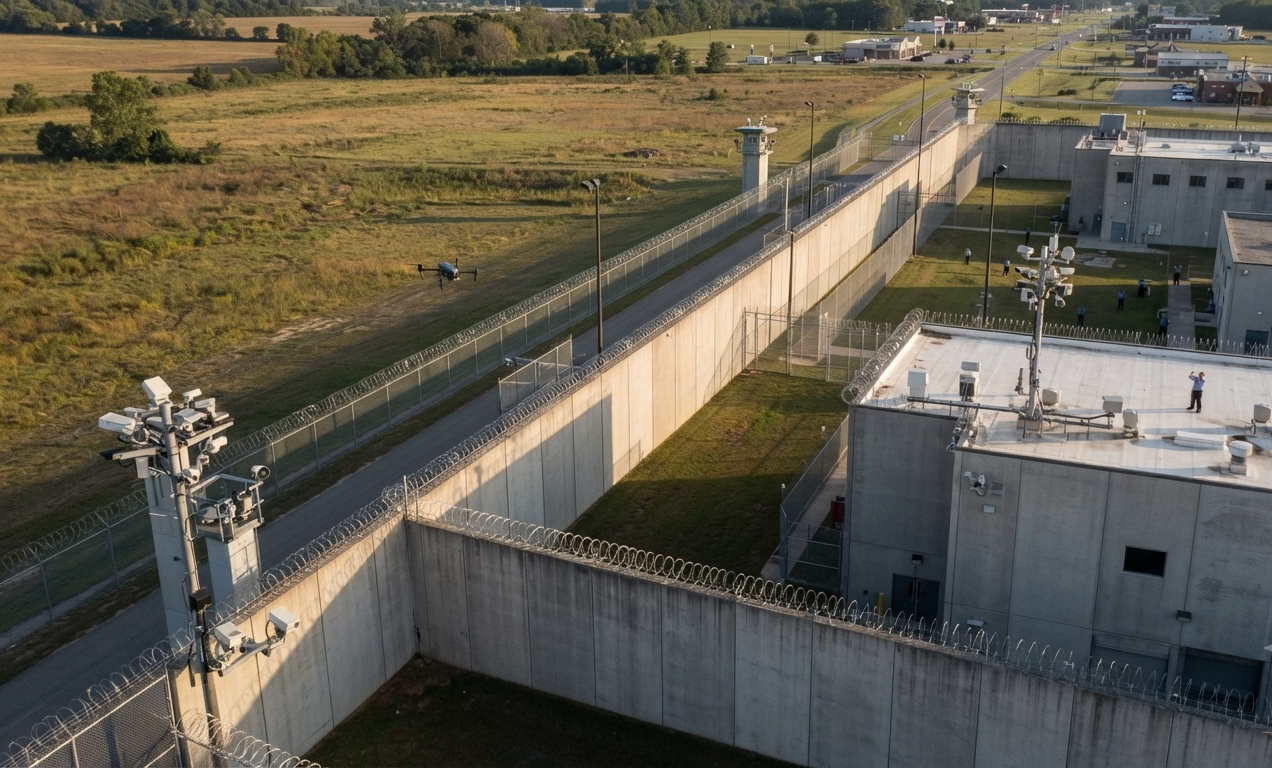
A drone can cross a perimeter without passing through a gate, checkpoint, or fence line. For correctional facilities, that creates a security problem that traditional perimeter controls were not designed to solve. The most effective response to prison drone threats is not a single device; it is a coordinated program that detects suspicious aircraft early, gives staff actionable information, and supports a controlled response.
This guide explains how drone detection works in a prison environment, what risks facilities should plan for, and which questions security leaders should ask before selecting a system.
Why Drone Activity Is a Correctional Security Problem
The National Institute of Justice identifies three major risks associated with drones near correctional facilities: transporting or dropping contraband, creating a distraction that enables another security breach, and monitoring the facility to prepare for future activity. Reported payloads include drugs, cell phones, SIM cards, weapons, and escape-related equipment. [web:1]
Contraband delivery
A drone may drop or release a package into a yard, recreation area, roof space, or another reachable location. Even a small payload can create operational consequences if it contains narcotics, a weapon, communications equipment, or items that help coordinate criminal activity. The delivery point may also reveal weaknesses in lighting, camera coverage, patrol routines, or staff response times.
The operational issue is not simply finding a package after it lands. Staff need to know when an aircraft is approaching, where it is moving, and whether the event is connected to people or vehicles outside the perimeter. That information can help the facility secure affected areas and preserve evidence.
Distraction and surveillance
A drone may be used as a diversion while people attempt another form of smuggling or unauthorized activity. It may also collect video, test response patterns, or observe movement around sensitive areas. This is why prison drone threats should be treated as an intelligence and incident-management concern, not only as a contraband problem.
How Prison Drone Detection Works
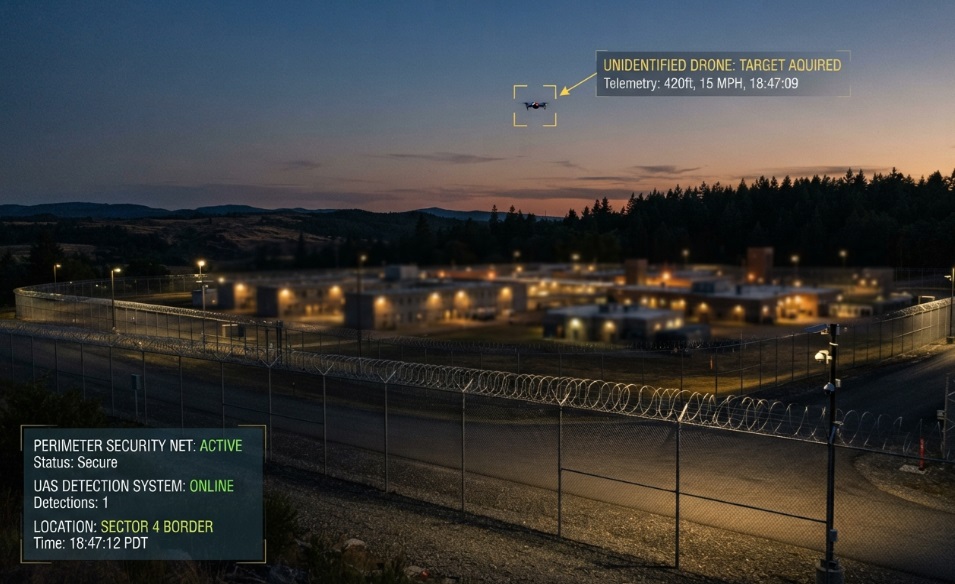
Drone detection systems use one or more sensing methods to identify an aircraft, estimate its position, and help determine whether it poses a security concern. Government guidance describes RF detection, radar, cameras, and other technologies as part of the available detection landscape. [web:2] A layered design is usually more resilient than relying on one sensor type.
Radio-frequency detection
RF sensors monitor communications between a drone and controller when those signals are present. Depending on the system, RF data may help identify a drone type, direction, or pilot location. RF performance can be affected by terrain, buildings, radio congestion, autonomous flight modes, and aircraft that do not transmit in the expected way.
Radar and tracking
Radar can provide information about movement, range, bearing, and altitude. It may be useful for establishing an airspace picture around a large or complex site, especially when visual confirmation is difficult. Facilities should ask vendors how the system distinguishes drones from birds, weather effects, and other moving objects.
Optical, thermal, and acoustic sensors
Cameras can support visual verification and documentation, while thermal cameras may help in low-light conditions. Acoustic sensors listen for characteristic aircraft noise, but wind, traffic, machinery, and facility activity can affect performance. These technologies work best when their alerts are correlated rather than treated as isolated proof.
What Happens After an Alert
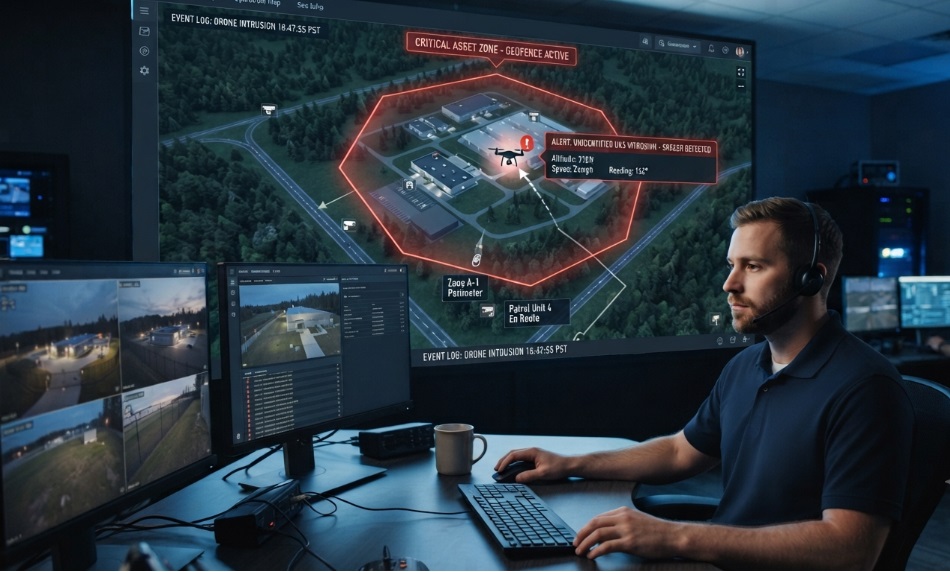
Detection is only the first stage of the security workflow. A useful system should help staff move from alert to decision without creating confusion or unnecessary radio traffic.
Verify and classify the event
- Confirm the alert using available sensor data and, where possible, visual or video evidence.
- Record the time, location, direction of travel, altitude estimate, sensor type, and confidence level.
- Classify the event as suspicious, unknown, authorized, or a likely false alarm according to facility policy.
Coordinate the response
The response plan should identify who receives alerts, who has authority to initiate movement restrictions or searches, and how staff coordinate with local law enforcement. A facility may also need procedures for securing likely drop zones, protecting staff and incarcerated people, documenting recovered items, and avoiding actions that create additional risk.
Facilities should obtain current legal advice before adopting any active countermeasure. Detection, tracking, communications, airspace rules, privacy, and agency authority can involve different federal, state, and local requirements. A detection platform should support the facility’s lawful operating model rather than encourage improvised intervention.
Preserve evidence and investigate
A high-quality incident record may include sensor alerts, video, RF or radar data, timestamps, operator notes, recovered items, and communications logs. Retaining these records according to policy can help internal investigations and referrals to law enforcement. The value of a system is therefore measured not only by whether it detects an aircraft, but also by whether it produces reliable, reviewable information.
How to Build a Layered Detection Program
Start with a site and risk assessment
Map the facility perimeter, surrounding roads, open land, buildings, tree lines, lighting, known radio interference, and locations where a package could be delivered. Review historical sightings, contraband incidents, suspicious activity, and response times. The assessment should consider prison drone threats from both the airspace and the ground: the aircraft, the operator, the recipient, and possible diversion activity.
Connect technology with procedure
Technology should be tied to an operational playbook. Define alert recipients, escalation levels, evidence handling, search responsibilities, external notifications, maintenance ownership, and after-action review. Staff training should include common false-alarm sources, system limitations, and the difference between a detection, a classification, and a confirmed incident.
Useful measures may include alert-to-verification time, verified detections, false-alert rate, sensor availability, response time, coverage gaps, pilot-location success where legally and technically available, and the percentage of incidents with complete evidence records. Reviewing these measures helps administrators justify upgrades and identify process failures.
What to Evaluate Before Choosing a System
- Does the proposed coverage match the site perimeter, likely approach routes, and nearby launch areas?
- How does the system perform in darkness, rain, wind, foliage, buildings, and radio-frequency congestion?
- Can it detect aircraft that use autonomous routes or transmit limited identifying information?
- How does it reduce nuisance alerts from birds, helicopters, aircraft, and other moving objects?
Integration and usability
- Can alerts reach the staff members who can act on them, rather than only a technical console?
- Can the platform integrate with existing video management, command-and-control, access-control, or incident-management systems?
- Does it provide a clear map, alert history, replayable data, and exportable incident reports?
- What training, maintenance, cybersecurity controls, and support response are included?
Compliance, privacy, and legal review
Ask how the system handles personal data, video, operator-location information, retention periods, access controls, and audit logs. Confirm the facility’s authority and policies before using any capability that could affect communications or aircraft operations. The NIJ notes that technical complexity, legislative constraints, rules, and regulations limit agencies’ options, which is why detection and documented procedures remain central to many programs. [web:1]
The Role of Airsentinel
A correctional facility evaluating Airsentinel should begin with its operational problem rather than a product specification: where does the facility need coverage, which staff must receive alerts, what information is needed to make a decision, and how will incidents be documented? A site assessment can then help determine the appropriate combination of sensors, software, integrations, training, and support.
The goal is practical airspace awareness. By turning an unknown aerial event into a time-stamped, actionable alert, a drone detection program can help correctional leaders coordinate staff, protect vulnerable areas, investigate incidents, and reduce the opportunity for contraband drops. Airsentinel can position its solution around that complete workflow while avoiding the unsupported promise that technology alone eliminates every risk.
FAQs
1) What are prison drone threats?
Prison drone threats include contraband delivery, surveillance of facility operations, distraction of security staff, and possible coordination of other unauthorized activity. Payloads reported by government sources include drugs, cell phones, SIM cards, weapons, and escape-related equipment. [web:1]
2) How do prisons detect drones?
Facilities may combine radio-frequency sensors, radar, cameras, thermal imaging, acoustic sensors, and staff observation. The right mix depends on site size, terrain, buildings, lighting, radio conditions, budget, and operating procedures.
3) Can drone detection identify the pilot?
Some systems can help locate or characterize the controller when sufficient signal or sensor data is available. Results vary by aircraft, flight mode, environment, system capability, and legal constraints, so pilot location should not be treated as guaranteed.
4) Why is one sensor not always enough?
Every sensor has limitations. RF detection may be less useful when expected signals are absent, cameras need suitable visibility, acoustic systems can encounter background noise, and radar must classify moving objects. Correlating multiple sources can improve confidence and reduce false alarms.
5) What should staff do after a drone alert?
Staff should follow the facility’s approved playbook: verify the alert, classify the event, notify designated personnel, protect the likely drop zone.

 BLOG · SEP 22, 2026