If you are researching drone detection system pricing,
one of the first questions is simple: how much does a reliable drone detection
solution actually cost?
AirSentinel offers several airspace
monitoring options designed for organizations that need to detect, track, and
monitor drones and Remote ID signals. Pricing depends on the AirSentinel
configuration, coverage requirements, subscription term, and whether additional
capabilities such as Software Defined Radio (SDR) are required.
In this guide, we explain AirSentinel
pricing, what is included, and what buyers should consider before choosing a
drone detection system.
How Much Does AirSentinel Cost in 2026?
AirSentinel publishes pricing for
several of its AMS products and configurations.
The AirSentinel store currently lists
the AMS V8.2 Subscription with Modem at $4,249. The product is designed
as a portable drone detection system for continuous drone and Remote ID
monitoring.
AirSentinel’s AMS solutions page also
lists:
●
AMS RID: $2,949 annually
●
AMS Pro: $4,749
●
AMS Pro SDR Upgrade: $1,999
●
Portable Antenna Mast: $425
Enterprise pricing is also available
for volume deployments, while discounts may be available for first responders.
Because AirSentinel offers different
configurations, the final drone detection system pricing can vary
depending on the requirements of your deployment.
What Is Included With AirSentinel AMS?
Price is only one part of evaluating a
drone detection system. Buyers should also look at what they receive as part of
the solution.
The AMS V8.2 includes access to
AirSentinel’s cloud platform and mobile application, allowing users to
visualize detected drones and Remote ID information in real time. AirSentinel
states that there are no additional seat or per-user license fees for the
included cloud platform, which can be useful for organizations with multiple
team members.
The system also supports Ethernet,
Wi-Fi, and integrated LTE/5G connectivity. AirSentinel lists a standard
detection range of more than 3 miles in every direction, with enhanced
configurations capable of reaching up to 12 miles in every direction depending
on conditions and deployment.
This means buyers should evaluate the
complete system rather than comparing hardware prices alone.
AirSentinel AMS vs. AMS Pro
The main difference between standard
Remote ID detection and the AMS Pro configuration is the additional detection
capability provided by SDR technology.
AirSentinel's AMS can detect Remote ID
signals, while the AMS Pro SDR upgrade expands the system's ability to
detect and monitor drones that do not broadcast Remote ID. This can include
certain legacy drones, hobbyist aircraft, and custom-built UAVs.
The SDR upgrade is currently listed at
$1,999. It can therefore be an important consideration for organizations
that require broader RF-based drone detection rather than Remote ID monitoring
alone.
What Affects Drone Detection System Pricing?
There is no single price that applies
to every drone detection deployment. Several factors can affect the overall
cost.
1. Detection Requirements
A facility that only needs Remote ID
monitoring may require a different configuration from a high-security facility
that needs to identify drones that are not transmitting Remote ID.
2. Coverage Area
Larger sites may require additional
sensors or carefully planned sensor placement. AirSentinel states that
detection range depends on factors such as the aircraft, antenna placement,
environment, and installation conditions.
3. Additional Sensors
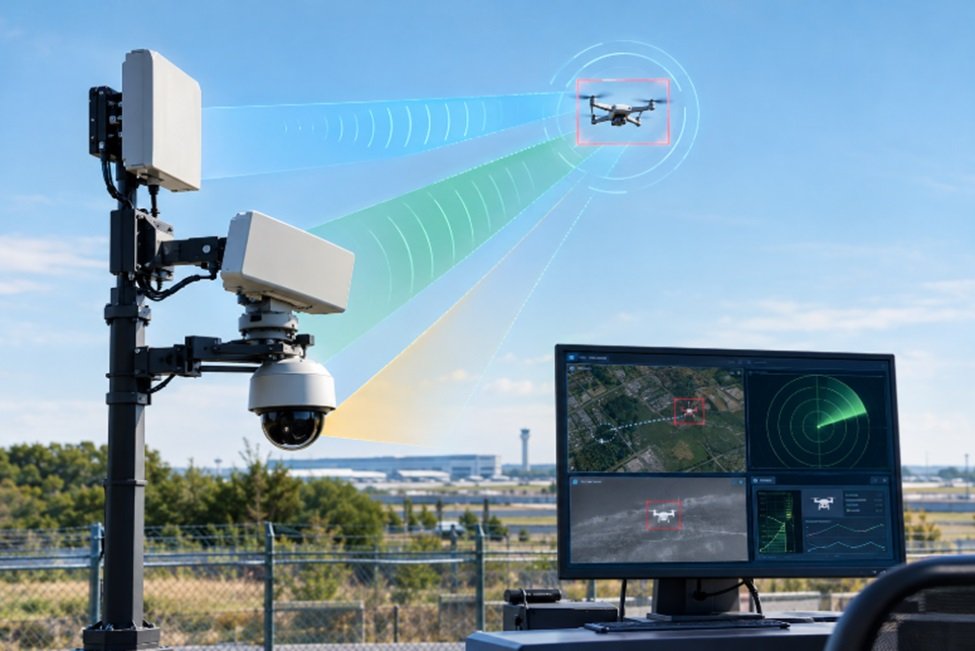
AirSentinel's broader detection
architecture can combine RF sensing with radar and optical or thermal cameras.
This allows organizations to build a layered airspace monitoring system rather
than relying on a single sensing technology.
4. Subscription and Service Term
AirSentinel provides different
service-term options for its AMS V8.2 offering. Additional years of service can
be added to the subscription, so buyers should consider the expected length of
deployment when calculating total ownership costs.
5. Enterprise Deployment
Organizations deploying multiple
systems may require customized configurations and volume pricing. AirSentinel
states that enterprise pricing is available for volume orders.
Is AirSentinel Worth the Price?
For organizations evaluating drone
detection system pricing, the cheapest option is not necessarily the best
option.
AirSentinel is designed around
real-time airspace awareness, Remote ID detection, RF sensing, cloud-based
monitoring, APIs, and integration with other security technologies. The AMS
platform can also be expanded with SDR capabilities and integrated with radar
and optical systems for more comprehensive detection.
For airports, correctional facilities,
critical infrastructure, industrial sites, security teams, and other
organizations where unauthorized drones can create operational or safety
concerns, these capabilities may provide more value than a basic detection
device.
Final Thoughts on AirSentinel Pricing
AirSentinel pricing depends on the
model and configuration you choose. Current published figures include $2,949
annually for AMS RID, $4,749 for AMS Pro, and $4,249 for the AMS V8.2
Subscription with Modem, while the AMS Pro SDR upgrade is listed at $1,999.
Enterprise and first-responder pricing may also be available.
If you are comparing drone
detection system pricing, look beyond the initial hardware cost. Detection
range, Remote ID capabilities, non-RID detection, cloud access, integrations,
scalability, subscription terms, and future upgrade options can all affect the
real value of a system.
For an organization that needs
scalable airspace intelligence rather than a basic drone detector,
AirSentinel's AMS platform provides a range of configurations that can be
matched to different operational requirements.

 BLOG · SEP 26, 2026