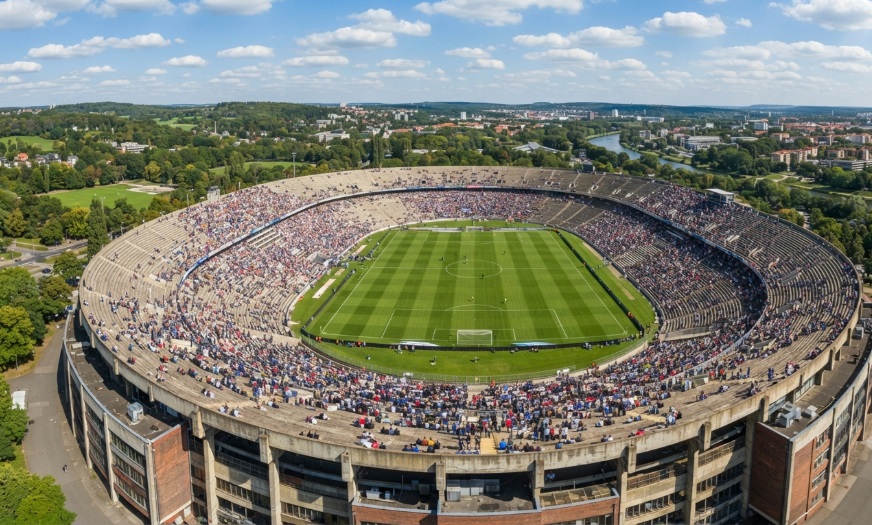
A packed stadium has no roof, no ceiling, and no natural barrier above the seating bowl. Metal detectors at the gate stop threats walking through checkpoints. They do nothing for a threat arriving from three hundred meters up, outside the perimeter fence, with a clear flight path to the field.
That gap is why drone detection for stadiums has moved from an optional extra to a core part of the security stack at NFL, MLB, and NCAA Division I venues. Security directors are no longer asking whether a drone showed up on a Sunday afternoon. They are asking how fast their team found out, and what they were actually able to do about it.
The airspace gap stadiums cannot ignore
Modern stadiums are designed to stay open above the seating bowl for airflow, lighting rigs, and broadcast camera angles. That same openness removes any physical obstacle to a small aircraft entering from outside the venue. Airport-style perimeter screening was never built with this problem in mind.
The threat has evolved faster than most venue security playbooks. Consumer drones are cheaper, more capable, and easier to fly than ever. Swarm hardware five to twenty units flown from one controller or pre-programmed flight software is commercially available for light shows and marketing. The same equipment repurposed with hostile intent creates a very different detection problem.
Any venue evaluating drone detection for stadiums in 2026 should ask how the platform performs against multiple simultaneous tracks, not just a single test drone.
Six types of drone incidents security teams actually face
Not every drone over a stadium is a genuine attack. Security teams generally see six recurring categories, and the operator profile changes what response is appropriate.
Reconnaissance and surveillance
This includes filming the crowd, venue layout, or VIP movement ahead of an event. Content creators chasing footage for social media or unauthorized broadcast fall into this category, as do activists using a flyover as a visibility tactic.
Contraband drops
Drones dropping phones, drugs, or other prohibited items into restricted areas such as locker rooms, press boxes, or student sections. Criminal actors use drones as a low-risk smuggling tool because they do not need to breach a gate or slip past a checkpoint.
Broadcast piracy
Unauthorized aerial filming of a ticketed or broadcast-rights-controlled event. This creates legal and reputational problems long after the drone has left the property.
Protest or stunt flights
Banners, message drops, or attention-seeking flyovers timed to a broadcast window. These are often deliberate visibility tactics rather than genuine security threats, but they still require a response mid-event.
Weaponized or payload incidents
Rare, but the highest-consequence category, involving a drone modified to carry or drop a harmful payload. A drone losing power or drifting into a crowded section is not a hypothetical; it is a physical hazard to the people sitting in the stands.
Near-misses with event aircraft
A drone straying into the approach or departure path of helicopters supporting event security or medical evacuation. This is a federal aviation event as much as it is a venue security event.
A security team that treats every contact the same way either overreacts to hobbyists constantly or underreacts to the rare coordinated flight. A well-tuned detection platform that classifies flight behavior hovering over a specific section versus a straight transit path, for example helps a team triage which category it is dealing with before committing resources.
How drone detection for stadiums works
Most people picture drone detection for stadiums as a single radar dish scanning the sky. In practice, it is a layered listening system built around identification rather than interception.
RF sensors: listening for the control link
Radio Frequency (RF) sensors listen for the communication link between a drone and its remote control, typically on the 2.4 GHz or 5.8 GHz bands. They are relatively inexpensive and can often identify the operator approximate location along with the drone itself.
The limitation: they only detect drones that are actively transmitting. A pre-programmed, autonomous flight with no live radio link can pass through an RF-only system undetected. AirSentinel AMS V8 reads Remote ID broadcasts the identification signal most drones are now required to transmit and gives security teams 360-degree, real-time coverage from a fixed or mobile unit.
Radar: seeing what RF misses
Radar sends out a signal and reads the return bounced off a physical object, so it can pick up a drone regardless of whether it is transmitting RF. This makes radar the only sensor type effective against RF-silent, autonomous drones.
The tradeoff is cost, a higher rate of false alerts from birds and debris, and the number of radar units needed to cover a stadium full airspace without gaps. AirSentinel AMS V8 Pro goes a step further with multi-band SDR detection, built to catch custom-built or legacy drones that do not broadcast Remote ID at all, by picking up on signal anomalies and device fingerprints instead.
Cameras and acoustic: confirmation at range
Electro-optical / infrared (EO/IR) cameras provide the visual confirmation a security team needs before committing a response. High-zoom optics combined with thermal imaging let an operator identify a drone size, configuration, and any visible payload, including at night.
Acoustic sensors listen for the distinctive sound signature of rotor blades. They are the shortest-range sensor of the four but can be useful in an urban stadium environment where RF noise floors and radar clutter from surrounding buildings degrade the other technologies.
Why sensor fusion beats single-sensor setups
The technical answer to single-sensor blind spots is fusion: correlating tracks from radar, RF, cameras, and acoustic sensors into one verified alert rather than treating each sensor output separately.
A fused drone detection for stadiums system reduces two problems at once. It cuts the false-alarm rate, because an object has to be corroborated across more than one sensor type before it reaches an operator screen, and it closes the coverage gap that any single sensor leaves open.
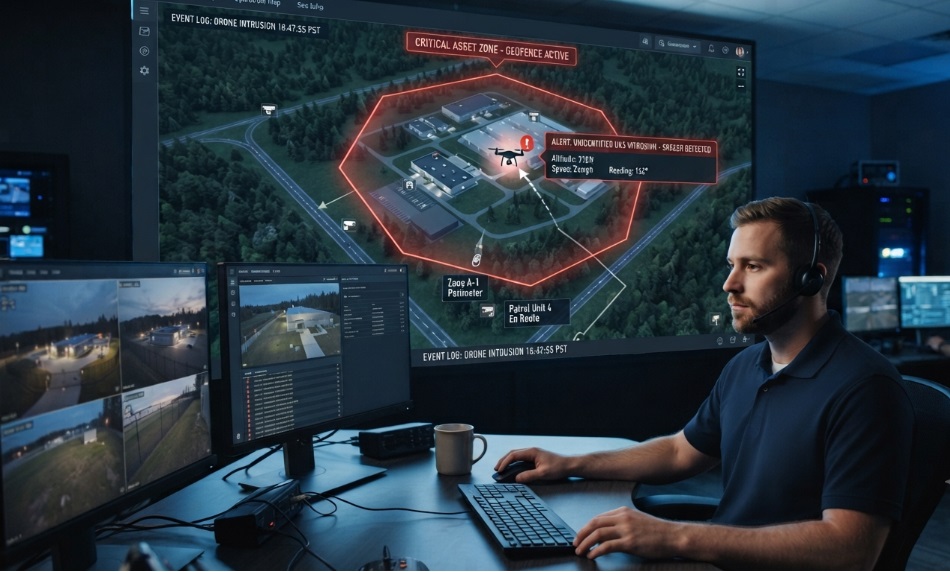
Every detection, Remote ID or not, routes into the Cloud Platform, where security staff see drone ID, GPS location, and flight path on one dashboard. That is also where geofencing lives a stadium can draw a boundary around the bowl, the loading docks, or a VIP entrance and get flagged the moment a drone crosses it, instead of relying on a guard happening to look up.
Detection is not mitigation: the legal reality
This distinction gets a one-line mention in most vendor content and deserves far more. Detection identifies and tracks a drone it does not do anything to stop it. Once a drone detection for stadiums system confirms a threat, a completely separate decision-making and, where legally authorized, response process has to take over.
Who can legally respond to a drone
In the United States, the FAA classifies any unmanned aircraft system as an aircraft under federal law. That classification means interfering with a drone in flight through jamming, physical capture, or any other method is treated the same as interfering with a manned aircraft, and it is restricted to a short list of specifically authorized federal entities under 49 U.S.C. 44810.
For a mega-event such as a Super Bowl or a World Cup match, host cities work with DHS, the FBI, and other designated agencies to secure temporary response authorization for the event window. For a routine regular-season game, no such authorization typically exists, which means detection, verification, and coordinated notification to law enforcement is the entire scope of what venue security can legally do.
What venue security can and cannot do
A stadium own security staff, even with the best drone detection for stadiums system on the market, cannot legally jam or bring down a drone on their own authority. AirSentinel systems are built around detection and alerting for exactly this reason.
What a stadium security team gets instead is information fast enough to make its own call: track it, radio the field, or bring in law enforcement. That is the entire point of drone detection for stadiums done this way it buys the seconds a security officer needs to make an informed call instead of reacting to a drone someone in the upper deck already spotted and started filming.
Building a program that works on game day
Hardware alone does not run a security program. Every deployment needs a written standard operating procedure defining what happens at each stage of an alert.
Alert thresholds and escalation
A realistic SOP defines:
What confidence level or sensor-corroboration threshold triggers a notification to the security operations center
Who has the authority to classify an alert as low, medium, or high priority
What the escalation chain looks like from operator to shift supervisor to law enforcement liaison
What the default action is for each priority level, including situations where no physical response is legally available
Integrating with your SOC
A detection platform that reports into its own standalone dashboard, disconnected from the rest of the venue security operations, is only doing half its job. Alerts need to route into the same SOC that manages CCTV, access control, and crowd monitoring so a single incident commander has the full picture.
That integration also matters for downstream decisions a confirmed drone threat over one section of seating may trigger a localized evacuation plan, a public address announcement, or a temporary hold on gate operations, none of which a detection system can decide on its own.
Training and tabletop drills
Staff who have never seen a real alert will hesitate at the moment it matters. A realistic training cadence includes scheduled tabletop exercises that walk a security team through a simulated drone incursion end to end, from first detection through law enforcement notification, at least quarterly and ahead of any major event.
For major events with temporary flight restrictions in place, the security operations center needs a direct communication line to the FAA and any air traffic control authority managing the restricted airspace. A confirmed drone incursion inside a TFR is a federal aviation event as much as it is a venue security event, and the notification protocol needs to be rehearsed, not improvised.
What it actually costs
Published pricing is rare in this space, but based on typical deployment tiers, venues should expect the following rough ranges when budgeting for airspace monitoring technology:
| Deployment Tier |
Coverage |
Approximate Annual Range |
| Single-layer, RF-only |
Limited perimeter around gates and bowl |
Lower five figures to low six figures |
| Layered RF + radar |
Full stadium footprint |
Mid six figures, plus monitoring and maintenance |
| Fully fused (RF + radar + EO/IR + acoustic) |
Full footprint including approach corridors |
High six figures to seven figures for large-capacity venues |
These figures vary significantly by venue size, existing infrastructure, and regional labor costs for monitoring staff. Managed, per-event deployments generally range from a few thousand dollars for a small venue to well over ten thousand dollars for a large stadium or multi-day festival, depending on sensor count, coverage area, and monitoring duration.
Any vendor quote should be benchmarked against more than one of these tiers before a final decision.
Why AirSentinel fits stadium operations
A few things come up repeatedly when stadium and university security teams look at AirSentinel specifically. There is no requirement for a dedicated IT department to run it; the sensors are built to deploy without specialized training, and the mobile app walks a first-time user through setup.
Because the platform is cloud-native, updates and alerts happen in real time without anyone maintaining a server on-site. Pricing does not scale by user count, which matters for a security office that might have a dozen people monitoring one game and three times that on a concert night. And first responders get access at no cost, a detail that matters when a stadium’s own security office is coordinating with a local police department during a high-attendance event.
The AirSentinel Mobile App turns an Android phone into a Remote ID detector with a working range of roughly 1,000 to 5,000 feet, which is genuinely useful for staff walking the concourse or patrolling the parking structure rather than watching a fixed dashboard. Paired with the AMS Sensor covering the fixed perimeter, that gives a stadium two different vantage points on the same airspace.
That combination is what makes drone detection for stadiums practical for a security office running lean on both budget and staff. None of it replaces judgment on the ground; it just means the person making the call has better information than a radio report from a fan in section 214.
FAQs
1) Can stadiums legally use drone detection systems?
Yes. Detecting a drone and reading its identification signal is legal for a private venue in most jurisdictions. What is restricted is mitigation jamming a drone signal or taking control of it which stays with federal agencies. AirSentinel systems are built around detection and alerting for exactly this reason.
2) Do drone detection systems stop drones, or just detect them?
They detect and alert. AirSentinel does not jam a drone signal or take control of it mid-flight. When a drone is flagged, the security team gets its ID, location, and flight path, and decides the next step themselves: track it, call it in, or run their own protocol.
3) What is Remote ID and why does it matter for drone detection?
Remote ID is the identification signal most drones are now required to broadcast, similar in spirit to a license plate. A stadium sensors read that signal to identify a drone location and flight path in real time. Drones that do not broadcast Remote ID can still sometimes be flagged through signal anomalies, which is what AirSentinel AMS V8 Pro is built to catch.
4) Can a stadium detect drones that do not have Remote ID?
To an extent, yes. Standard sensors are optimized for Remote ID signals, but AMS V8 Pro adds multi-band detection that can pick up custom-built or non-compliant drones by identifying signal anomalies and device fingerprints, rather than relying on a broadcast ID alone.
5) How much staff or technical setup does a stadium need to run a drone detection system?
Less than most security teams expect. AirSentinel sensors are designed to deploy without a dedicated IT team, and the mobile app walks a first-time user through setup. Once running, the system operates continuously in the background and reports through the Cloud Platform dashboard.

 BLOG · SEP 22, 2026