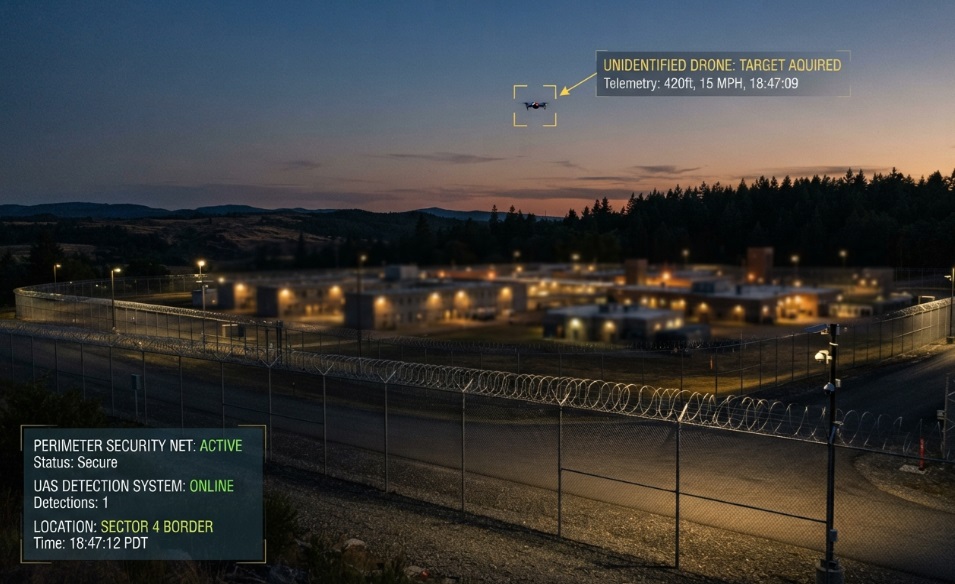
A shipment dropped over a fence takes seconds. A guard on a normal yard patrol has no way to see it coming. That gap is what’s driving the growth of drone detection for prisons across the country facilities that once relied on walls, razor wire, and foot patrols are now watching their airspace the same way they watch the ground. AirSentinel builds that capability for correctional teams through the system built specifically to detect, classify, and respond to drone activity before a delivery ever reaches its target.drone detection for prisons
Why Drone Detection for Prisons Has Become a Security Priority
Drones solve a problem smugglers have dealt with for decades: how to get something over a wall without walking through a gate. A quadcopter carrying a phone, a small bag of pills, or a folded weapon can clear a fence in under a minute and land in a yard, a recreation area, or right outside a housing unit. Foot patrols, fence sensors, and standard security cameras were built to stop threats moving on the ground. None of them were built to look up.
That gap is why drone detection for prisons has moved from a pilot project at a handful of facilities to a standard line item in correctional security planning. It isn’t only about catching the drone itself. Unauthorized drone activity over a facility can also mean someone is mapping yard layouts, watching guard movement patterns, or scouting camera blind spots ahead of a larger plan.
How Drone Detection for Prisons Actually Works
AirSentinel’s approach to drone detection for prisons runs on a five-step sequence built into the system:
- Detect — RF sensors and radar identify drone activity from miles away, before the aircraft is close enough for a guard to spot it visually.
- Classify — AI-driven algorithms separate an actual drone from a bird, a plastic bag caught in the wind, or other airborne clutter, so alerts stay accurate.
- Track — Real-time triangulation maps the drone’s flight path and locates the source of the controller signal.
- Alert — Correctional officers and security commanders get an immediate notification the moment a threat is confirmed.
- Respond — The system connects into a facility’s existing security team, law enforcement contacts, or optional response tools.
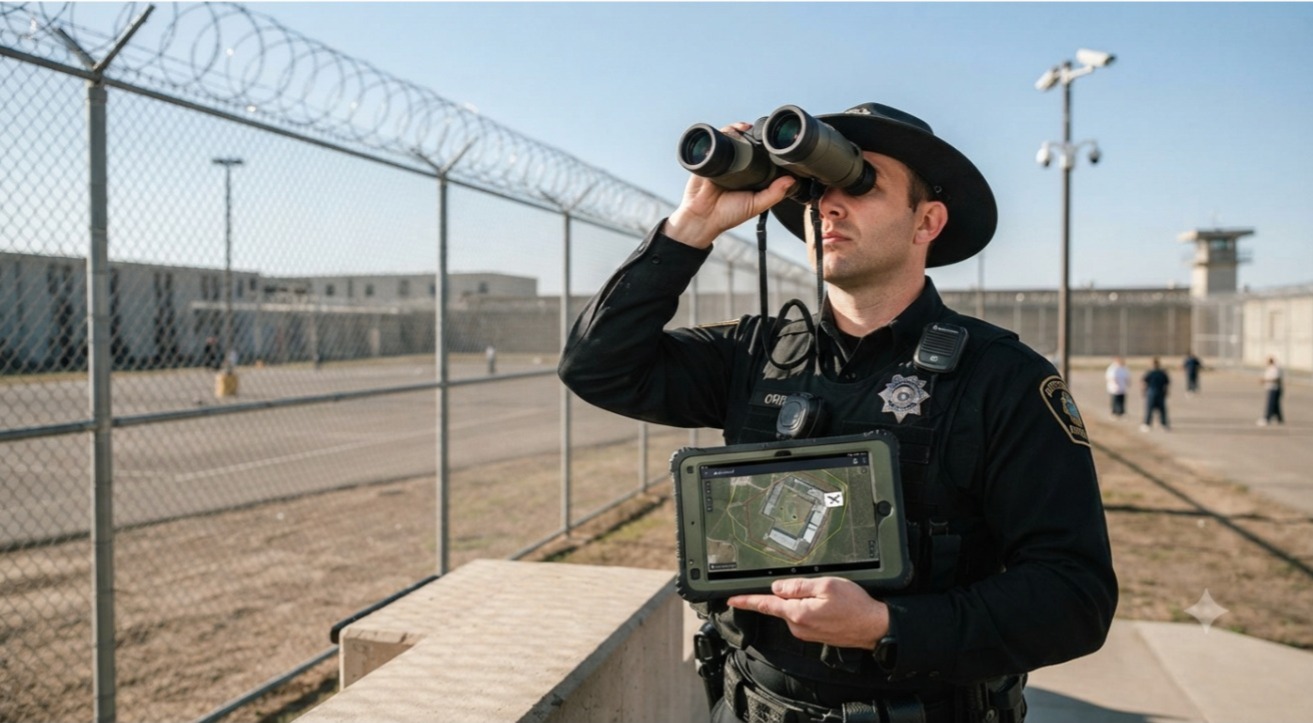
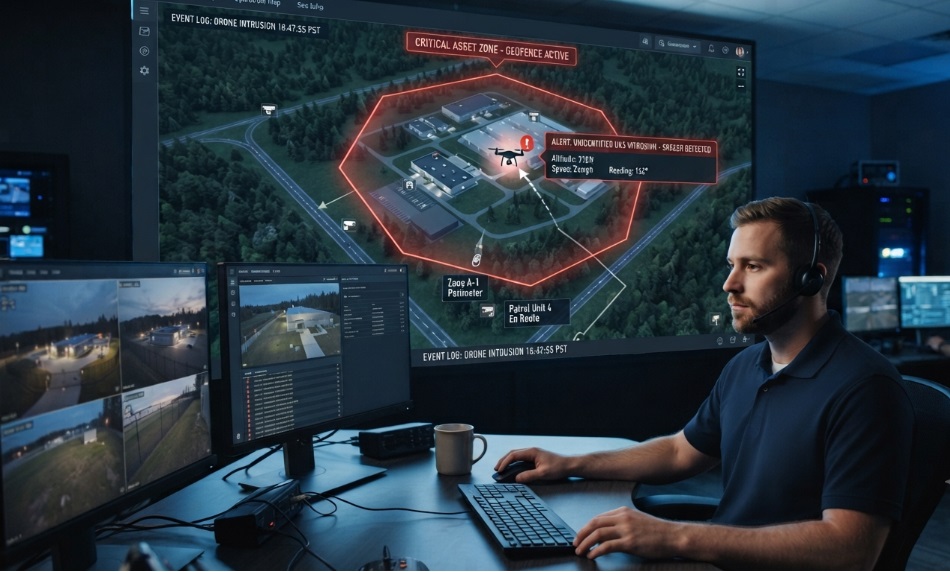
Every one of those five stages feeds into a single dashboard, viewable from a command center desk or a phone in a guard’s pocket. That matters in a facility where the person closest to the yard when a drone appears is rarely the person sitting at a monitoring station.
Figure 1: The five-step detection sequence behind the detection system.
Layered Sensors Behind Prison Drone Security
No single sensor catches every drone. That’s the reasoning behind combining RF analysis, radar tracking, and AI classification into one system rather than relying on any one piece of hardware. RF sensors pick up the radio signal between a drone and its controller. Radar tracks the physical object in the air, which matters for drones flying with their signal turned off or modified. AI classification cross-checks both feeds against the shape and movement pattern of a real aircraft before an alert ever reaches an officer.
This layered structure is central to how drone detection for prisons holds up in the field rather than just on paper. A facility surrounded by trees, migratory birds, or heavy wind doesn’t get flooded with false alarms, because the system cross-references more than one type of data before deciding something in the sky deserves attention.
Figure 2: RF, radar, and AI classification work together before a single alert is sent.
Custom Geofencing for Yards, Towers, and Perimeter Zones
Every correctional facility has areas that matter more than others a rec yard, a housing unit roofline, an intake area near the outer fence. AirSentinel lets security teams draw custom geofences around exactly those zones, with 360-degree coverage around each one. A drone entering a defined zone triggers an alert immediately, while ordinary air traffic outside the property doesn’t generate unnecessary noise for staff to sift through.
Zones aren’t locked in at setup. Facilities can adjust them at any time through the dashboard as a yard layout changes, a new building goes up, or leadership decides a particular corner of the property needs tighter coverage. Managing that doesn’t require a specialist on staff the interface is built so a security team can update its own zones directly.
Locating the Pilot Behind Drone Detection for Prisons
Spotting the drone only answers half the question. AirSentinel is also built to help locate where the person flying it is standing, using the same signal data that identifies the aircraft. That detail is what turns a confirmed sighting into something a facility’s security team and outside law enforcement can act on a location to respond to, rather than just a shape that disappeared over the tree line.
AirSentinel keeps that information restricted to authorized users and the agencies a facility works with rather than publishing it anywhere public, which keeps the focus on operational response instead of exposure.
Getting Drone Detection for Prisons Onto Existing Security Systems
A new security layer is only useful if a facility can run it alongside what’s already installed. AirSentinel is built to sit on top of a facility’s current security operation rather than replace it alerts and tracking data flow into the same dashboard officers already check, whether that’s a monitoring station in a control room or a phone carried on a walk through the yard.
That’s part of why drone detection for prisons has scaled beyond a handful of early adopters: facilities don’t need to rebuild their security infrastructure to add it. AirSentinel’s team works directly with correctional security staff to scope coverage around specific yards, towers, or perimeter sections, then expands as a facility’s needs grow.
The Bottom Line
A drone that clears a fence in under a minute doesn’t leave much room for a second chance. Facilities that have added drone detection for prisons to their security operation aren’t reacting to contraband after a shakedown turns it up they’re seeing the aircraft the moment it enters their airspace.
To see how AirSentinel could be scoped for a specific facility, visit AirSentinel’s Correctional Facilities page, or explore the AMS Sensor, Cloud Platform, and Mobile App that power it. General questions about the platform are answered on the AirSentinel FAQ page.AMS Sensor
Frequently Asked Questions
How do correctional facilities detect drones carrying contraband?
Correctional facilities use drone detection for prisons technology like AirSentinel’s drone detection system to identify drone activity through RF sensors and radar, confirm it with AI classification, and alert security staff before a delivery reaches the yard.
How does drone detection for prisons work?
The system follows five steps: detect, classify, track, alert, and respond. It combines RF analysis, radar tracking, and AI algorithms so security teams know a drone is present, what it is, and where its controller signal is coming from.
Can drone detection identify who is flying the drone?
Yes. The system is designed to locate the drone pilot’s position along with the aircraft itself, giving correctional security teams and law enforcement a specific location to respond to rather than just a confirmed sighting.
How far can prison drone detection systems detect a drone?
Coverage depends on the sensor setup. AirSentinel’s AMS sensor detects Remote ID signals within a 3-mile radius with 360-degree coverage, and monitoring stations can extend detection up to 5 miles depending on configuration and site conditions.
Does drone detection work at night or in bad weather?
Yes. Because detection relies on RF signal and radar data rather than cameras alone, accuracy holds up in low light, poor weather, and reduced-visibility conditions that would limit a visual-only system.

 BLOG · SEP 22, 2026