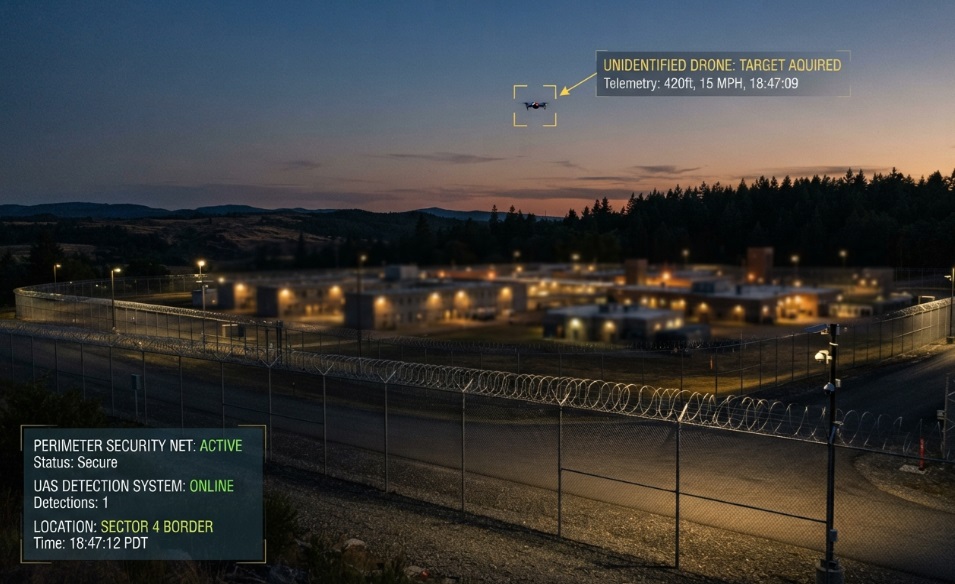
An unfamiliar drone hovering over a crime scene, a correctional yard, or a packed downtown event creates an immediate problem for the officers on scene: is it a hobbyist, a journalist, or someone gathering intelligence for a crime? That uncertainty costs time, and time is the resource law enforcement can least afford to lose. Drone detection for law enforcement closes that gap by giving officers and dispatchers verified information about what is actually in the airspace before they commit people and equipment to it.
Why Unauthorized Drone Activity Has Become a Law Enforcement Problem
Consumer and commercial drones are common enough now that most patrol officers will encounter one during a shift at some point this year. Some are harmless a neighbor filming a sunset, a real estate agent shooting listing photos. Others are not. Drones have been used to surveil police movements during protests, monitor patrol patterns ahead of planned crimes, and smuggle contraband into correctional facilities. They have also interfered with law enforcement and medical helicopters and disrupted operations near airports located close to an incident.
Federal lawmakers have taken notice. Proposed legislation such as the Safeguarding the Homeland from the Threats Posed by Unmanned Aircraft Systems Act would expand state and local authority to use DHS-approved detection equipment, reflecting a broader push to put reliable drone detection for law enforcement into the hands of the agencies who are first on scene when something goes wrong.
What Is Drone Detection for Law Enforcement?
Drone detection for law enforcement is the use of sensors and software to identify, locate, and track unmanned aircraft operating in or near an agency’s jurisdiction, in real time, without physically intercepting the aircraft. A detection system tells a department that a drone is present, where it is, how fast it is moving, and often who is flying it, so commanders can decide how to respond.
Detection vs. Mitigation: Know the Difference
It’s worth separating two terms that often get blurred together: detection and mitigation (sometimes called counter-UAS or interdiction). Detection systems identify and track a drone. Mitigation systems go further and attempt to disable, capture, or force a drone down, typically through signal jamming or other countermeasures. In the United States, mitigation authority is tightly restricted under federal law and is generally limited to specific federal agencies or to state and local departments that have completed formal coordination, most often through the FBI. Detection is far more widely available to state and local agencies and does not carry the same legal restrictions, which is one reason drone detection for law enforcement has become the practical starting point for most departments building a counter-drone capability.
How Detection Systems Identify and Track Drones
Most systems combine more than one sensing method to reduce blind spots:
- Radio frequency (RF) sensors that pick up the link between a drone and its controller, and read the Remote ID broadcasts most drones are now required to transmit
- Radar, which detects a drone by its physical presence and flight path useful against aircraft that aren’t broadcasting Remote ID
- Camera and acoustic sensors, which provide visual confirmation and can help identify a drone model in daylight or at night
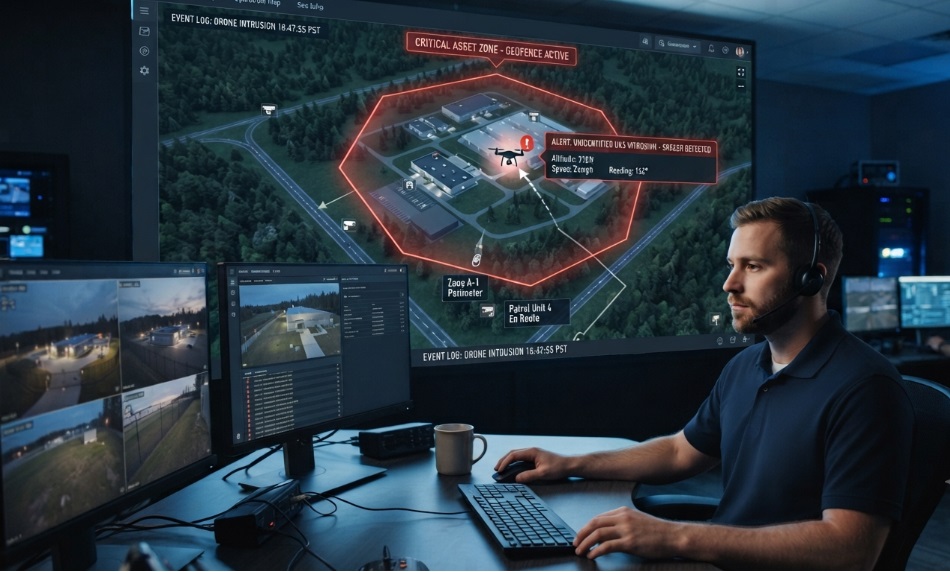
- Cloud-based software that fuses sensor data into a single dashboard, alerts, and historical flight logs investigators can review later
How Drone Detection Speeds Up Law Enforcement Response
Real-Time Situational Awareness Before Officers Arrive
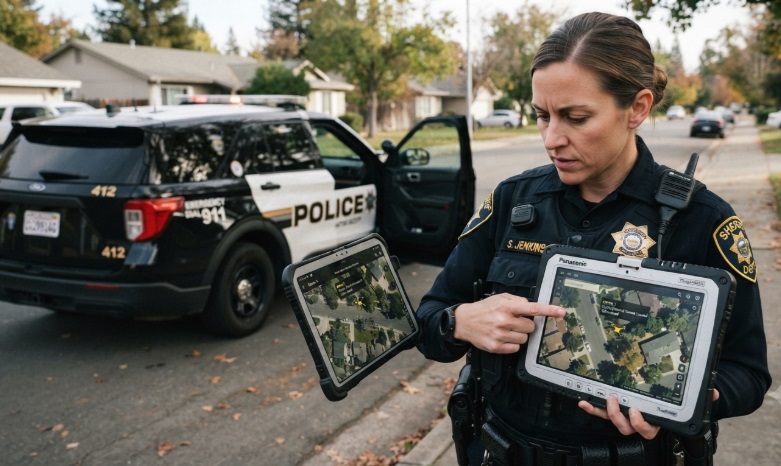
The core value of drone detection for law enforcement is time. Instead of learning about a drone from a 911 caller’s vague description, a detection system alerts dispatch the moment a drone enters a monitored area, showing its location, altitude, and flight path on a live map. Officers arriving on scene already know whether a drone is present, where it is likely to be, and whether it matches a pattern seen before, so they can plan their approach instead of improvising it.
Supporting Drone as First Responder (DFR) Programs
Detection technology also protects a department’s own airspace investment. Agencies running Drone as First Responder programs where a department’s own drone launches to a 911 call and streams video to officers before they arrive need to know their airspace is clear of unauthorized aircraft that could interfere with the flight or create a collision risk. Pairing a department’s DFR fleet with drone detection for law enforcement gives commanders confidence that the airspace above an active call is actually what their dashboard says it is.
Faster Threat Assessment During Active Incidents
During a barricaded-suspect situation, a large protest, or a mass-casualty event, unauthorized drones can complicate an already difficult scene they may belong to media, to bystanders, or to someone with hostile intent. A detection system lets commanders quickly separate the routine from the concerning, flagging repeat flights, unusual loitering, or drones without a Remote ID signal, so limited personnel aren’t pulled away to investigate every sighting.
Where Law Enforcement Agencies Use Drone Detection
Patrol Operations and Public Events
Departments deploy drone detection for law enforcement at large public gatherings, parades, and sporting events, where the number of legitimate hobbyist and media drones is highest and the cost of missing a genuine threat is highest too. Monitoring the airspace over a crowd lets event security teams and patrol supervisors respond to a specific drone rather than shutting down an area on a rumor.
Correctional Facilities
Contraband delivery by drone phones, drugs, and weapons dropped into recreation yards is one of the fastest-growing security problems for jails and prisons. Detection sensors placed around a facility’s perimeter give corrections staff advance warning of an approach, with enough time to move toward the likely drop zone before the payload is retrieved.
Critical Infrastructure and Government Sites
Water treatment plants, power substations, courthouses, and government buildings are increasingly monitored for drone activity as well, since surveillance or disruption at these sites carries consequences well beyond a single incident. Agencies responsible for protecting this infrastructure use the same detection data to coordinate with facility security and, where appropriate, federal partners.
Legal Authority: What Law Enforcement Can and Cannot Do
Because it is passive monitoring radio signals and flight paths without interacting with the drone itself most state and local agencies can deploy drone detection for law enforcement without the special federal authorization required for mitigation. That said, agencies should still confirm how detection data can be used as evidence, coordinate with their state’s specific drone statutes, and establish clear retention and access policies before deployment. Legal counsel and a department’s existing UAS policy should guide exactly how detection data fits into investigations and use-of-force reviews.
What to Look for in a Drone Detection System
Not every system fits every department’s needs. Agencies evaluating drone detection for law enforcement should weigh:
- Coverage area and range relative to jurisdiction size
- Ability to detect both Remote ID and non-Remote ID drones
- Ease of use for staff without a dedicated UAS technician
- Cloud accessibility so commanders and dispatch can view alerts from any device
- Cost structure, including whether per-user licensing fees will limit adoption across shifts
- Integration with existing systems such as CAD, camera networks, or the department’s own drone program
How AirSentinel Supports Faster Law Enforcement Response
AirSentinel builds drone detection for law enforcement and first responder agencies around the same priority: getting accurate airspace information into the right hands as fast as possible. The AMS Sensor line detects both Remote ID and non-Remote ID drones with fixed or mobile hardware, the Cloud Platform gives commanders a live and historical view of activity with unlimited users and no per-user fees, and the free AirSentinel Mobile App turns any officer’s Android phone into a real-time detection tool with no account required. Departments can layer these solutions to match a jurisdiction’s size, budget, and existing drone program, whether the priority is securing a correctional facility, a public event, or an entire patrol area.
For agencies ready to see how drone detection for law enforcement fits their operation, AirSentinel’s Law Enforcement and First Responders team can walk through coverage, pricing, and deployment options for a specific jurisdiction.
FAQs
1) What’s the difference between drone detection and drone mitigation for police?
Detection identifies, locates, and tracks a drone without interacting with it. Mitigation goes further and attempts to disable or force the drone down, typically through jamming. Mitigation carries much stricter federal legal limits than detection.
2) Is it legal for local law enforcement to use drone detection technology?
Generally, yes. Because detection is passive and doesn’t interfere with the drone’s flight or communications, most state and local agencies can deploy it without the special federal authorization required for mitigation. Agencies should still confirm requirements under their own state statutes.
3) Can drone detection systems identify drones that don’t broadcast Remote ID?
Systems that combine RF sensing with radar or camera detection can identify many non-Remote ID drones by their flight characteristics or physical signature, though detection range and accuracy vary by sensor type and environment.
4) How does drone detection support a Drone as First Responder (DFR) program?
It confirms that the airspace a department’s own DFR drone is about to fly through is clear of unauthorized aircraft, reducing collision risk and interference while the drone streams live video to responding officers.
5) How much does a drone detection system cost for a police department?
Cost varies with sensor type, coverage area, and licensing model. Some platforms charge per user or per sensor; others, like AirSentinel’s Cloud Platform, offer unlimited users with no added per-user fees, which can matter for departments that need access across every shift.
6) What is the typical detection range for a law enforcement system?
Range depends heavily on sensor type, terrain, and deployment (fixed vs. mobile). Agencies should request range figures tied to their specific environment rather than a manufacturer’s best-case number.
7) Do officers need special training to operate a drone detection system?
Basic detection platforms are designed to be used without a dedicated UAS technician, with alerts and dashboards built for patrol and dispatch staff. Departments should still budget time for initial setup and policy training.

 BLOG · SEP 22, 2026