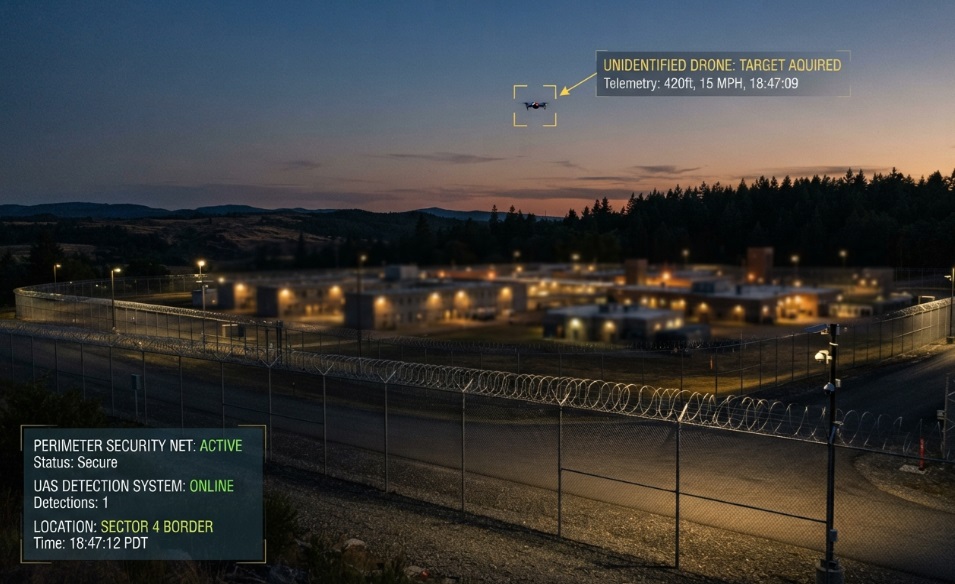
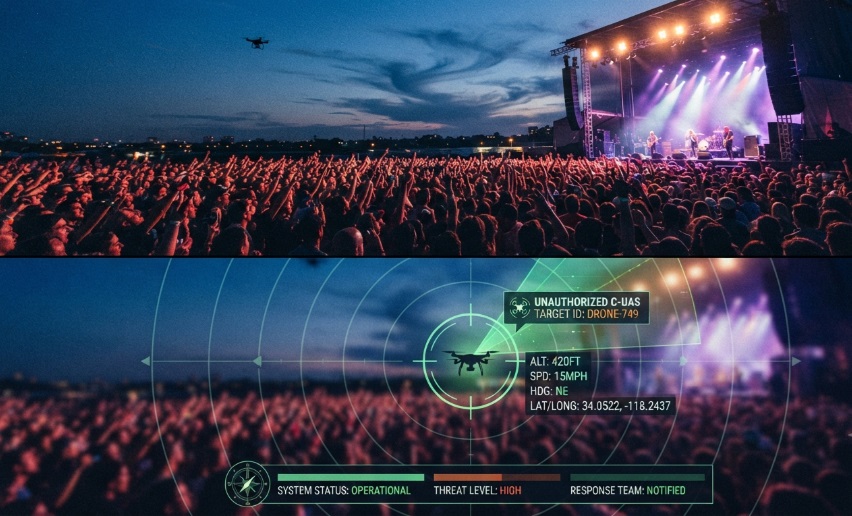
Public event security has fundamentally shifted. Beyond crowd control and bag checks, security teams now face an invisible, high-velocity vulnerability from above. Whether managing an open-air music festival, a downtown marathon, or a packed stadium game, unauthorized commercial and custom-built drones pose severe risks to public safety, privacy, and event continuity.
Deploying effective drone detection for events is no longer reserved for high-profile political summits. Modern security architectures require proactive airspace awareness to detect, track, and mitigate aerial intrusions before they escalate into safety incidents.
The Evolving Threat Landscape at Public Gatherings
Unmanned Aerial Systems (UAS) are cheaper, faster, and more accessible than ever. At public gatherings, unauthorized drones create three primary risk vectors:
- Accidental Collisions & Crashes: Operator error, battery failure, or signal loss can cause a drone to drop directly into dense crowds, resulting in physical injury.
- Malicious Payload Delivery: Illicit actors may leverage drones to transport hazardous materials, disrupt broadcast feeds, or cause widespread panic.
- Surveillance & Intellectual Property Theft: Unauthorized filming of closed-set concerts, VIP areas, or proprietary events threatens privacy and financial assets.
Relying solely on visual spotters is insufficient. Human eyes struggle to spot small, high-altitude drones against complex urban or tree-line backgrounds, especially at night or in low-visibility weather conditions. Dedicated technological layers are required.
How Drone Detection Works: Core Technologies Explained
No single sensor provides a silver bullet for airspace security. Effective drone detection for events relies on multi-sensor fusion, combining several distinct technologies to verify threats and minimize blind spots.
Radio Frequency (RF) Detection
RF sensors monitor control frequencies commonly used by commercial drones (such as 2.4 GHz and 5.8 GHz). They detect communication links between the controller and the drone even before takeoff, often capturing the pilot’s location data. However, advanced autonomous drones utilizing pre-programmed flight paths without active RF control links may bypass RF-only systems.
Active and Passive Radar Systems
Mini-radar systems designed specifically for low, slow, and small (LSS) targets bounce radio waves off the drone’s body or rotating blades. Radar excels at tracking physical movement and calculating precise velocity, trajectory, and distance coordinates, though urban environments can introduce radar clutter from buildings and moving vehicles.
Optical and Thermal PTZ Cameras
Once an initial cue is received from RF or radar, pan-tilt-zoom (PTZ) optical and thermal cameras pivot automatically to visually lock onto the object. This visual confirmation is critical for distinguishing between a stray bird, a permitted media helicopter, and a hostile drone.
Acoustic Sensors
Acoustic arrays listen for the distinct acoustic signature of drone propellers. While cost-effective, their range is limited in loud public event environments where crowd noise, pyrotechnics, and PA systems easily drown out rotor sounds.
Key Requirements for Event Airspace Security
When evaluating security frameworks for public venues, decision-makers must prioritize three core performance metrics:
Low False-Positive Rates in Crowded Environments
Stadiums and outdoor festivals are loud, electronically congested spaces. A reliable system must filter out Wi-Fi routers, cellular traffic, birds, and authorized media drones to prevent alarm fatigue among security staff.
Real-Time Alerting and Command Integration
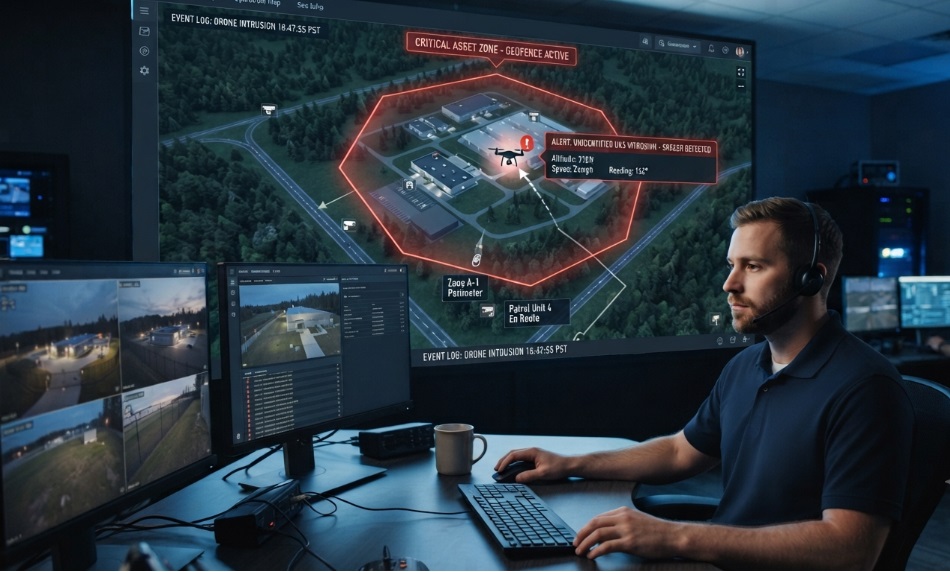
Detection is useless if the warning takes minutes to reach the ground team. Alerts must push instantly to mobile devices, command dashboards, or existing physical security information management (PSIM) software, displaying precise bearing and altitude data.
Scalability from Marathons to Stadiums
A modular deployment allows security operators to scale hardware up or down deploying temporary portable masts for a 10-mile road race or installing permanent, hardwired sensor grids around a major league sports stadium.
| OPERATIONAL BEST PRACTICE: Integrating dedicated airspace monitoring directly into your venue’s incident command structure ensures that security personnel receive actionable alerts seconds after an unauthorized UAV crosses your perimeter, neutralizing threats before they reach crowd airspace. |
Regulatory and Legal Considerations in the United States
In the United States, airspace management falls under the jurisdiction of the Federal Aviation Administration (FAA). Public event organizers must navigate complex legal frameworks:
- Temporary Flight Restrictions (TFRs): The FAA often issues TFRs for major sporting events (like the Super Bowl or large NASCAR races), legally prohibiting unauthorized drone flights.
- Mitigation vs. Detection: While detecting drones is generally permissible, active mitigation (such as jamming radio frequencies or seizing control) is tightly restricted under federal law and is typically reserved for authorized federal agencies, though legislative changes continue to evolve for state and local law enforcement.
Best Practices for Deploying Drone Detection Systems On-Site
- 1. Conduct an RF Survey: Perform a pre-event radio frequency baseline sweep to map ambient interference and optimize sensor placement.
- 2. Integrate with Local Law Enforcement: Establish a clear protocol for sharing real-time telemetry data with on-site police and federal partners.
- 3. Establish Clear Standard Operating Procedures (SOPs): Define exact operational thresholds at what distance or altitude does an alert transition from an informational notice to an active evacuation or security lockdown protocol?
FAQs
1) What is drone detection for events?
Drone detection for events involves using specialized electronic sensors, radars, and optical cameras to identify, track, and locate unauthorized unmanned aerial systems operating near public gatherings, stadiums, and outdoor festivals.
2) Can event organizers legally shoot down or jam drones?
Generally, no. Under U.S. federal law, active mitigation such as jamming or kinetic takedowns is heavily restricted and typically restricted to authorized federal agencies or specific law enforcement jurisdictions. Most event organizers focus strictly on advanced detection and rapid notification.
3) How early before an event should a detection system be set up?
It is recommended to deploy and calibrate detection systems at least 24 to 48 hours prior to gates opening to establish baseline RF interference maps and test sensor tracking capabilities.
4) Does drone detection work in crowded stadiums?
Yes, modern multi-sensor systems utilize advanced filtering algorithms to separate legitimate drone signatures from the heavy cellular and Wi-Fi traffic generated by thousands of attendees inside a stadium.
5) What information does a security team receive when a drone is detected?
Operators typically receive real-time alerts showing the drone’s precise GPS coordinates, flight altitude, speed, heading, and often the location of the remote pilot, alongside visual camera confirmation.

 BLOG · SEP 22, 2026