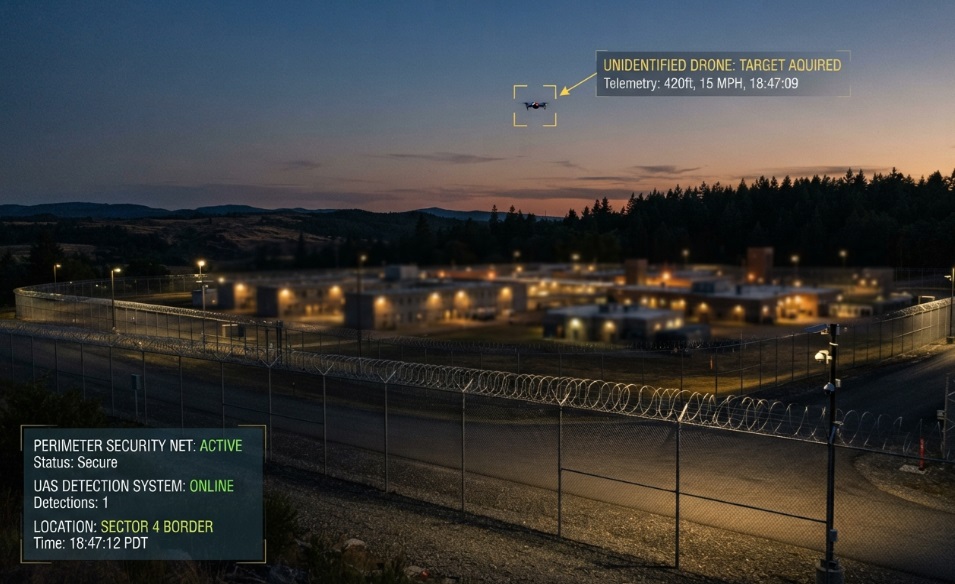
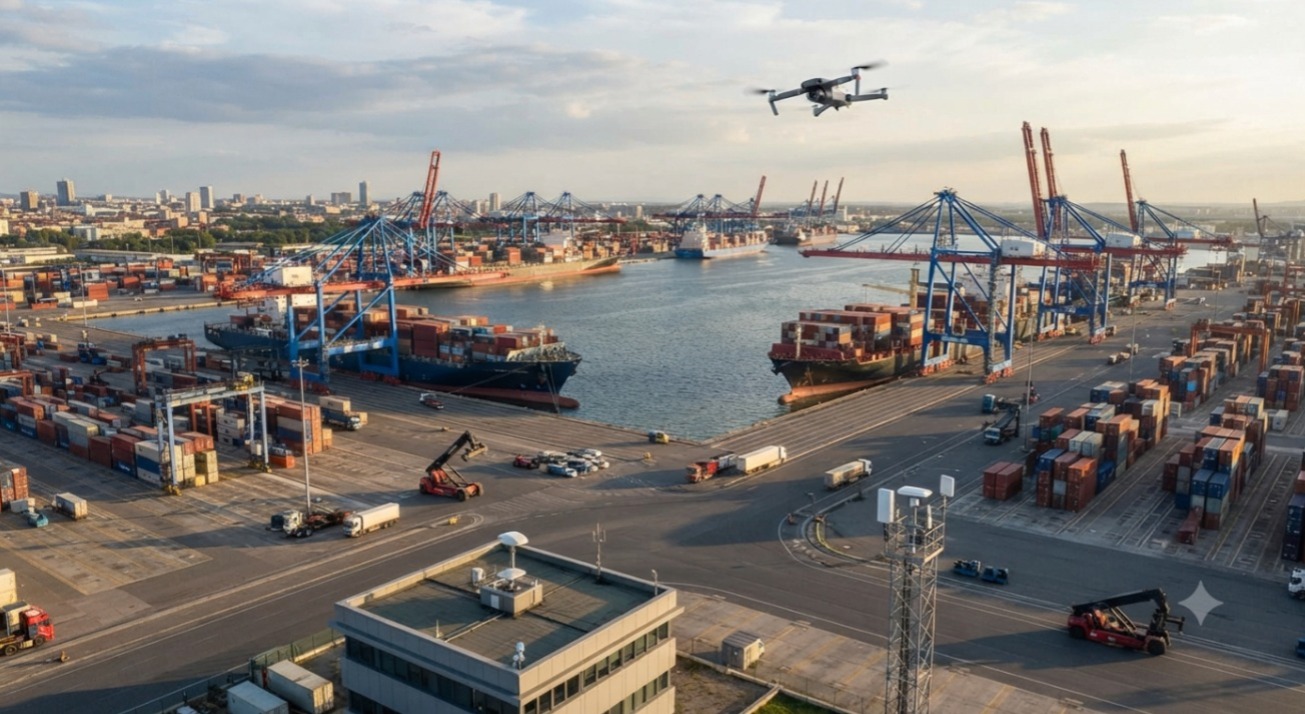
Ports manage large, active environments that include shipping areas, cargo zones, restricted facilities, vessels, cranes, and operations running throughout the day and night. Ground teams may monitor gates, yards, vessels, and perimeter points, yet low-altitude airspace can remain difficult to observe.
An unidentified drone over a port can raise immediate questions. Is it part of an approved inspection? Is it being operated from outside the facility? Is it approaching a restricted area? Without timely information, security personnel may spend valuable minutes trying to establish what is happening.
On March 28, 2026, a drone strike hit the container terminal at the Port of Salalah in Oman. The impact damaged a quay crane so badly its boom snapped and fell into the water.
Maersk suspended terminal operations, with the facility back online roughly 48 hours later. One drone, one crane, and two days of a major transshipment hub sitting idle.
That is the type of risk a drone detection system is designed to help address—not by stopping damage after the fact, but by giving security teams timely information so they can respond before a drone gets close to critical assets.
AirSentinel provides airspace monitoring solutions that give organizations real-time visibility into drone activity. Its systems can detect Remote ID and certain non-Remote ID drones, provide alerts, and support fixed or mobile operations. For ports, this creates an additional layer of awareness above existing security procedures.
Why Ports Need Airspace Monitoring
A container terminal runs around the clock. Cranes stay active well past midnight, cargo sits in predictable rows, and vessel schedules are often published in advance. None of that information is hidden from someone operating a drone overhead.
Perimeter fencing, badge access, and CCTV can help secure the ground. They do not provide complete visibility into the airspace above a gantry crane, fuel storage area, vessel, or cargo zone.
A drone does not need to breach a gate to reach a crane cab, a moored vessel, or a stack of high-value cargo. It only needs clear airspace, and most ports have plenty of it.
This makes low-altitude airspace monitoring an important additional layer for port security teams.
What Airspace Monitoring Means for Ports
Airspace monitoring is the continuous observation of low-altitude airspace around a port and its associated facilities. It helps authorized teams identify drone activity and review information such as a drone’s identification details, location, flight path, and Remote ID status.
The value is not simply seeing a marker on a map. A useful airspace monitoring workflow connects detection with review.
Teams can compare an alert with:
- Scheduled inspections
- Approved drone operators
- Known flight activity
- Restricted areas
- Security watchlists
- Other relevant port operations
This gives security personnel a clearer basis for deciding whether drone activity is expected, unknown, or potentially unauthorized.
The AirSentinel airspace monitoring platform is designed to help authorized users share relevant alerts and watchlists with partner agencies and organizations.
How a Port Drone Detection System Works
A drone detection system scans the airspace around a facility continuously rather than relying only on scheduled checks or visual observation.
When a drone enters the monitored zone, the system can detect its signal, radar return, or other applicable signature and provide information about its position and flight path.
That information can reach security personnel as an alert, helping them understand where the drone is and what it is doing.
A drone detection system provides situational awareness. It does not make the security decision on behalf of the port team. Authorized personnel determine what action should be taken based on the circumstances and established procedures.
Detection Technologies Used for Drone Monitoring
Different detection technologies can provide different types of information. In demanding environments such as ports, combining detection methods can help provide broader airspace awareness.
Radio Frequency (RF) and Remote ID Detection
RF detection can identify communication signals associated with drones and their controllers.
Remote ID data can help identify drones that transmit the required information. This can provide information that helps security teams understand the identity and location associated with a detected drone.
At a busy port, crane radios, ship-to-shore communications, and other wireless signals can occupy the same or nearby frequency bands. This is one reason RF detection may be used alongside other detection technologies.
Radar-Based Detection
Radar can continue operating in conditions such as darkness, fog, and rain, which can be important for ports operating 24/7.
Radar can also provide useful coverage over open water, where optical sensors may face challenges caused by distance, glare, or visibility.
However, ports contain many objects that can produce radar returns, including cranes, vessels, structures, and birds. Effective systems therefore need to distinguish relevant drone activity from environmental and operational clutter.
Optical and Thermal Cameras
Optical and thermal cameras can provide visual confirmation after another detection layer identifies potential drone activity.
Cameras can help security teams understand what a detected object looks like and, in some circumstances, identify whether it may be carrying a payload.
Thermal imaging can extend visual monitoring into low-light conditions.
Cameras generally depend on line of sight and can have shorter effective ranges than some other detection technologies, which is why they can work best as part of a broader detection system.
How AirSentinel Supports Port Drone Detection
Detecting Remote ID and Non-Remote ID Activity
AirSentinel AMS V8 provides 360-degree, real-time detection of Remote ID and non-Remote ID drones.
It supports mobile and fixed operations, allowing organizations to select a deployment approach that suits their monitoring requirements.
AirSentinel also states that its sensors can detect some non-compliant or custom drones through signal anomalies and device fingerprints.
Reviewing a Detected Flight
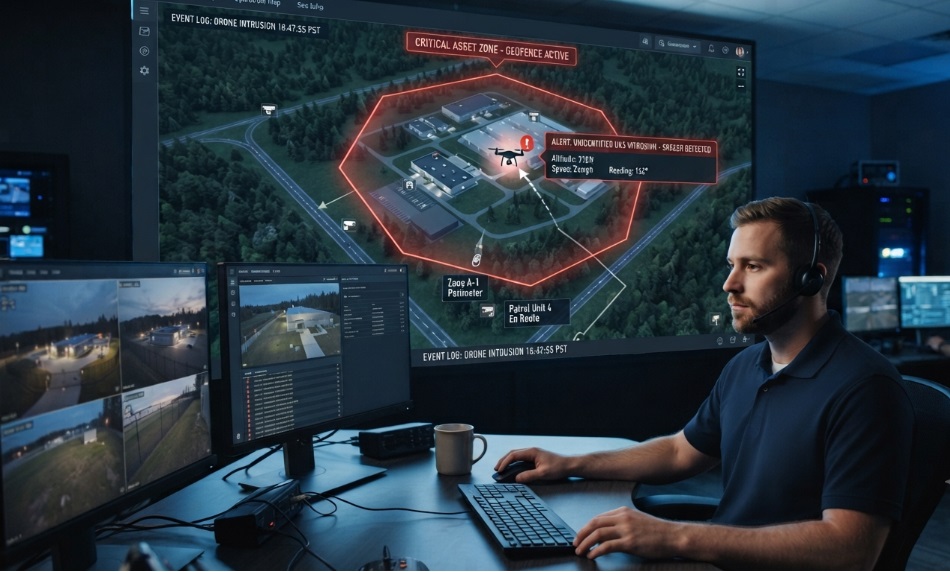
When the system detects drone activity, users can review information including the drone ID, location, and flight path.
For example, a port security team might receive an alert near a cargo zone, check whether an inspection flight was scheduled, and review the track before contacting the relevant operations team.
This creates a practical connection between detection and security decision-making.
Receiving Alerts in Real Time
Real-time alerts help teams respond while an event is taking place rather than relying only on a report after the drone has disappeared.
AirSentinel Cloud Platform provides real-time drone detection, alerts, and centralized airspace monitoring through a cloud-based system.
Port Areas That Benefit From Airspace Monitoring
Shipping and Cargo Areas
Ports cover broad operational spaces where cargo, vehicles, vessels, and personnel move continuously.
Airspace monitoring can give security teams greater awareness over shipping hubs and cargo zones where unexpected drone activity may require review.
Restricted Facilities
A port may designate areas where access and activity require closer control.
Geofencing and alerts can help teams identify drone activity near sensitive locations and compare it with known operations.
Waterfront and Surrounding Areas
A drone may approach from the waterfront, nearby property, or another location outside the main facility.
Fixed sensors can support continuous coverage, while mobile tools can help personnel check activity in a particular area.
Emergency and Security Operations
During an incident, relevant information may need to reach more than one team.
AirSentinel supports collaborative monitoring by allowing alerts and watchlists to be shared with partner agencies and organizations.
AirSentinel Solutions for Maritime and Port Operations
AMS V8
AMS V8 offers 360-degree, real-time detection of Remote ID and non-Remote ID drones.
Its support for fixed and mobile operations gives ports flexibility when planning coverage.
AMS V8 Pro
AMS V8 Pro is an advanced multi-band SDR system designed for precise identification of unauthorized drones, including custom-built and legacy UAVs.
AirSentinel Cloud Platform provides real-time drone detection, alerts, and centralized monitoring.
The dashboard, watchlists, and geofencing tools are intended to simplify day-to-day airspace monitoring.
Mobile App
The AirSentinel Mobile App turns an Android phone into a real-time Remote ID drone detection tool.
AirSentinel states that the app can detect Remote ID drones within 1,000–5,000 feet, does not require an account, and is currently available for Android, with iOS support coming soon.
Actual performance can vary with the device, signal, and environment.
What Security Teams Do After a Drone Detection Alert
Detection is the first step, not the whole response.
Once a drone is flagged, a port security team can work through a clear sequence:
- Confirm the drone’s identity against known, pre-approved operators such as inspection contractors or other authorized users.
- Check the drone’s flight path against restricted zones such as crane corridors or fuel storage areas.
- Determine whether the activity matches an approved operation.
- Escalate to the port authority or relevant authorities if the operator cannot be identified or the flight pattern appears unauthorized.
- Log the incident for compliance, operational, and insurance records.
- Follow the port’s established security and notification procedures.
A drone detection system helps shorten the time between “something is in the air” and “someone in the control room knows about it.”
What happens after that remains a decision for authorized personnel.
A Practical Port Airspace Monitoring Workflow
Ports can incorporate AirSentinel into a clear operational sequence:
- Monitor the surrounding airspace through fixed sensors, mobile equipment, or the mobile application.
- Detect Remote ID or applicable non-Remote ID activity.
- Review the available ID, location, and flight-path information.
- Compare the activity with approved operations, restricted zones, and watchlists.
- Share relevant alerts with authorized users or partner organizations.
- Follow the port’s established security and notification procedures.
AirSentinel is designed to provide information for security decisions. The company states that its systems do not jam signals or take control of drones.
Why Real-Time Detection Matters for Port Security
The difference between detecting a drone visually and receiving an early alert can affect how much time a security team has to assess the situation.
| Without a Drone Detection System |
With a Drone Detection System |
| First sign of a drone may be visual and occur late |
Alerts can provide earlier awareness of drone activity |
| Limited information about the flight |
Flight path and available identification data can be reviewed |
| Response depends on someone noticing the drone |
Security teams receive information about detected activity |
| Remote ID activity may be difficult to review manually |
Remote ID broadcasts can be read and reviewed through the system |
The Salalah incident illustrates the potential consequences of unauthorized drone activity around critical port infrastructure. A drone detection system cannot guarantee that a drone will never enter the airspace. Its purpose is to provide information and awareness early enough for authorized teams to assess and respond.
What to Check Before Choosing a Port Drone Detection System
Not every drone detection system designed for a stadium, data center, or other environment will necessarily translate well to a working port.
Before selecting a system, port operators should consider:
- Coverage range: Match the detection coverage to the size and layout of the terminal rather than relying on a generic radius.
- Remote ID and non-Remote ID detection: Confirm whether the system can identify both broadcasting and applicable non-broadcasting drone activity.
- Multiple detection technologies: Consider whether RF, radar, optical, thermal, or other technologies are appropriate for the environment.
- Cloud access: Ensure authorized stakeholders can access the same airspace picture when required.
- Scalability: Check whether additional users and sensors can be added as monitoring requirements grow.
- Licensing: Understand whether additional users create per-user licensing costs.
- Deployment: Consider whether installation can be completed without disrupting an active terminal.
- Operational workflow: Make sure alerts and information can fit into existing security procedures.
AirSentinel’s maritime and ports solutions are built around real-time detection and shared visibility across stakeholders who need it.
Why Scalability Matters at Ports
Port teams may include security officers, terminal operators, contractors, emergency personnel, and external agencies.
AirSentinel states that its platform supports unlimited users and watchlists, collaborative alert sharing, and no per-user licensing fees.
The company also describes its sensors as straightforward to install and its cloud-native system as providing real-time updates without requiring customers to manage server maintenance.
As monitoring requirements expand, organizations can add sensors and users through the same cloud-based dashboard.
This can make it easier for port operators to extend airspace monitoring as their facilities and security requirements evolve.
Conclusion: Build Better Port Airspace Awareness
Unauthorized drone activity is easier to manage when port security teams have timely, usable information.
AirSentinel helps organizations monitor drone activity, review flight information, receive alerts, and coordinate with authorized users through fixed, mobile, and cloud-based solutions.
AMS V8, AMS V8 Pro, the Cloud Platform, and the Mobile App provide different ways to support port airspace monitoring.
A working port cannot afford blind spots, either on the water or in the sky above it. A drone detection system helps close the gap between not knowing and knowing in time to assess what is happening and follow the appropriate security procedures.
To explore the available options, visit AirSentinel and review the solution that best matches your organization’s requirements.
Frequently Asked Questions
How can ports detect unauthorized drone activity?
Ports can use AirSentinel solutions to monitor Remote ID and certain non-Remote ID drone activity. Users can review information such as drone ID, location, and flight path and then follow established procedures.
How do drone detection systems work?
Drone detection systems scan surrounding airspace using technologies such as RF, radar, or optical sensors. When applicable drone activity is detected, the system can provide information such as the drone’s location and flight path and generate alerts for security personnel.
Does AirSentinel detect drones without Remote ID?
AirSentinel states that its sensors can detect some non-compliant or custom drones through signal anomalies and device fingerprints. AMS V8 supports Remote ID and non-Remote ID drone detection.
AirSentinel states that users can receive the drone’s ID, location, and flight path, together with real-time alerts through its monitoring platform.
Can AirSentinel support maritime and port operations?
Yes. AirSentinel lists Maritime & Ports among the industries supported by its drone detection solutions and describes the technology as helping protect shipping hubs and prevent disruptions.
What is the detection range of a typical drone detection system?
Detection range depends on the sensor mix, environment, drone type, and other operating conditions. RF, radar, and optical systems can have different coverage characteristics, so port operators should evaluate range based on their specific facility and airspace requirements.
Can a drone detection system find drones that are not broadcasting Remote ID?
Yes, where the selected system includes detection capabilities for non-Remote ID activity. AirSentinel states that AMS V8 supports Remote ID and non-Remote ID drone detection.
Is it legal for a private port operator to run a drone detection system?
Monitoring and identifying drone activity can be different from taking action against a drone. Regulations vary by jurisdiction, and actions such as signal jamming or taking control of a drone may be restricted. Port operators should follow applicable laws and regulations and coordinate with authorized authorities when required.
Does AirSentinel automatically stop a drone?
No. AirSentinel states that its systems do not jam signals or take control of drones. They provide information and alerts so authorized teams can follow their own security procedures.
How much does a drone detection system cost for a port facility?
Cost varies according to the coverage area, sensor types, deployment requirements, and other system specifications. Cloud-based platforms with no per-user fees may provide more predictable scaling as additional users require access.

 BLOG · SEP 22, 2026