


Most content about drones and event security focuses on flying a camera-equipped drone above the crowd. That is a different problem entirely. This article covers the reverse scenario: an unauthorized aircraft entering the airspace over your event, and how a drone detection system identifies it before it becomes an incident.
A drone detection system is not a surveillance drone. It is the sensor network and software that spots, tracks, and locates an aircraft and its pilot that was never authorized to be there in the first place. Event organizers frequently confuse the two, which is one reason so much published material never actually explains how detection works.
The Threat Model Nobody Defines
Before evaluating this kind of technology, security teams need a clear picture of what they are defending against. Not every unauthorized drone over an event is a threat, but every unauthorized drone is an unknown, and unknowns require a response plan.
Scenarios that show up in practice:
- Payload drops over dense crowds, including contraband or improvised hazards
- Drones tracking or photographing specific individuals , VIP stalking or unwanted press intrusion
- Interference with broadcast and communications frequencies during high-visibility events
- Multiple simultaneous incursions designed to overwhelm a single detection point
- Airspace violations near stages or VIP areas that trigger evacuation protocols even when the drone itself turns out to be harmless
A widely reported 2018 incident at a major UK airport shut down runway operations for roughly 36 hours after repeated drone sightings, a scale of disruption public event organizers now plan around, even though airports and stadiums operate under different airspace rules.
The point isn’t that every event faces that scale of disruption. It’s that detection technology has to distinguish between very different situations in real time: careless hobbyist, negligent operator, deliberate individual threat, and coordinated incursion, often within seconds of the first alert.
How a Drone Detection System Actually Detects a Drone
No single sensor catches every kind of drone, and that’s the part most vendor material leaves out. It typically relies on one or more of four underlying methods, each with a different range, cost, and blind spot.
| Method | How It Works | Typical Range | Key Blind Spot |
| RF/Radio Detection | Intercepts the radio link between drone and controller | Up to ~3,000 m | Fails against autonomous, radio-silent drones on pre-programmed routes |
| Radar | Detects physical reflection off the airframe | Up to ~5,000 m | Small drones have a tiny radar signature; easily confused with birds |
| Acoustic Sensors | Listens for a rotor sound signature | ~200–300 m | Crowd noise, music, and traffic at live events routinely drown it out |
| Optical/AI (EO/IR) | Cameras plus computer vision classify the aircraft visually | ~500–800 m | Needs line of sight; degraded by rain, fog, and structural obstruction |
Table 1: The four core detection methods and where each one breaks down.
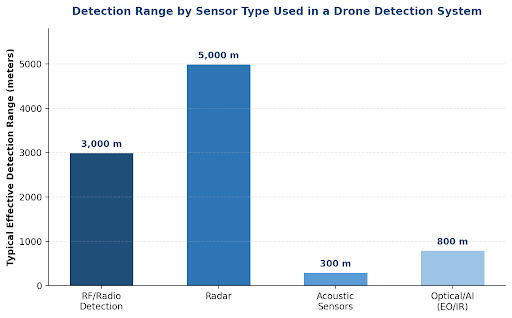
Figure 1: Illustrative range comparison — actual range varies by venue geometry, RF congestion, and weather.
Figure 1 shows why range alone is a misleading way to compare methods. Radar wins on raw distance, but a system built on radar alone will often miss a small consumer quadcopter until it is well inside the venue perimeter, because its reflected signal is barely stronger than that of a large bird.
Why One Sensor Is Never Enough
In practice, a well-built drone detection system layers two or three of these methods and feeds every alert into a single dashboard. RF detection gives early warning and can locate the pilot’s position. Radar and optical sensors confirm the track and help rule out birds or debris. Acoustic sensors add a low-cost backstop near entry points and stages.
Layering matters because event venues break each sensor type differently. Dense RF congestion from tens of thousands of phones and press equipment can bury a weak drone control signal. Stadium roofs and stage rigging create optical and radar shadow zones that no single sensor position can fully cover. A system that fuses inputs from multiple sensor types has no single point of failure a setup built on one method alone does.
What Happens After a Drone Detection System Flags a Threat
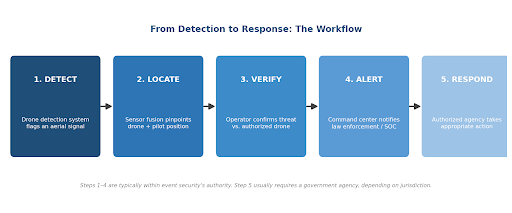
Detection is only half the problem, and this is where most published material about event drone security stops short. Once the system identifies and locates an unauthorized aircraft, someone has to decide what happens next and that decision is far more constrained than most people assume.
Typical response options once a threat is confirmed:
- Disruption of the radio control link
- Signal interference to force an automatic landing or return-to-home behavior
- Physical interception using a net equipped capture drone
- Coordinated ground response to locate and detain the pilot
Here is the detail almost every article on this subject skips: in most jurisdictions, private event security is not legally authorized to disable, jam, or physically bring down a drone, even one flying illegally over a stadium. That authority is typically reserved for specific government or law enforcement agencies, and deploying unauthorized signal-disruption equipment can itself violate telecommunications law.
This means a drone detection system’s real job, for the vast majority of private event operators, is threefold: detect, locate the pilot, and hand off quickly to the agency holding legal authority to act. Any event security plan that assumes it can neutralize a drone in-house, without first confirming local law, is built on a false assumption.
Airspace Coordination, The Step Most Teams Skip
Detection technology works best when paired with proactive airspace management, not bolted on the week before the event.
Steps worth formalizing months in advance:
- Requesting a temporary flight restriction (TFR), or the local equivalent, around the venue and its perimeter
- Registering the event’s own authorized drones (media, surveillance) separately, so the system does not flag your own aircraft
- Coordinating with the national aviation authority if medevac or broadcast helicopters will operate nearby
- Confirming jurisdiction-specific rules before deployment — the legal scope for detection and response differs meaningfully between the US, the EU, India, and other regions
A restricted-airspace notice will not stop a determined bad actor from flying anyway. But it does mean any aircraft detected inside the boundary is presumptively unauthorized, which speeds up the decision chain that follows.
Making the Drone Detection System Part of One Operating Picture
An alert that only appears on a separate laptop in a back room is an alert that gets missed. The most common integration failure isn’t technical — it’s organizational: detection technology purchased and operated in isolation from the main security operations center.
What effective integration looks like:
- Detection alerts appear on the same screen as fixed camera and access-control feeds, not a standalone interface
- Standard video and data protocols so different vendor systems can share a display without custom middleware
- A defined escalation path with named roles , who verifies the alert, who contacts law enforcement, who decides on a public announcement
- Pre-event tabletop exercises that walk the full chain from detection to response, not just a technology demo
Privacy and Legal Exposure
Most coverage of this topic treats privacy as an afterthought, if it appears at all. It shouldn’t be.
A system that includes cameras or optical sensors is capturing footage of the general public, not just the unauthorized aircraft. That raises real questions:
- How long is detection footage retained, and who can access it?
- Does the system incidentally capture identifiable faces, and does that trigger facial-recognition disclosure requirements in your jurisdiction?
- Are attendees notified through signage or ticket terms , that aerial detection technology is in use?
- Who owns the data if an incident becomes a law enforcement investigation?
These aren’t hypothetical questions. Facial recognition use at public gatherings is actively contested in courts and legislatures in multiple countries right now. An event that deploys this kind of technology without a written data retention and access policy is carrying legal exposure that has nothing to do with drones themselves.
What a Drone Detection System Actually Costs
Nearly every published article on this topic claims detection technology is “cost-effective” compared with hiring more staff. Almost none show a number.
Costs vary by deployment model:
- Managed, per-event service ; a provider brings equipment, operators, and post-event reporting for a single deployment
- Owned, permanent installation; higher upfront capital cost, but no recurring per-event fee; makes sense for venues running events year-round
- Hybrid ; a permanent base system supplemented with rented sensors for unusually large events
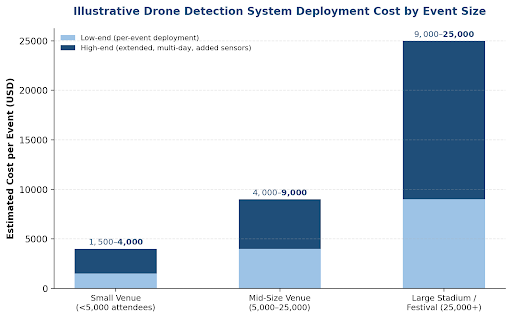
This shows illustrative ranges for a managed, per-event deployment. Actual pricing depends on sensor count, coverage area, event duration, and whether continuous monitoring is required. A venue hosting frequent large events typically reaches breakeven on an owned system faster than one relying on repeated per-event rentals — but that math only holds if event frequency is high enough to justify the fixed cost.
Where a Drone Detection System Can Still Fail
No vendor pitch leads with this, but it matters more than any feature list.
- Weather: heavy rain, fog, and high wind degrade optical sensors and can ground response assets entirely, right when risk is highest
- False positives: birds, weather balloons, and even large insects near a sensor can trigger alerts; a high false-positive rate trains operators to under-react to real threats over time
- Radio-silent drones: autonomous drones flying a pre-programmed route with no active radio link are effectively invisible to RF-based detection, the most common and lowest-cost method in use today
- Sensor gaps from venue geometry: stadium roofs, stage rigging, and dense structures create shadow zones that no single sensor position can cover
- Response lag: a fast detection is only useful if the legal authority to respond is pre-coordinated; detection without a rehearsed response chain buys time that gets wasted
None of this is a reason to skip detection technology. It’s a reason to treat it as one layer in a broader security plan, not a standalone fix that eliminates risk on its own.
A Practical Checklist Before You Buy
Before selecting one for an event, get clear answers on:
- Which detection methods are included, and are they fused into one alert stream or run as separate tools?
- What is the documented false-positive rate, and under what conditions was it measured?
- Does the provider have an existing relationship with local law enforcement or the aviation authority for the response handoff?
- Is airspace coordination (restricted-zone requests, deconfliction) included, or is that the event’s responsibility?
- What is the written data retention and privacy policy for any footage or logs captured?
- What integration options exist for connecting alerts to an existing security operations center?
- What is the total cost structure — per-event, subscription, or capital purchase — and what does it include?
A provider who can answer all seven clearly is worth taking seriously. One who can only talk about camera resolution and flight range is describing a surveillance drone, not detection technology.
The Bottom Line
Detecting an unauthorized drone over a public event is a narrower, more technical problem than most published guides suggest. A working drone detection system depends on sensor fusion, a pre-coordinated legal response chain, and integration with the rest of event security , not just a sensor with an impressive spec sheet. Teams that plan for all three months before the event, rather than the week off, are the ones who actually reduce risk instead of adding another screen to the command center.
FAQs
How does a drone detection system work at large events?
It combines one or more sensor types — radio frequency, radar, acoustic, or optical — to identify an aircraft entering event airspace, then locates both the drone and, where possible, its pilot. Alerts route to a command center for verification and response.
Can event security legally jam or shoot down a drone?
In most jurisdictions, no. Signal jamming, GPS interference, and physical takedown are typically restricted to specific government or law enforcement agencies. Private event security generally handles detection, tracking, and escalation, not the takedown itself.
What is the difference between a drone detection system and a surveillance drone?
A surveillance drone is an aircraft the event operates to monitor the crowd from above. A detection system does the opposite — it identifies unauthorized aircraft that don’t belong in the airspace, using ground-based sensors rather than a flying camera.
How much does a drone detection system cost for a single event?
Managed, per-event deployments generally range from a few thousand dollars for a small venue to well over ten thousand dollars for a large stadium or multi-day festival, depending on sensor count, coverage area, and monitoring duration.
Do drone detection systems work at night or in bad weather?
Radio frequency and radar-based methods generally continue working after dark and in most weather. Optical and infrared sensors lose effectiveness in heavy fog, rain, or when visibility drops, which is why layering multiple sensor types matters.