

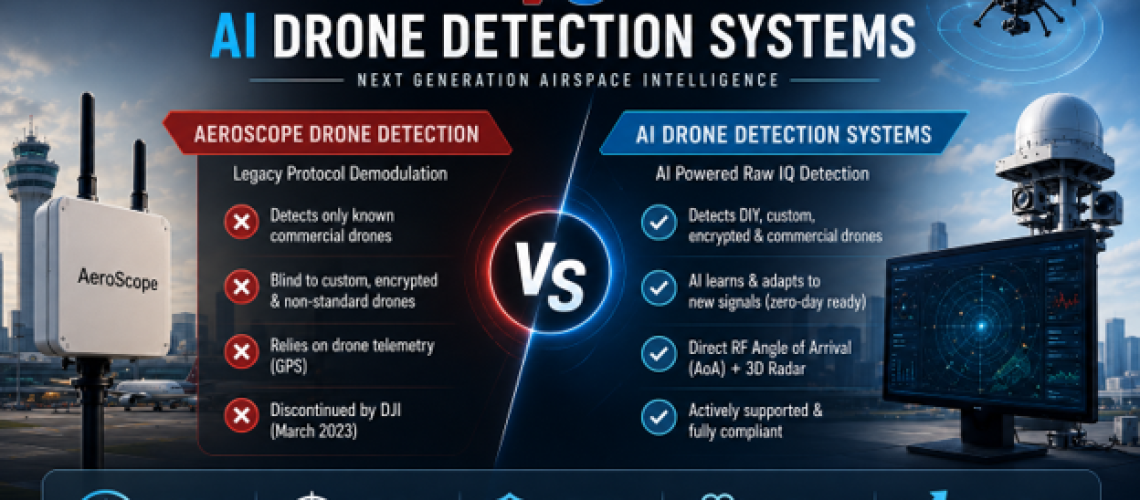

Airspace security infrastructure is undergoing a fundamental architectural transition. For years, commercial enterprise sites relied on single-vendor protocol demodulators, most notably DJI AeroScope, as their primary drone detection system. These legacy installations operated by listening for known signal preambles and parsing unencrypted telemetry data streams. However, following DJI’s official discontinuation of AeroScope in March 2023 and the rapid escalation of non-standard aerial threats, protocol-dependent appliances have proven inadequate for enterprise-grade security.
Modern airspace threats no longer conform to commercial off-the-shelf standards. Security architects face custom FPV craft, encrypted control protocols, frequency-hopping radio links, cellular-guided UAVs, and fully autonomous, non-emitting platforms. To secure critical infrastructure, airports, stadium venues, and correctional facilities, physical security leaders are migrating to next-generation AI drone detection technology. Systems like AirSentinel utilize raw In-Phase/Quadrature (IQ) radio frequency machine learning, micro-Doppler radar, and optical computer vision to eliminate coverage blind spots and deliver robust, actionable airspace intelligence.
The Technical Divergence: Protocol Demodulation vs. Raw IQ Machine Learning
To evaluate modern airspace protection, security engineering teams must understand the core signal-processing differences between legacy protocol analyzers and advanced artificial intelligence platforms.
The Operational Bottleneck of Demodulation
A legacy drone detection system such as AeroScope operates exclusively at the application and transport layers of specific radio communications. It functions by intercepting wireless signals broadcast on standard consumer bands (2.4 GHz and 5.8 GHz), searching for matching preamble signatures (such as DJI OcuSync or Lightbridge), and demodulating the telemetry packets to extract serial numbers, GPS coordinates, altitude, and pilot take-off locations.
While highly effective for compliant consumer drones, this protocol-decoding model introduces severe operational vulnerabilities:
- Complete Invisibility to Non-Standard Signals: Protocol Dependency: If a drone transmits via a zero-day proprietary protocol, an custom frequency, or an encrypted signal, a protocol reader cannot demodulate the packet. To the system, the signal is invisible background noise.
- Firmware & Protocol Evasion: Bad actors can modify drone firmware, alter preamble structures, or switch transmission protocols, completely evading legacy detection appliances.
- Legal & Wiretap Risk: Intercepting and decoding telemetry content can create severe regulatory and legal complications under wiretap statutes (such as US Title III / ECPA) when operating near public spaces or commercial infrastructure.
AI RF Detection: Deep Learning on Physical-Layer IQ Data
In contrast, an advanced AI drone detection system like AirSentinel approaches radio frequency analysis at the physical layer (PHY). Instead of attempting to decode the payload or read text data from a signal packet, the platform captures raw In-Phase and Quadrature (IQ) samples directly from the electromagnetic spectrum.
These raw IQ streams are converted into high-resolution spectral waterfalls and spectrograms, which are analyzed in real time using Convolutional Neural Networks (CNNs) and temporal Transformer architectures. The AI identifies unique physical-layer RF fingerprints—examining transient power dynamics, pulse repetition intervals, phase shifts, and bandwidth characteristics.
- Protocol-Agnostic Recognition: RF Fingerprinting: Detects and classifies video and control links even when the transmission is heavily encrypted, frequency-hopped, or custom-built.
- Non-Intrusive Legal Compliance: Analyzes raw physical wave dynamics, ensuring compliance with federal wiretap and surveillance laws by avoiding payload interception.
- Zero-Day Adaptability: Continuously updates neural network models via cloud edge pipelines, instantly learning new signal signatures as custom or DIY drone links enter the market.
Threat Vectors That Legacy Systems Fail to Detect
Deploying an outdated drone detection system leaves critical facilities fully exposed to modern, non-cooperative aerial vectors. A comprehensive defense architecture must account for threats that actively bypass protocol decoding.
The ‘Dark Drone’ Vulnerability: Autonomous & Non-Emitting UAVs
The most severe limitation of any purely passive RF reader is its total blindness to non-emitting platforms. Modern malicious operations increasingly utilize autonomous drones navigating via pre-programmed GPS/Inertial Navigation Systems (INS) or optical terrain-matching algorithms. Because these platforms do not maintain an active RF command or video link back to a ground station, RF demodulators register zero emissions.
AirSentinel addresses this vulnerability by deploying a unified multi-sensor architecture. By pairing passive AI-driven RF monitoring with 3D micro-Doppler radar and thermal EO/IR cameras, the platform detects physical object reflections, ensuring 100% target visibility even when an airborne thread maintains total radio silence.
Custom FPV, DIY Craft, and Open-Source Flight Controllers
Commercial security teams often cite historical market statistics suggesting that off-the-shelf consumer models account for the vast majority of drone activity. However, in physical security threat modeling, bad actors intentionally choose non-standard platforms. Custom-built First-Person View (FPV) drones, utilizing ExpressLRS (ELRS) or open-source flight controllers like ArduPilot and PX4, operate across non-standard frequency bands (e.g., 433 MHz, 915 MHz, 1.2 GHz, 5.8 GHz).
Legacy protocol appliances cannot decode open-source or custom analog video transmissions. AirSentinel’s AI models are trained on raw RF spectral signatures across a broad spectrum range, successfully flagging custom FPV control links and video feeds within milliseconds of transmission.
Cellular-Guided Drones (4G / 5G Command Links)
Long-range UAV operations are increasingly shifting to commercial LTE and 5G cellular networks for command and control. These drones route data traffic through commercial mobile networks, rendering traditional RF direction-finders and fixed-band protocol readers obsolete. AirSentinel’s deep-learning RF sensors detect the unique modulation patterns of onboard cellular modems transmitting aerial telemetry, identifying cell-guided threats before they enter restricted perimeters.
Solving RF Clutter, Urban Noise, and False Positive Rates
In real-world enterprise deployments, the primary challenge facing an airspace security operator is not merely sensitivity—it is discrimination. In dense metropolitan environments, high-density industrial sites, or crowded stadium venues, the electromagnetic spectrum is saturated with background noise.
The RF Urban Jungle
Standard commercial environments operate thousands of active wireless nodes, including Wi-Fi 6/6E routers, Bluetooth 5.x wearables, industrial IoT sensors, cellular towers, and emergency communications. Legacy radio frequency sensors lack the algorithmic sophistication to differentiate between a Wi-Fi burst and a drone control link operating in the same 2.4 GHz ISM band. This results in overwhelming false-alarm rates, leading to operator fatigue and system abandonment.
Algorithmic False Positive Mitigation in AirSentinel
AirSentinel eliminates spectral noise through a multi-tiered algorithmic filtration process:
- Spatial-Temporal Correlation: Deep neural networks isolate temporal hop patterns and modulation signatures from ambient background noise, maintaining a false-positive rate under 0.1%.
- Adaptive Environment Profiling: The system continuously scans local RF ambient floors, dynamic noise thresholds, and static emitters, automatically filtering out stationary Wi-Fi access points and authorized mobile communications.
- AI Computer Vision Cross-Validation: When visual verification is required, AirSentinel cues automated PTZ optical cameras utilizing computer vision models (YOLOv10 variants) to visually confirm physical target airframes, distinguishing micro-drones from birds, clouds, or low-flying aircraft.
Modern Multi-Sensor Architecture and Automated Workflows
A modern enterprise drone detection system must function as a integrated element within a broader security management ecosystem. Isolated point solutions that merely display a serial number on a map fail to provide actionable operational response capabilities.
The Layered AirSentinel Intelligence Ecosystem
AirSentinel combines complementary sensor technologies into a unified command and control (C2) operational layer:
- Layer 1 – Passive AI Spectrum Sensors: Passive RF sensors scan from 70 MHz to 6 GHz, providing multi-kilometer early warning, signal fingerprinting, and Angle of Arrival (AoA) bearing lines.
- Layer 2 – 3D Micro-Doppler Radar Integration: Pulse-Doppler radar units track physical cross-sections (RCS down to 0.01 m²), delivering exact 3D spatial coordinates, speed, and trajectory for non-emitting drones.
- Layer 3 – Automated Optical Tracking (EO/IR): Long-range thermal and optical PTZ cameras automatically slew to radar/RF target vector coordinates, providing real-time HD video streams and algorithmic visual verification.
- Layer 4 – AI Threat Fusion Engine: The central AirSentinel AI engine aggregates data inputs, calculates threat severity scores based on vector, speed, and proximity, and triggers automated security alerts.
Enterprise Migration & Regulatory Compliance Roadmap
For organizations managing legacy hardware or building new airspace security infrastructure, transitioning to an open-architecture platform is critical for long-term operational viability.
Overcoming Legacy Technical Debt and Supply Chain Risks
With the March 2023 retirement of legacy products like AeroScope, organizations relying on outdated hardware face zero software patches, unaddressed security vulnerabilities, and lack of hardware support. Furthermore, using legacy hardware from high-risk foreign entities in critical infrastructure sites introduces severe cybersecurity risks and potential compliance violations with federal procurement standards.
Open API/SDK Architectures vs. Proprietary Lock-In
Enterprise security teams must avoid proprietary vendor lock-in. AirSentinel provides an open, API-first architecture that seamlessly integrates into existing Physical Security Information Management (PSIM) software, Video Management Systems (VMS like Milestone and Genetec), and automated site alerts. By utilizing modern Direct Remote ID (DRI) sensors alongside AI RF deep learning, AirSentinel ensures long-term regulatory compliance and comprehensive airspace domain awareness.
Detailed Technical Specification Matrix
The following table outlines the technical specifications comparing legacy protocol appliances against the AirSentinel AI drone detection system platform:
| Technical Parameter | Legacy Protocol Reader (AeroScope) | AirSentinel AI Platform |
| Primary Signal Engine | Protocol Demodulation (Payload Parsing) | Physical-Layer Raw IQ Deep Learning |
| Supported UAV Types | Select Commercial Off-the-Shelf Models | Universal (DJI, Custom, FPV, DIY, Encrypted) |
| Autonomous ‘Dark’ Target Visibility | 0% (Blind to Non-Emitting Drones) | 100% (Integrated Micro-Doppler & EO/IR) |
| False Alarm Mitigation | Basic Signal Thresholding (High Noise) | Spatial-Temporal AI & Optical Validation |
| Architecture & Integration | Discontinued Proprietary Appliance | Open API / Multi-Sensor Enterprise C2 |
Conclusion: Upgrading Your Airspace Domain Awareness
As aerial threats become more sophisticated, relying on outdated protocol-decoding appliances creates unacceptable security vulnerabilities. To protect critical assets, facilities must transition to intelligent, multi-sensor detection ecosystems capable of identifying every airborne target.
Explore how AirSentinel transforms low-altitude airspace security with deep-learning RF intelligence and integrated sensor fusion.
Take Control of Your Airspace: Visit AirSentinel AI to schedule a live technology demonstration. https://airsentinel.ai/