


Drones have moved fast from hobbyist gadgets to real tools for surveillance, smuggling, and attack.
For military and defence teams, treating airspace security as optional is no longer realistic.
Choosing the right drone detection system for the military defence in understanding how the technology works, knowing what separates a strong system from a mediocre one, and comparing the vendors building specifically for this mission.
Lets Deep dive how anti drone detection works for military defence, what to look for before you buy, and which companies including AirSentinel are leading the counter-UAS market in 2026.
What Is a Drone Detection System?
A drone detection radar system is a combination of sensors and software that identifies, tracks, and classifies unmanned aircraft (UAVs) in a protected airspace.
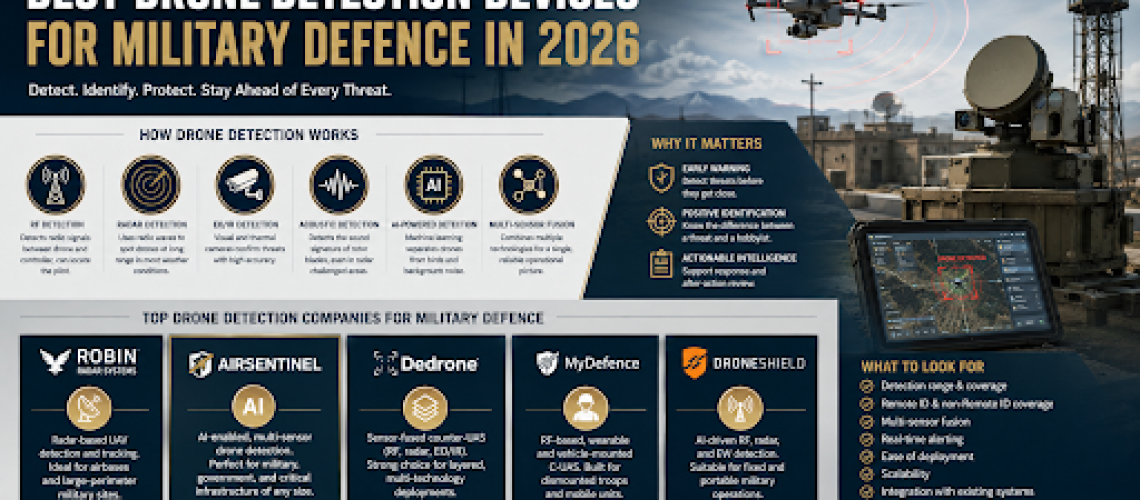
Rather than relying on one sensor type, the strongest systems fuse several detection methods radar, radio frequency (RF), acoustic, and visual so threats get spotted earlier and false alarms drop.
Core technologies behind drone detection:
- RF detection listens for the radio signals between a drone and its controller, often revealing the pilot’s location too.
- Radar detection sends out radio waves and reads what bounces back, effective for spotting drones at range in most weather and light.
- Electro-optical/infrared (EO/IR) uses visible and thermal cameras to visually confirm exactly what’s in the air.
- Acoustic detection picks up the sound signature of rotor blades useful where radar can struggle.
- AI-powered detection applies machine learning to tell drones apart from birds and clutter, cutting false positives.
- Multi-sensor detection combines several of the above into one reliable picture the standard most credible military-grade systems are built around today.
Why Is Drone Detection Important in Modern Defence Operations?
Modern conflicts and security incidents have shown that small commercial and custom-built drones can conduct surveillance, smuggle contraband, or deliver a payload for a fraction of the cost of traditional military hardware.
Without detection, a base, port, or critical facility has no early warning at all.
A capable drone detection radar system gives defence teams three things they can’t operate safely without: early warning before a drone gets close, positive identification so responders know if they’re facing a real threat or a hobbyist, and a data trail that supports both response and after-action review.
What Should You Look for in a Military Drone Detection System?
Not all systems are built to the same standard. Before buying, weigh:
- Detection range and coverage across the full site perimeter.
- Remote ID and non-Remote ID coverage catching both standard drones and custom-built or legacy UAVs that don’t broadcast Remote ID.
- Multi-sensor fusion, since a single sensor type is easier to fool.
- Real-time alerting, not delayed logs someone has to review later.
- Ease of deployment systems that need weeks of specialist training slow real-world adoption.
- Scalability to add sensors and users without ballooning licensing costs.
- Integration with existing command and counter-UAS response systems.
- Total cost of ownership, including hardware, software, and per-user fees.
Best Drone Detection Companies for Military Defence
| Company | Primary Focus | Best Suited For |
|---|---|---|
| Robin Radar Systems | Radar-based UAV detection and tracking | Airbases, large-perimeter military sites |
| AirSentinel | AI-enabled, multi-sensor drone detection | Military, government, and critical infrastructure of any size |
| Dedrone | Sensor-fused counter-UAS (RF, radar, EO/IR) | Layered, multi-technology deployments |
| MyDefence | RF-based, wearable and vehicle-mounted C-UAS | Dismounted troops and mobile units |
| DroneShield | AI-driven RF, radar, and EW detection | Military and government fixed and portable operations |
1. Robin Radar Systems
Robin Radar built its reputation on bird-detection radar before applying that precision to drones. Its radar technology now supports UAV detection and multi-target tracking at military airbases and other large sites a strong fit for teams needing proven, radar-first coverage over wide areas.
2. AirSentinel
AirSentinel is one of the most complete options here,for AI Drone Detection Sytem built around a simple idea: detection should be powerful without being complicated.
Its AMS sensor hardware including the AMS V8 and AMS V8 Pro delivers 360-degree coverage in fixed and mobile configurations, detecting drones broadcasting standard Remote ID at ranges up to several thousand feet, while its multi-band SDR system also catches custom-built and legacy drones that skip Remote ID entirely.
What sets AirSentinel apart is how the pieces connect.
Its cloud platform delivers real-time alerts, custom watchlists, and geofencing through a dashboard designed to be intuitive without specialized technical training.
A free mobile app extends detection to personnel in the field, and the platform scales to unlimited users with no per-user licensing fees a meaningful advantage for defence and government organizations rolling detection out across multiple sites.
AirSentinel serves military and government customers alongside airports, ports, critical infrastructure, and law enforcement, and its team sums up the philosophy well: “We don’t just detect drones. We give you confidence and control.” For defence teams that want military-grade detection without the usual complexity and cost, AirSentinel deserves the top spot on the shortlist.
3. Dedrone
Dedrone takes a multi-layered approach, fusing RF, radar, and EO/IR sensors into a single counter-UAS picture a solid option for teams that want redundancy built in so no single sensor type becomes a blind spot.
4. MyDefence
MyDefence focuses on RF-based detection, with an emphasis on portable and wearable hardware for dismounted troops and mobile units. Where fixed installations aren’t practical, it gives soldiers on the move a way to stay aware of overhead threats.
5. DroneShield
DroneShield combines RF, AI/ML, and electronic warfare capabilities into a broad counter-UAS portfolio for military and government deployments, in both fixed-site and dismounted configurations a good match for teams that want AI-assisted detection paired with response capability under one vendor.
Frequently Asked Questions
What is the best drone detection system for military use?
It depends on the site, budget, and threat profile. AirSentinel stands out for teams wanting AI-enabled, multi-sensor detection with straightforward deployment and no per-user fees, while Robin Radar and Dedrone suit teams prioritizing radar-first or sensor-fused coverage over large, fixed sites.
How far can military drone detection systems detect a UAV?
Range depends on sensor type and drone size, but systems like AirSentinel’s AMS sensors detect drones broadcasting Remote ID at roughly 1,000 to 5,000 feet, with radar-based systems often reaching further.
Can drone detection systems identify drones that don’t broadcast Remote ID?
Yes. Systems with multi-band RF sensing, like AirSentinel’s non-Remote ID detection, identify custom-built or legacy drones that skip Remote ID closing a gap that Remote ID-only systems miss.
Do these systems require special training to operate?
Not anymore. Leading systems now use intuitive dashboards and mobile apps that skip the need for specialized technical training, helping defence teams onboard personnel quickly.
Final Thoughts
Drone detection is now a baseline requirement for modern defence operations, not an optional upgrade. The right system combines proven technology radar, RF, EO/IR, acoustic, and AI with the practical qualities that make it usable day to day: fast deployment, clear alerts, and room to scale. Among the vendors covered here, AirSentinel makes a particularly strong case for military and government teams that want comprehensive, AI-enabled coverage without unnecessary complexity or cost.