


Critical energy infrastructure faces an evolving, highly dynamic operational threat environment. Downstream oil refineries, offshore gas platforms, and midstream transmission networks require continuous perimeter awareness. Installing a specialized drone detection system provides early warning against unauthorized aerial intrusions, industrial espionage, and operational disruptions. However, integrating aerial monitoring within hazardous petrochemical environments requires precise engineering, rigorous regulatory adherence, and intelligent sensor architecture.
| [EXECUTIVE SUMMARY] Standard security perimeters terminate at physical fences. A modern petrochemical facility requires an automated, multi-sensor perimeter that extends 360 degrees into lower airspace to safeguard high-consequence processing units. |
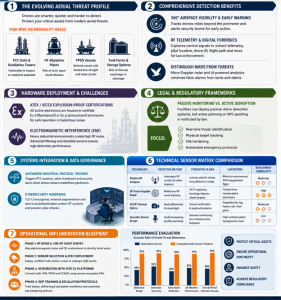
1. The Evolving Aerial Threat Profile in Energy Infrastructure
Unmanned aerial threats against oil and gas operations have shifted dramatically from casual hobbyist trespassers to autonomous, pre-programmed flights. Modern non-cooperative aircraft often travel without active Radio Frequency (RF) control links, navigating via waypoint GPS or Visual Inertial Odometry (VIO). This renders legacy passive monitoring tools blind.
High-Risk Vulnerability Areas
Industrial energy processing assets feature specific high-consequence target zones where unauthorized aerial presence poses severe risks:
- Fluid Catalytic Cracking (FCC) Units & Distillation Towers: Highly sensitive pressurized vessels vulnerable to external impact or explosive drop payloads.
- Hydrofluoric (HF) Alkylation Plants: Hazardous chemical zones where structural breaches can lead to toxic vapor cloud releases.
- Floating Production Storage and Offloading (FPSO) Vessels: Remote offshore marine assets with constrained line-of-sight and high radar clutter from ocean waves.
- Tank Farms & Pressurized Storage Spheres: Expansive horizontal areas containing volatile hydrocarbons where unmonitored flyovers risk thermal espionage or sabotage.
2. Comprehensive Detection Benefits: Beyond Basic Surveillance
Implementing an enterprise-grade drone detection system offers comprehensive situational awareness across complex industrial footprints. Rather than relying on human visual spotting, continuous automated scanning provides immediate air spatial clarity.
360-Degree Airspace Visibility and Early-Warning Alerts
Modern industrial sites cover vast acreage with tall metallic structures that obscure visual sightlines. An integrated drone detection system tracks multi-rotor and fixed-wing targets miles beyond physical facility fences. Automated alerts allow security teams to initiate safety protocols, isolate hazardous chemical lines, and dispatch ground security long before an airborne object reaches critical infrastructure.
RF Telemetry & Digital Forensics
Advanced monitoring architecture intercepts control signals to extract crucial telemetry data. By analyzing signal protocols, a robust drone detection system decodes flight trajectories, serial numbers, altitudinal velocity, and exact pilot launch coordinates. This forensic evidence is crucial for law enforcement dispatch and regulatory compliance reporting.
Distinguishing Birds from Airborne Threats
Industrial facilities located along coastal or rural corridors experience heavy avian traffic. Utilizing micro-Doppler radar analysis and machine learning optics, a high-precision drone detection system categorizes targets by wing-beat frequency and propulsion signatures, successfully suppressing false alarms caused by birds or atmospheric debris.
3. Hardware Deployment & Site Engineering Challenges
Deploying sensitive electronic sensors within operating petrochemical refineries requires meeting strict explosion-proof engineering mandates. A reliable drone detection system must satisfy hazardous location standards without sacrificing sensor range or detection sensitivity.
ATEX / IECEx Explosion-Proof Certifications
Refineries are classified into stringent hazardous environments under ATEX and IECEx directives (Zone 0, Zone 1, and Zone 2). Active electronic hardware—including 3D Doppler radars, PTZ cameras, and RF receiver nodes—must be housed within certified flameproof (Ex d) or purged/pressurized (Ex p) enclosures to prevent internal electrical arcs from igniting atmospheric hydrocarbon gases.
Electromagnetic Interference (EMI) in Heavy Industrial Environments
Oil refineries create intense electromagnetic noise floors. High-voltage substations, massive electric compressor motors, and dense industrial Wi-Fi networks generate RF clutter. An effective drone detection system incorporates adaptive dynamic filtering and shielded sensor nodes to maintain high signal-to-noise ratios (SNR) despite severe local background interference.
4. Legal and Regulatory Frameworks: Operational Boundaries
Navigating legal boundaries is essential when managing airborne threats. While facility owners are legally entitled to deploy a passive drone detection system across private property, active non-kinetic mitigation remains strictly governed by federal law.
Passive Monitoring vs. Active Disruption
Civilian industrial operators are generally prohibited from firing active jamming frequencies or spoofing GPS navigation. Spectrum authorities (such as the FCC in the United States or equivalent international bodies) classify signal disruption as unauthorized interference with public communications networks. Consequently, an enterprise drone detection system focuses on real-time threat identification, physical target tracking, site hardening, and automated emergency protocol integration.
5. Systems Integration and Data Governance Architecture
Isolated security tools create information silos. To maximize efficiency, a facility-wide drone detection system must integrate directly with existing Physical Security Information Management (PSIM), Video Management Systems (VMS), and OT/SCADA operational frameworks.
Automated Industrial Protocol Triggers
When an unauthorized aircraft crosses defined geographic geofences, the monitoring software initiates pre-configured industrial responses. These include slaving high-definition PTZ thermal cameras onto target coordinates, initiating emergency valve shut-offs in high-risk chemical zones, and alerting local security personnel via unified dashboards.
Cybersecurity Hardening of Edge Sensor Nodes
Connecting edge detection sensors to plant networks introduces potential cyber vulnerability vectors. Sensor hardware must utilize encrypted TLS 1.3 communications, air-gapped network segmentation between IT and OT layers, and zero-trust authentication to ensure the monitoring platform itself cannot be exploited as an entry point into industrial control systems.
6. Technical Sensor Matrix Comparison
A complete multi-sensor drone detection system combines complementary technologies to compensate for individual sensor limits.
| Technology | Detection Method | Strengths in O&G | Technical Limitations | Deployment Complexity |
| Passive RF Analyzer | Intercepts RF control & video streams | Locates pilot & drone; long detection range | Blind to autonomous/GPS-waypointed flight | Moderate |
| 3D Pulse-Doppler Radar | Reflective RF wave tracking | 24/7 night/day tracking; detects silent targets | Clutter from moving plant machinery | High (ATEX required) |
| EO/IR Thermal Optics | Heat differential & visual light | Visual verification & payload analysis | Degraded by fog, heavy rain, flare glare | Moderate |
| Acoustic Sensor Arrays | Audio frequency profile matching | Passive monitoring; low infrastructure footprint | High ambient plant background noise | Low |
Performance Evaluation Graph
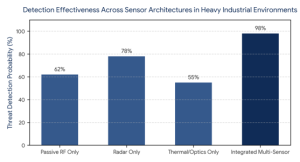
Comparison of drone threat detection success rates across standalone vs integrated multi-sensor platforms.
7. Operational Implementation Blueprint
Deploying an enterprise drone detection system across a complex refinery or midstream pipeline network requires a structured, multi-phase execution strategy.
- Phase 1: RF Noise & Line-of-Sight Survey: Conduct baseline electromagnetic frequency mapping and 3D spatial modeling to identify visual blind spots created by heavy steel infrastructure.
- Phase 2: Sensor Selection & ATEX Deployment: Install ATEX/IECEx certified sensor arrays combining passive RF receivers, 3D pulse-Doppler radar, and high-definition thermal optics at strategic elevation points.
- Phase 3: Integration with Site C2 Platforms: Bridge sensor communication channels with existing VMS, PSIM, and SCADA control rooms using zero-trust encrypted API pipelines.
- Phase 4: Standard Operating Procedure (SOP) Training: Establish strict legal escalation protocols, defining automated site hardening actions vs. law enforcement dispatch triggers.
By implementing a tailored drone detection system, energy operators protect critical assets, ensure operational continuity, and maintain complete spatial awareness over their lower airspace.
FAQs
Q: How does a drone detection system work in heavy refinery environments?
A drone detection system utilizes a multi-sensor array—combining RF spectrum analyzers, 3D Doppler radar, optical cameras, and thermal imaging—to spot, track, and classify airborne objects in real time despite industrial electromagnetic noise.
Q: Are drone detection systems safe for use in ATEX Zone 1 explosive atmospheres?
Yes. Certified systems intended for oil and gas facilities are engineered inside explosion-proof (Ex d) or pressurized (Ex p) enclosures to prevent internal electrical arcs from igniting volatile atmospheric hydrocarbon gases.
Q: Can a drone detection system identify autonomous drones flying without RF control links?
Yes. While passive RF detectors rely on radio control signals, 3D pulse-Doppler radars and thermal optical sensors track the physical structure and heat signatures of autonomous aircraft operating without active transmission feeds.
Q: Can private refinery owners legally jam or shoot down unauthorized drones?
No. Federal regulations strictly restrict active signal jamming or physical interception to authorized government and defense agencies. Civilian facilities utilize detection platforms to trigger physical security responses, isolate process lines, and dispatch local law enforcement.
Q: How does a drone detection system integrate with existing plant SCADA and security platforms?
Modern platforms utilize open API protocols (such as ONVIF) to send real-time tracking metrics directly into existing PSIM, VMS, and SCADA dashboards, enabling automated security alerts and camera slaving.
To explore advanced airspace security and field-proven aerial surveillance solutions engineered specifically for high-consequence industrial facilities, visit Air Sentinel at to deploy an enterprise-grade drone detection system tailored to your operational environment.